
The BRICS New Delhi Declaration marks an important stage in BRICS’s evolution from a grouping focused primarily on economic cooperation to a broader platform for technological development, scientific collaboration, energy security, resilient supply chains, education, and sustainable development. Adopted at the 18th BRICS Summit in New Delhi in September 2026, the Declaration reflects Bharat’s priorities during its BRICS Chairmanship under the theme ‘Building for Resilience, Innovation, Cooperation and Sustainability’. The declaration places particular importance on strengthening cooperation among emerging economies and developing countries at a time when technological transformation, energy insecurity, critical mineral competition and disruptions in global supply chains are reshaping the international system.
For Bharat, the BRICS process has been significant because it has connected diplomacy with Science, Technology, Education and Industrial Capability. Rather than viewing scientific cooperation as an isolated academic activity, the Bharatiya approach increasingly treats Science and Technology as instruments of economic resilience, strategic autonomy and sustainable development. The New Delhi Declaration, therefore, should be understood not only as a diplomatic document but also as an expression of an emerging development-oriented technology agenda for the Global South.
STI: Foundation of Cooperation
One of the most important dimensions of the BRICS agenda is the growing role of Science, Technology and Innovation (STI). BRICS countries possess substantial scientific capabilities, research institutions, technological industries and human resources. Yet these capabilities remain unevenly distributed. Cooperation can, therefore, help transform individual national strengths into collective technological capacity.
Bharat gave particular attention to this objective during its 2026 Chairmanship. The Chennai Consensus on Science, Technology and Innovation, adopted at the BRICS Science, Technology and Innovation Ministerial Meeting in August 2026, emphasised a people-centred and humanity-first approach to STI cooperation. It called for stronger research collaboration, shared infrastructure, knowledge exchange, researcher mobility and opportunities for young scientists and innovators.
BRICS STI cooperation is no longer limited to meetings and statements. It is increasingly linked to research infrastructure, collaborative projects, innovation ecosystems, start-ups, and the movement of scientific talent.
The proposed BRICS Global Research Advanced Infrastructure Network (BRICS GRAIN) is particularly significant. Shared access to major research facilities can help countries overcome the high cost of advanced scientific infrastructure. Large-scale facilities in areas such as high-performance computing, astronomy, materials science, biotechnology, quantum technologies and advanced engineering can become shared resources for researchers across BRICS.
For Bharat, this provides an important opportunity to use Science diplomacy as an instrument not only of foreign policy, but also of national development and global technological leadership
The BRICS Science and Research Repository represents another important development. A structured digital platform for research institutions, scientists, publications, datasets, infrastructure and collaborative opportunities could improve the visibility and connectivity of scientific capabilities across member countries. This approach is consistent with a broader transformation in science diplomacy. Instead of a simple donor-recipient model, BRICS can develop a system of co-creation, co-development and shared innovation. This approach is particularly relevant for the Global South, where scientific capacity-building must increasingly move beyond technology transfer toward joint research and indigenous capability development.
Thrust to AI
Artificial Intelligence (AI) is another major area of strategic importance for BRICS cooperation. AI is simultaneously a scientific technology, an economic resource and a geopolitical capability. Access to computing infrastructure, data, advanced algorithms, skilled researchers and semiconductor technologies increasingly determines national technological competitiveness. Bharat’s BRICS agenda placed AI alongside high-performance computing, quantum technologies, advanced materials, biotechnology, photonics, geospatial technologies and other emerging fields. For BRICS countries, AI cooperation can address several common challenges. These include healthcare, agriculture, climate prediction, disaster management, education, urban planning, financial inclusion and language technologies. Developing AI solutions for the diverse linguistic and socio-economic conditions of the Global South is particularly important because many existing technologies have been developed primarily for advanced industrial economies. A BRICS approach can therefore emphasise accessible, affordable, trusted and responsible AI. It can combine frontier research with practical applications in developing societies.
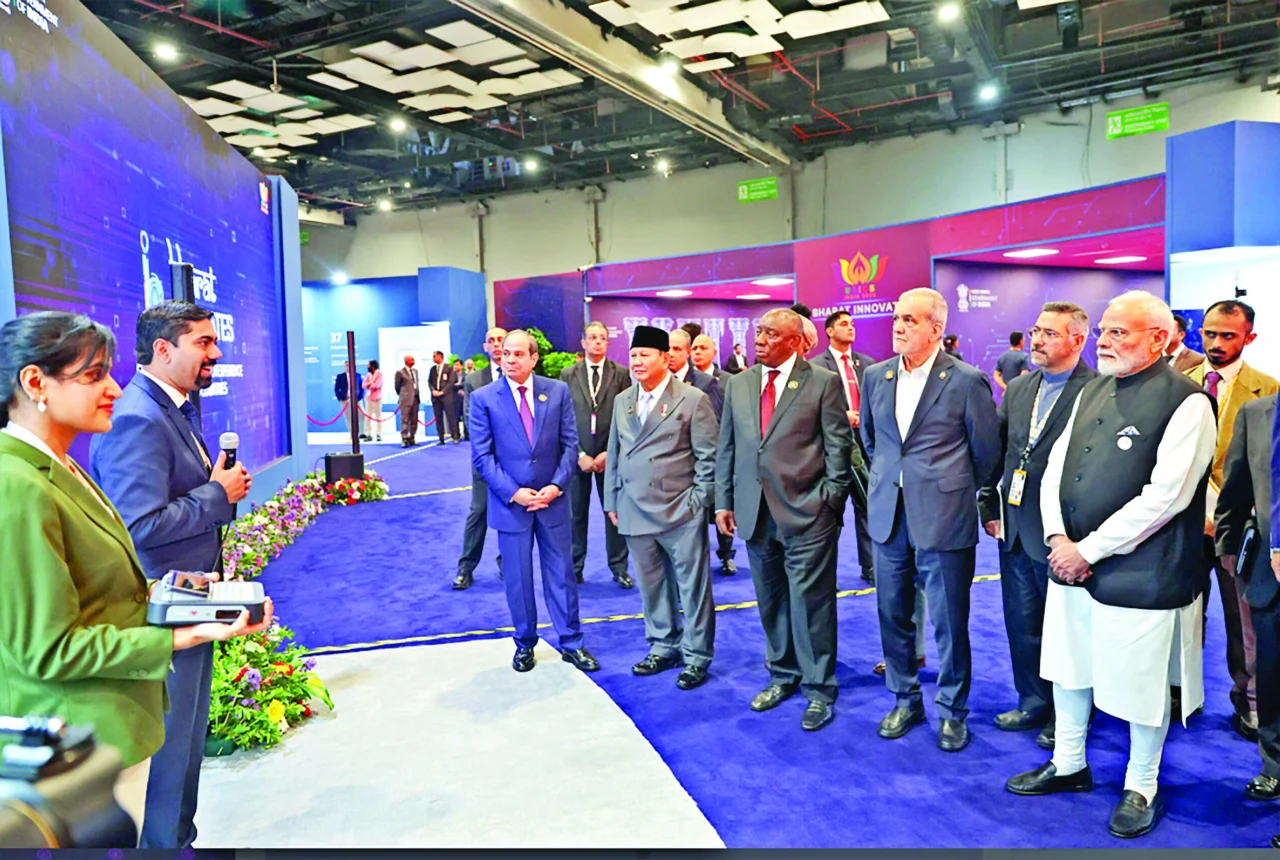
Bharat’s experience with Digital Public Infrastructure offers another area for cooperation. Digital identity, digital payments, open digital platforms and public service technologies demonstrate how digital systems can be deployed at large population scales. Cooperation among BRICS countries could support adapting such systems to different national contexts while respecting sovereignty, privacy, and national regulations.
Energy Transition
Energy security is closely connected with technological development. The global transition towards renewable and low-carbon energy systems is increasing demand for minerals and materials required for batteries, solar technologies, electric mobility, power electronics, grid systems and other clean energy technologies.
The BRICS agenda recognises the importance of an equitable and inclusive energy transition. For developing economies, the transition cannot simply mean replacing one energy system with another without considering affordability, energy access, industrialisation and development needs. BRICS cooperation can, therefore, focus on technological innovation, renewable energy, energy storage, grid modernisation, hydrogen, nuclear energy and energy efficiency while recognising the differing energy structures of member countries.
Critical minerals have emerged as a strategic issue because modern technologies depend on reliable supplies of minerals such as lithium, cobalt, nickel, graphite and rare earth elements. The concentration of mining, processing or refining capacity in a limited number of countries creates vulnerabilities in global supply chains. For BRICS, cooperation in critical minerals can include geological surveys, mineral exploration, recycling, processing technologies, substitution research, strategic reserves and resilient supply chains. Such cooperation can reduce vulnerability to external disruptions and strengthen member countries’ industrial base. The issue is not merely economic. Critical minerals increasingly connect science, technology, national security and diplomacy. Countries that possess mineral resources but lack processing and advanced manufacturing capabilities may remain dependent on external technological systems. Conversely, countries with technological capabilities but limited mineral resources need secure and diversified supply chains. BRICS can establish partnerships that connect resource-rich countries with research institutions, technology companies, and manufacturing ecosystems.
The New Delhi Declaration also needs to be viewed against the background of major changes in global trade and production. The COVID-19 pandemic, geopolitical conflicts, trade restrictions and technological competition have demonstrated the vulnerability of highly concentrated supply chains
Economic Cooperation
The New Delhi Declaration also needs to be viewed against the background of major changes in global trade and production. The COVID-19 pandemic, geopolitical conflicts, trade restrictions and technological competition have demonstrated the vulnerability of highly concentrated supply chains. Economic resilience has consequently become an important component of national security.
BRICS cooperation can help diversify supply chains in areas such as pharmaceuticals, semiconductors, energy technologies, food systems, fertilisers, critical minerals, and advanced manufacturing. The objective should not be to replace global trade with isolated national systems. Rather, it should develop more diversified, reliable, and mutually beneficial networks of production and trade.
Greater cooperation among BRICS economies can also create larger markets for innovative enterprises and start-ups. The 2026 BRICS Industry Ministers’ process emphasised industrial cooperation, MSMEs, start-ups, logistics and photovoltaic technologies. Bharat also proposed mechanisms such as a BRICS Incubator Network and a BRICS Startup Innovation Fund to strengthen innovation-led growth. This is an important shift. Innovation requires not only laboratories and researchers but also finance, entrepreneurship, manufacturing capacity and access to markets. Connecting these elements across BRICS could help transform scientific discoveries into commercial technologies.
Financial cooperation is another dimension of this process. Greater use of BRICS financial institutions and mechanisms could support infrastructure, innovation, and development projects while increasing emerging economies’ capacity to participate more effectively in international finance.
One of the deeper implications of the BRICS agenda is the movement from technology transfer towards technology co-creation. Traditional development models often assumed that advanced technologies would be developed in technologically advanced countries and subsequently transferred to developing economies. Such a model can create long-term technological dependence. BRICS offers an alternative possibility. Countries can combine their scientific capabilities, natural resources, industrial strengths and human capital to develop technologies jointly. For example, collaboration in renewable energy could combine materials research, manufacturing, mineral resources, and large-scale deployment. Cooperation in biotechnology could combine research institutions, clinical capabilities, manufacturing and large populations for testing and implementation. This model can generate shared technological sovereignty without requiring technological isolation.
Science Diplomacy & Global South
The BRICS agenda demonstrates how Science and Technology are becoming increasingly important instruments of diplomacy. Science diplomacy traditionally emphasised international scientific collaboration even when political relations were difficult. Today its scope is broader. It includes research partnerships, technology standards, digital infrastructure, critical minerals, supply chains, energy systems, health security and emerging technologies.
For the Global South, science diplomacy can become an instrument for reducing structural technological inequalities. Countries need access not simply to finished technologies but to the capacity to understand, adapt, improve and eventually create technologies themselves. This requires universities, research institutions, laboratories, industry and governments to work together.
BRICS can, therefore, contribute to a more polycentric global knowledge system in which scientific excellence is distributed across multiple regions rather than concentrated in a small group of countries. Thus, the BRICS New Delhi Declaration represents an important step towards connecting diplomacy with Science, Technology, Energy, Economic Resilience and Human Development. The declaration’s significance extends beyond diplomatic statements. Its Science and Technology agenda is supported by concrete initiatives involving shared research infrastructure, scientific repositories, young researchers, innovation partnerships and collaborative research. The Chennai Consensus provides an important STI foundation for this process.
Message of New Delhi Declaration
The energy and critical mineral agenda reflects the strategic importance of secure technological supply chains. Economic cooperation seeks greater resilience in trade, manufacturing and investment. Education and human resource development recognise that scientific and technological progress ultimately depends upon people. The central challenge now is implementation. BRICS must convert declarations into funded research projects, shared infrastructure, technology partnerships, educational exchanges, start-up ecosystems and resilient supply chains.
If BRICS achieves this transition from dialogue to implementation, it can become more than a diplomatic grouping. It can emerge as a major platform for scientific cooperation, technological capability, sustainable development and strategic autonomy across the Global South.
The New Delhi Declaration’s larger message is clear. In the 21st Century, the strength of international partnerships will increasingly depend on nations’ ability to share knowledge, build technology, develop human capital, secure resources, and innovate together. For Bharat, this provides an important opportunity to use Science diplomacy as an instrument not only of foreign policy, but also of national development and global technological leadership.