THIRUVANANTHAPURAM: For years, Keralam’s political debate has revolved around promises, protests and Centre-state blame games. Now, the BJP is putting a harder number on the table Rs 3,795 crore.
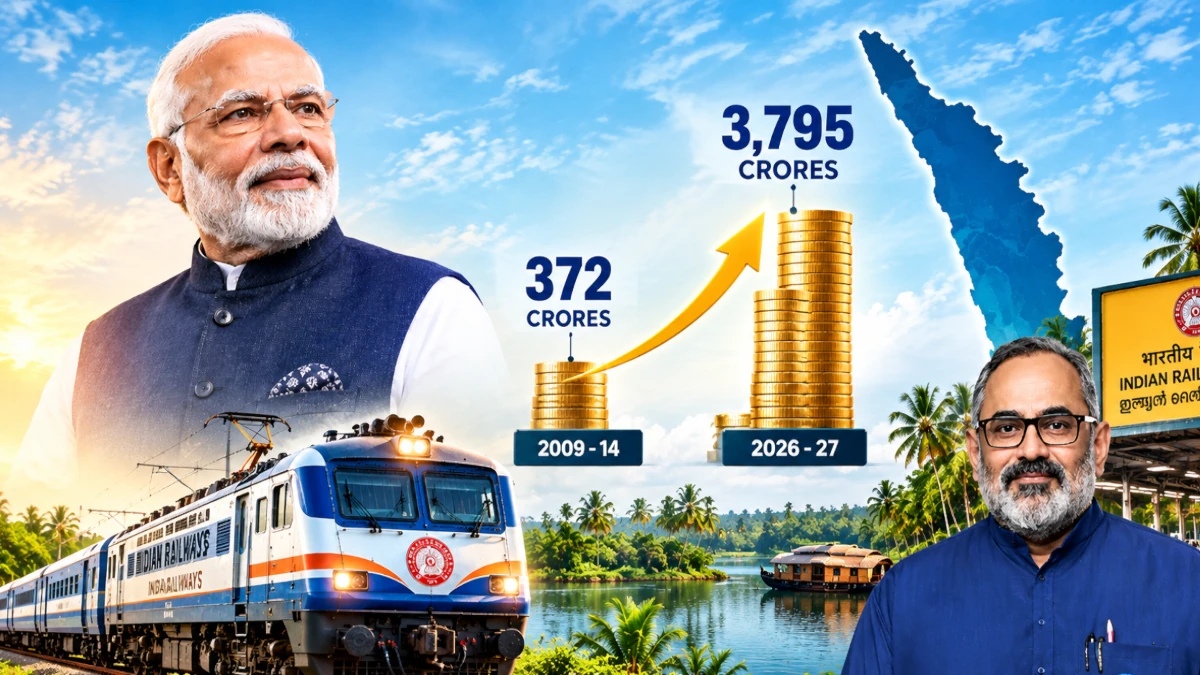
That is the Railway Ministry’s allocation for infrastructure and safety works falling fully or partly in Keralam for 2026–27. The comparable annual outlay during 2009–14 was Rs 372 crore. The difference is more than tenfold. Keralam’s railway infrastructure is finally receiving the scale of investment that the state has long demanded.
The contrast is difficult to miss. During the UPA period, Keralam’s annual railway outlay averaged Rs 372 crore. Under the Modi government, the figure climbed to Rs 3,042 crore in 2025–26 and now stands at Rs 3,795 crore for 2026–27.
The BJP has seized on those numbers to challenge the Congress and the CPM over their record in government and their long-standing claims of political influence at the Centre.
The number that changes the argument
For the BJP, this is not merely another budget statistic. It is a test of performance.
- Rs 372 crore: That was the annual average outlay for Keralam’s railway infrastructure and safety works during 2009–14.
- Rs 3,795 crore: That is the allocation for 2026–27.
- The Railway Ministry itself describes the latest figure as more than ten times the 2009–14 annual outlay.
The significance of the comparison lies in what comes next.
The BJP argues that Keralam cannot continue to judge governments by the number of ministers, MPs or political alliances they produce. It says the real test should be whether infrastructure reaches the state, whether projects are sanctioned, whether money is allocated and whether long-pending bottlenecks are finally addressed.
That argument is now around railways.
Rs 18,041 crore in ongoing railway works
The Centre’s railway push is not limited to the annual budget allocation.
The Railway Ministry said ongoing railway works in Keralam were worth Rs 18,041 crore. As of April 1, 2025, six projects covering 266 km and costing ₹9,415 crore had been sanctioned, including two new-line projects and four doubling or multitracking projects.
The list includes major projects such as the Angamali–Sabarimala new line, Ernakulam–Kumbalam doubling, Kumbalam–Thuravur doubling, Shoranur–Vallathol doubling and Trivandrum–Kanyakumari doubling.
The Centre has also sanctioned surveys for third- and fourth-line projects with a proposed 160-kmph speed potential on several important Keralam corridors, including Shoranur–Mangaluru, Shoranur–Ernakulam, Ernakulam–Kayamkulam and Kayamkulam–Thiruvananthapuram.
The message is therefore increasingly built around capacity, connectivity and modernisation not simply the announcement of individual trains.
The station makeover is part of the same story
The transformation is also visible at railway stations. Under the Amrit Bharat Station Scheme, Keralam has 35 stations included in the programme, with 11 already redeveloped according to the Railway Ministry’s March 2026 statement.
The programme is designed to upgrade station buildings, passenger facilities, foot overbridges, lifts, escalators, waiting areas, toilets, parking and accessibility infrastructure. For a state where railway capacity has long been a political issue, these projects offer the Centre something valuable: infrastructure that passengers can actually see.
BJP’s challenge to the Congress and CPM
This is where the railway numbers collide with Keralam’s traditional political narrative. The argument is that the Congress and CPM have spent decades presenting themselves as defenders of Keralam’s interests while the state’s infrastructure demands remained unresolved.
The party is now asking a pointed question: what matters more to Keralam political representation in Delhi or measurable investment on the ground?
The BJP’s answer is obvious.
- It points to the railway allocation.
- It points to ongoing projects.
- It points to station redevelopment.
And it points to new capacity-building projects that could fundamentally alter the state’s railway network. The party has branded this approach “Politics of Performance” and “Politics of Seva.”
That is political messaging, not an independent assessment of the entire Centre-state development record. But the underlying railway allocation figures are official and provide the numerical basis for the argument.
Amit Shah widens the battle
The railway debate comes against a much larger confrontation between the Modi government and the Keralam government over finances.
At the ‘New India, New Keralam’ conclave in January, Union Home Minister Amit Shah contrasted Central transfers to Keralam under the UPA and NDA governments. Shah said Keralam received Rs 72,000 crore from the Centre between 2004 and 2014, compared with Rs 3.23 lakh crore between 2014 and 2024.
Shah also accused Chief Minister Pinarayi Vijayan of creating a narrative that the Modi government was treating Keralam unfairly and challenged the Chief Minister to dispute the figures.
Vijayan’s government has maintained the opposite position, accusing the Centre of restricting Keralam’s finances and raising issues including borrowing limits, IGST recovery and delays relating to centrally sponsored schemes.
The two sides are therefore fighting over two fundamentally different versions of Keralam’s relationship with New Delhi. The LDF stresses financial constraints and what it describes as Central interference.
The BJP stresses allocations, projects and physical infrastructure. The railway figures have become one of the strongest pieces of evidence in that larger confrontation.
But money is not the same as completion
There is, however, another number that complicates the political battle. The Railway Ministry says 476 hectares of land are required for railway projects in Keralam. Only 65 hectares, or 14 per cent, had been acquired, leaving 411 hectares still to be acquired.
The ministry said Rs 1,975 crore had been deposited with the Keralam government for land acquisition and called for state support to accelerate the process. That means the next political test is no longer simply allocation. It is execution.
A sanctioned railway line does not carry passengers. A budget announcement does not automatically become a completed track. A station plan does not become a functioning facility until construction is finished.
The Centre’s own data therefore points to both sides of the story substantially higher allocations and a significant implementation challenge.
For decades, Keralam’s political contest was dominated by the UDF and LDF. The BJP is now trying to introduce a different question into that contest.
Instead of asking which alliance can better mobilise voters, it wants the debate to focus on what voters can physically see around them — roads, railway tracks, stations, bridges, trains and connectivity. That becomes particularly significant in a state where infrastructure bottlenecks have long been a public concern.
The era of measuring Delhi’s commitment to Keralam by political rhetoric should end; investment and delivery should be the yardstick.
The Congress and CPM, meanwhile, face a different challenge explaining the sharp increase in railway allocations while putting forward their own account of Keralam’s infrastructure needs, state finances and Centre-state relations.
Beyond Congress versus BJP
Keralam’s railway debate is no longer just another chapter in the familiar Congress-versus-CPM political script. For decades, the UDF and LDF have dominated the state’s political narrative, while questions of infrastructure, Central funding and development have often been trapped inside the same two-front contest.
That equation is now being challenged by the BJP, which is putting Central government investment directly before the public and arguing that development should be measured by outcomes, not political rhetoric.
The numbers give that argument its sharpest edge. According to the Railway Ministry, Keralam’s annual railway allocation stood at Rs 372 crore during 2009–14. In 2026–27, it has risen to Rs 3,795 crore more than ten times the earlier annual outlay.
For the Congress and CPM, the political challenge is straightforward. After decades of competing for power in Keralam, they now face questions about what their governments delivered on the infrastructure front and how they intend to match the scale of Central investment being highlighted by the BJP.
The BJP’s message is equally clear judge governments by the projects they fund, the infrastructure they build and the tangible changes people can see.
That does not settle the wider development debate. Project execution, land acquisition, employment, state finances, welfare and other indicators remain part of the record voters can examine. But one fact is difficult to argue away: Keralam’s railway allocation has moved from Rs 372 crore a year in 2009–14 to Rs 3,795 crore in 2026–27.