Congress leader P. Chidambaram has portrayed the Election Commission’s electoral-roll revision exercise as a retreat following political protests and judicial intervention. However, the available information distinguishes routine Special Summary Revision from the Special Intensive Revision process.
The key question is whether the Election Commission of India (ECI) has abandoned the Special Intensive Revision (SIR) in 17 States and Union Territories, as alleged, or whether the two exercises serve different purposes.
What is the claim?
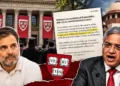
Congress leader P. Chidambaram has questioned the Election Commission’s handling of the Special Intensive Revision (SIR) of electoral rolls. The claim, links the Commission’s decision to conduct Special Summary Revision (SSR) in 17 States and Union Territories to protests and Supreme Court intervention.
Chidambaram has also alleged that 13.3 crore names were removed from electoral rolls without due process. These are serious allegations, but they must be assessed separately from the announcement of the SSR exercise and the legal status of the SIR process.
After the protests and the notice issued by the Supreme Court, wisdom has dawned on the ECI and Mr Gyanesh Kumar
S.I.R. has been abandoned for the 17 remaining States and UTs, and it will only be the customary SSR (special summary revision)
Documents to prove citizenship need not be produced
Why were 20 States discriminated against under S.I.R. and 13,30,00,000 names (including the dead) were removed without Due Process?
After removing crores of names illegally, now the ECI has undertaken another exercise to include the ‘left out’ voters!
Mr Gyanesh Kumar should be surcharged for the double expenditure
— P. Chidambaram (@PChidambaram_IN) October 16, 2026
What are SIR and SSR?
The two exercises are not interchangeable.
Special Summary Revision (SSR) is a process used to update electoral rolls. It enables eligible citizens to enrol as voters and allows the rolls to be updated when voters have died, moved or are otherwise no longer eligible at a particular address. The qualifying date for the routine exercise is generally January 1, as per media reports.
Special Intensive Revision (SIR) is a separate revision exercise. The announcement of SSR in 17 States and Union Territories does not, by itself, establish that SIR has been cancelled or abandoned.
The distinction matters because the names of the exercises, their procedures and their purposes cannot be treated as evidence of a political retreat without further documentation.
Why is the SSR exercise being conducted?
According to reports, the ECI announced SSR across 17 States and Union Territories, including five States scheduled for Assembly elections in early 2027.
The exercise is intended to update electoral rolls by including newly eligible voters and accounting for deaths and changes of residence. Such revisions are part of the electoral-roll maintenance process.
The announcement of SSR, therefore, does not independently prove that the Commission withdrew SIR because of protests or court proceedings.
Did the Supreme Court rule that SIR was illegal?
The Supreme Court issued notice to the ECI on a petition concerning SIR and sought information about the Commission’s decision-making process.
A notice seeking a response is not the same as a final judgment declaring the exercise illegal. It indicates that the court is examining the matter; it does not establish that the petitioner’s allegations have been upheld.
Similarly, Chidambaram’s allegation that 13.3 crore names were removed without due process should not be presented as a judicially established finding unless supported by a court ruling or verified evidence.
Has the ECI abandoned SIR in 17 States?
The Election Commission sources are per reporrs are saying that SIR has not been scrapped in any State or Union Territory. It further states that the exercise had already been completed in 17 States and Union Territories under Phases I and II, including poll-bound States.
Section 21 of the Representation of the People Act, 1950, is important in connection with electoral-roll revision in poll-bound States.
Fact-check verdict
The claim that SSR in 17 States and Union Territories proves the abandonment of SIR is not established. SSR and SIR are distinct exercises, and a Supreme Court notice does not amount to a ruling that SIR is illegal.
Political claims about electoral rolls should be judged against official notifications, documentary evidence and court orders, not inferred solely from the announcement of a different revision exercise.