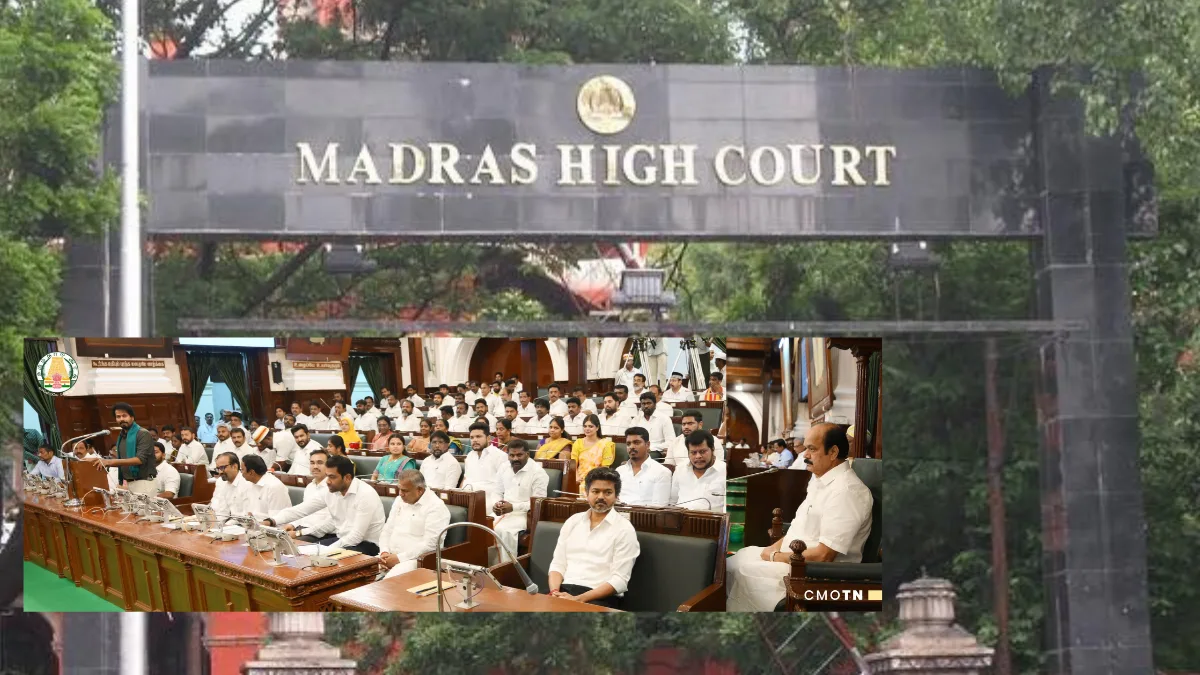
The Madras High Court has held that MLAs who remain silent when an amendment is proposed and put to vote in the Assembly cannot later approach the court to challenge the procedure adopted for passing it, particularly when they had an opportunity to object at the relevant stage.
A division bench comprising Chief Justice S A Dharmadhikari and Justice G Arul Murugan, which reserved orders on September 9, 2026, delivered its verdict on September 23.
In its 27-page order, the bench dismissed a writ petition filed by AIADMK Chief Whip Agri S S Krishnamurthy.
The court said that MLAs who either vote “Aye” or remain silent without raising any objection during the proceedings of the House cannot, weeks later, ask a court to treat their own silence as a nullity.
The Text of the D.O. Letter dated 28.7.2026, addressed to the Hon'ble Prime Minister of India Thiru. Narendra Modi, from the Hon'ble Chief Minister of Tamil Nadu Thiru. C. Joseph Vijay, regarding Mekedatu Dam.#CMJosephVijay pic.twitter.com/HbdwQAM3nQ
— CMOTamilNadu (@CMOTamilnadu) July 28, 2026
According to the petitioner, the Government Resolution circulated to Members on June 18, 2026, objected to the Karnataka Government’s proposal to build a dam at Mekedatu and asked the Union Government to withhold clearances for the project.
The petitioner asserted that the circulated text did not contain any demand for a fresh tribunal under Section 4 of the 1956 Act.
The demand, he pleaded, surfaced only during the debate on June 19, when the Leader of the Opposition raised it, and was accepted by the Chief Minister and incorporated into the Resolution without it ever being separately moved, seconded, debated or put to a distinct vote, as required under Rule 104 of the Tamil Nadu Legislative Assembly Rules governing amendments.
It was stated that the Resolution, so altered, was nonetheless recorded and communicated to the Union Government as having been carried unanimously, even though members of the AIADMK, the PMK and the CPI were said to have objected to the manner of its inclusion.
The bench observed that the grievance of the petitioner was not with the Assembly’s opposition to the Mekedatu project itself, but with the legality of the process by which the tribunal clause found its way into the final text that was sent outside the House.
The judges said the affidavit of the first respondent, the Secretary of the Tamil Nadu Legislative Assembly, also brought on record that the very same grievance was raised on the floor of the House on August 7 by the leader of the AIADMK Legislature Party.
The Speaker, after explaining the sequence of events, ruled that no illegality had occurred. The ruling was not questioned or otherwise departed from.
The court said: “In reply, the petitioner did not deny any of this sequence. Indeed, he built his case squarely upon it.”
The court noted that the petitioner admitted that the amendment notice could not be considered by the Speaker for want of time, was never separately moved, seconded, debated or voted upon, and that the file was closed not because the amendment had gone through the procedure, but because the Chief Minister had announced it.
The petitioner, therefore, pleaded that the tribunal clause was never lawfully introduced as an amendment at all, and that its inclusion in the Resolution communicated to the Union Government misrepresented what the House actually decided.
The court, citing a Supreme Court judgment, noted that the Speaker has been described as “the guardian of the privileges of the House and its spokesman and representative upon all occasions”, who is “the interpreter of its rules and procedure” and who is “invested with the power to control and regulate the course of debate and to maintain order”.
The court further noted that the power to regulate procedure and conduct of business vests in the Speaker by virtue of the rules framed under Article 118 of the Constitution of India.
The Supreme Court had also reiterated that “the House is not subject to the control of the courts in the administration of the internal proceedings of the House.”
The bench said, “It is not open to this Court to sit in appeal over that exercise merely because the petitioner contends that a more elaborate procedure ought to have been followed.”
The judges further said: “If members present in the House, who had the opportunity then and there to object, chose instead to vote ‘Aye’ or to remain silent, they cannot, weeks later, ask a court to treat their own silence as a nullity.”
“The principle that a person who stands by, watches an act take place, and permits it to occur without protest cannot subsequently be heard to complain of it, applies with as much force to the floor of a legislature as it does to any other public proceeding,” the court said.
“This is not a case of a citizen who was shut out or misled; it is a case of a Member, and of the party he belongs to, who was present in the House when the amendment was proposed, read out and voted upon.”
“A challenge of this kind cannot succeed unless prejudice is ‘ex facie apparent’,” the bench said.
Dismissing the petition, the court concluded: “In the case at hand, no case of the requisite gravity, such as want of jurisdiction, substantive illegality, mala fides, breach of any constitutional limitation, has been made out by the petitioner.”