Kashi, the eternal city of Shiva, has never been one that stands still. It has observed dynasties, pilgrims, scholars and traders for over three millennia, and each era has left its mark on the land between the Varuna and the Assi. The two streams that gave Varanasi its name. The present era is writing its own chapter, and this time, the Varuna itself.
On July 15, 2026, the Cabinet Committee on Economic Affairs, chaired by Prime Minister Narendra Modi, cleared the Varuna Elevated Corridor at a capital cost of Rs 10,998.32 crore. The 43.218-km, predominantly six/four-lane access-controlled corridor will link NH-31 with the Varanasi Ring Road along the riverbank.
The National Highways Authority of India (NHAI) will build it under the Hybrid Annuity Model, with Rs 4,565.33 crore earmarked for civil construction and Rs 934.91 crore for land acquisition. The approval came alongside a sister project, the 46.039-km Ganga Elevated Corridor worth Rs 14,447.64 crore, which will connect NH-19 with the Ring Road. Together, the two corridors represent an investment of over Rs 25,445 crore in a single city’s mobility, a scale that would have been hard to imagine for Varanasi two decades ago.
Why an elevated road and why along the Varuna
Anyone who has driven from Cantonment to Godowlia at dusk knows the problem. Varanasi’s core is dense, its lanes are old, and its roads were never designed for the volume of cars, buses, rickshaws and freight vehicles they now carry. Widening those roads would mean cutting through settled neighbourhoods, markets and structures of heritage value, a price the ancient city cannot afford to pay.
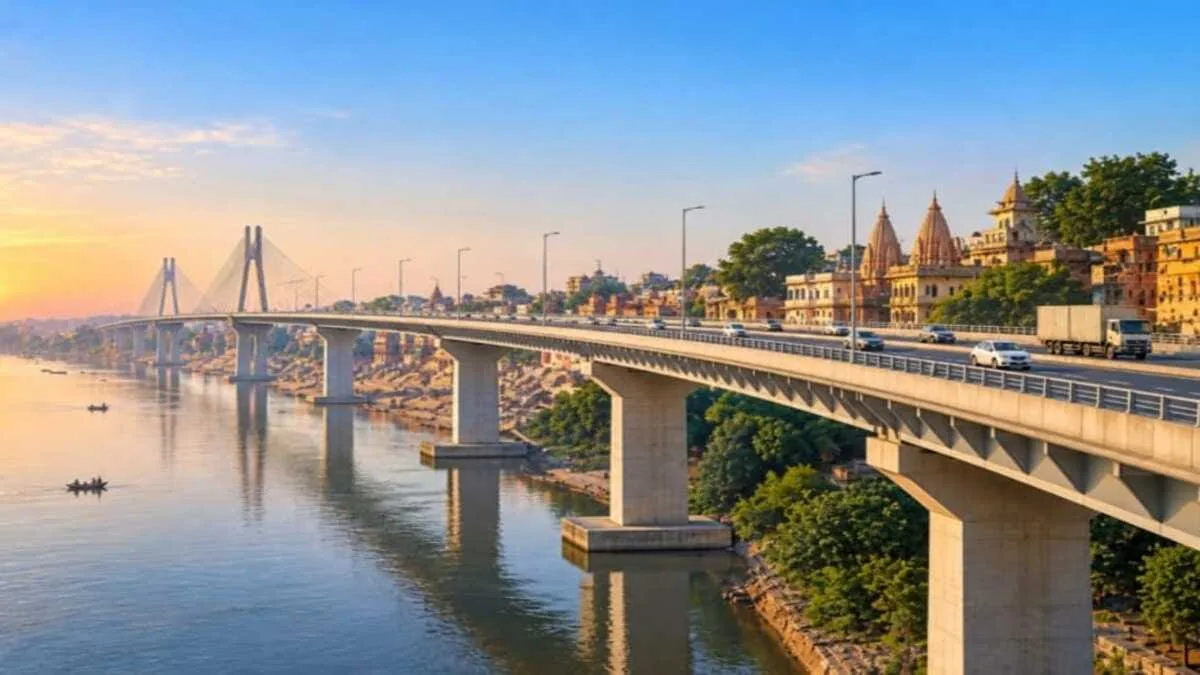
The elevated alignment offers a way around that dilemma. By lifting the main carriageway above ground and following the river’s course, planners can add high-capacity road space without tearing into the old urban fabric. Flyovers, loops, ramps and service roads will feed traffic on and off at chosen points, while the main deck carries through and regional movement above the city’s busiest stretches.
The design also carries a touch of ambition. The corridor will feature an iconic cable-stayed bridge and an extradosed foot-over-bridge-cum-major bridge, structures that will add a contemporary silhouette to a skyline long defined by temple spires and ghats.
Saving time by transforming journeys
Built for speeds of 80 to 100 kmph, the corridor is projected to cut travel time between NH-31 and Kashi Railway Station from roughly 40 minutes to about 20. The journey between Varanasi Junction and Lal Bahadur Shastri International Airport, which can currently stretch close to an hour, is expected to shrink to around 20 minutes.
Those numbers matter for more than convenience. Shorter, predictable trips lower vehicle operating costs, reduce fuel burn and idling, making the city more dependable for businesses that run on schedules. Congestion points that have long frustrated commuters, including Varanasi Junction, Phulwaria and Chaukaghat, should see relief as long-distance traffic is separated from local movement.
The corridor is also a pillar of the Varanasi Decongestion Plan. It will improve access to the city’s key gateways through Varanasi Cantonment, Varanasi City Railway Station, Kashi Railway Station, Deen Dayal Upadhyaya Junction, the airport and Ramnagar Port on the Ganga waterway.
Serving pilgrims, students and residents alike
Varanasi’s transformation over the past decade has changed who visits and how many arrive. The Shri Kashi Vishwanath Dham, inaugurated by the Prime Minister in December 2021, opened a direct passage from the Jyotirlinga shrine to the Ganga and turned a once-cramped approach into a spacious pilgrimage complex. Devotees have come in unprecedented numbers ever since, and festivals such as Dev Deepawali now draw vast crowds to the ghats.
That success has its own demands. When footfall surges during festivals and peak pilgrimage seasons, the added road capacity will help spread traffic across the network instead of choking a handful of arteries. Smoother access to the ghats and the Vishwanath Dham means devotees spend more time in worship and less in queues of vehicles.
The benefits reach the city’s knowledge institutions too. Better connectivity to centres such as Sampurnanand Sanskrit University will ease daily travel for students, teachers and researchers, reinforcing Kashi’s standing as a seat of learning that stretches back to antiquity.
An engine for Purvanchal’s economy
Infrastructure in Varanasi is increasingly about the wider region, not just the city. Aligned with the PM Gati Shakti National Master Plan, the Varuna corridor will improve links to the Chandauli Socio-Economic Zone, the Chandauli Social Node and six major logistics nodes.
Tighter integration of national highways, rail infrastructure and freight routes will help move farm produce, industrial goods, construction materials and minerals between Varanasi, Chandauli and neighbouring districts. For farmers and small manufacturers of eastern Uttar Pradesh, a region long held back by poor connectivity, faster movement to markets can make the difference between thin margins and real earnings. This is Antyodaya in practical form: growth that travels outward from the city to the last village on the supply chain.
Access to Ramnagar Port is equally significant. With the Ganga developed as a national waterway, a road network that connects cleanly to river freight gives Varanasi a genuine multimodal advantage, combining road, rail, air and water within a single urban region.
Part of a larger Kashi vision
The Varuna corridor does not stand alone. It is one strand in a decade-long effort to rebuild Varanasi’s infrastructure while respecting its sanctity. The Ganga Elevated Corridor, with its 910metre cable-stayed bridge over the river and a 1.32-km extradosed bridge fitted with travelators, will complement it on the other flank. The 3.75-km urban ropeway between Cantonment and Godowlia, planned as India’s first public-transport ropeway, targets the same congested belt from the air. River cruises, the Ring Road and airport upgrades fill in the rest of the picture.
What ties these projects together is a clear philosophy. Heritage cities need not choose between preserving their past and preparing for their future. Varanasi’s case shows that with careful alignment and engineering, modern capacity can be placed around and above the old city rather than through it.
Big projects in dense cities come with real tests. Land acquisition must be fair and transparent, construction must not disrupt the rhythm of pilgrim life for longer than necessary, and the Varuna itself, a river that has suffered from encroachment and pollution, deserves to emerge healthier from this development, not more neglected. How NHAI and local authorities handle these questions will shape how residents judge the corridor.
Timelines will matter just as much. Hybrid Annuity projects spread payments across the construction and operation period, which gives the developer a stake in quality, but the public will measure success by visible progress on the ground. Regular updates, clear diversion plans during construction and early completion of the most congested stretches would go a long way in building trust.
If those tests are met, the Varuna Elevated Corridor could become a model for India’s historic cities with a structure that carries the traffic of a growing economy while the lanes below keep their ancient character.
For a city that Hindus believe rests on the trident of Shiva, the idea of an elevated road has a quiet symbolism. Kashi has always existed a little above the ordinary world. Now, in a very practical sense, its movement will too, and the city that gave India its oldest living memory is being prepared to carry that memory confidently into the decades ahead.