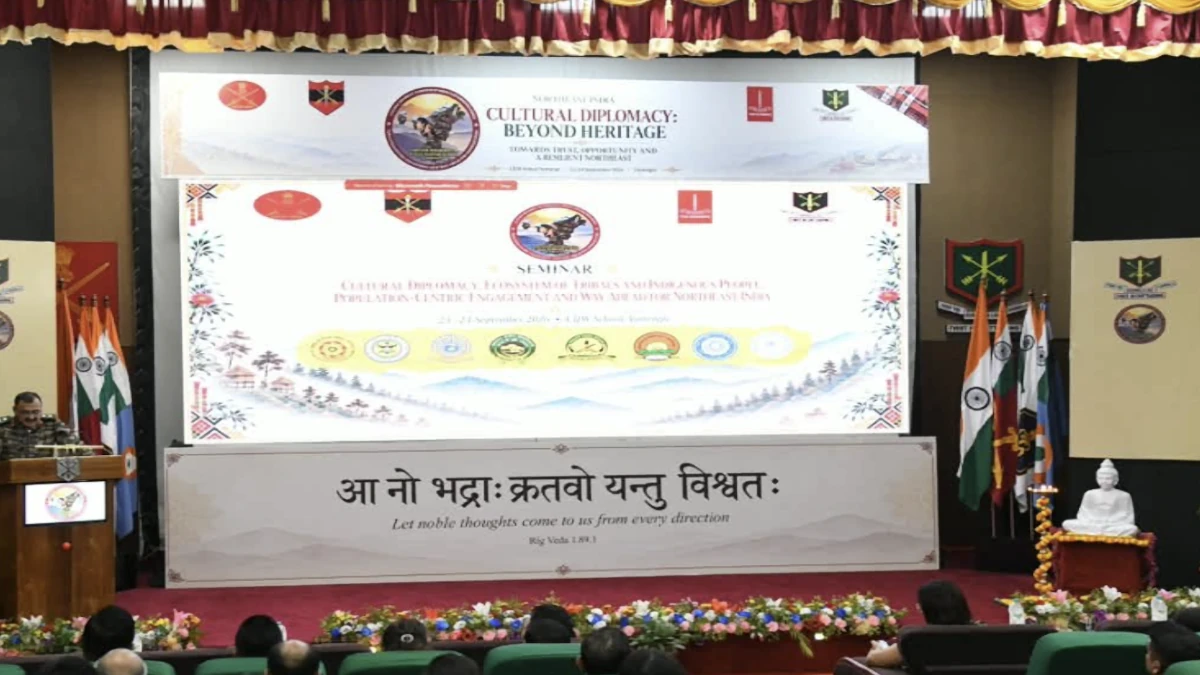
GUWAHATI: Counter Insurgency and Jungle Warfare School, Vairengte, conducted a two-day seminar on “Cultural Diplomacy, Ecosystem of Tribals and Indigenous People, Population-Centric Engagement and Way Ahead for Northeast India” on September 23–24, 2026.
The seminar brought together eminent moderators and speakers from NIT Silchar, Assam University, Central University of Jharkhand, Mizoram University, North-Eastern Hill University, Tripura University, the Indian Institute of Public Administration, and DIPR, DRDO, along with army officers, academicians, and students. The three thematic sessions brought academic research, professional experience and local understanding onto a common platform.
The first thematic session, “Cultural Diplomacy & Ecosystem of Tribals and Indigenous People,” explored the cultural strengths of Northeast India and their potential for strengthening people-to-people linkages. The session discussed cultural diplomacy through food, hospitality, tourism, festivals, tea, textiles, language, and indigenous traditions, along with the Northeast’s potential to serve as a cultural bridge to India’s eastern neighbourhood. The discussion also examined tribal customs and indigenous practices across different communities and states, including the practical and scientific reasoning associated with several traditional practices. Meaningful participation of women in initiatives undertaken by institutions and organisations emerged as an important theme. The session also examined cross-border cultural and ethnic linkages through kinship, language, traditions, movement, and historical relationships.
The second thematic session, “Population-Centric Engagement,” placed trust at the centre of meaningful engagement with local populations. Deliberations highlighted the need for the Army, security forces and other institutions to understand existing community structures and engage through local associations, community organisations and their leadership. The session also highlighted the importance of cultural intelligence, strong kinship structures, and attachment to roots, with Mizoram providing a useful example of a closely connected and relatively non-hierarchical society. Contemporary challenges, particularly drug abuse, were discussed alongside changing youth aspirations and the need for greater involvement of digitally educated youth in government, institutional and community mechanisms.
The final thematic session, “Economic & Technological Pathways & Way Ahead,” focused on future development opportunities for the region. Participants analysed extensive comparative economic data and offered suggestions to strengthen Northeast India’s economic development. The technological dimension highlighted existing Government technology initiatives while also proposing new technology-enabled solutions to improve governance, accessibility, service delivery, and development outcomes.
A thought that resonated repeatedly through the seminar was the Vedic invocation “आ नो भद्राः क्रतवो यन्तु विश्वतः” — “Let noble thoughts come to us from every direction.” Emphasised by several speakers, it aptly reflected the spirit of the interaction—bringing together diverse disciplines, experiences and perspectives while remaining open to ideas from different directions.
An interesting progression of ideas also emerged through the two days. The discourse began with the 3 Cs — Connectivity, Culture and Community, emphasising that regional engagement must go beyond physical connectivity alone. As the discussion widened towards cross-border linkages and cooperation, the thought expanded to the 5 Cs — Culture, Community, Connectivity, Cooperation and Confidence. In his closing remarks, Maj Gen Kulvir Singh, SM, PhD, Commandant, CIJW School, carried this progression further into a comprehensive 7 Cs framework: Culture, Community, Connectivity, Capacity, Commerce, Confidence and Convergence. He also underscored inclusive growth and women’s meaningful participation as essential to shaping the way ahead for Northeast India.
This 3–5–7 progression captured the seminar’s broad journey—from cultural understanding and community engagement, through cooperation and confidence, to capacity building, economic opportunity, and convergence of efforts.
The seminar strengthened Army–academia interaction and generated practical perspectives towards an inclusive, people-centric and progressive future for Northeast India.