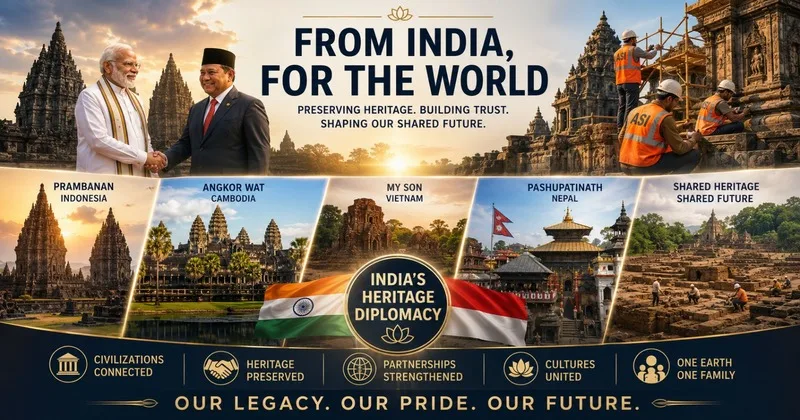
From Prambanan to Angkor Wat, My Son to Wat Phu, and Pashupatinath to Ananda Temple, India’s living presence is evident everywhere. Today, while preserving its own history, India is forging a new cultural vision by leveraging this shared civilizational heritage as a foundation for global cooperation.
Indeed, the convergence of the Archaeological Survey of India’s (ASI) expertise, the cultural vision under Prime Minister Narendra Modi’s leadership and the spirit of “Vasudhaiva Kutumbakam” (the world is one family) has established India as a trusted partner in global heritage conservation. A new chapter has now been added to this journey: during Prime Minister Narendra Modi’s state visit to Indonesia, a historic agreement was signed between the two nations for the conservation and restoration of the world-famous Prambanan Hindu temple in Yogyakarta. The ASI will spearhead this project, with a target completion date set for 2029.
Prambanan: Where Indian Civilisation Lives On
Indonesia’s Prambanan temple stands as a living testament to the maritime and cultural expansion of Indian civilisation through ancient architecture. Built in the 9th century and dedicated to Lords Shiva, Vishnu, and Brahma, the temple has been designated a World Heritage Site by UNESCO. On July 8, 2026, Prime Minister Narendra Modi offered prayers at the temple and formally inaugurated the conservation work. This inauguration reaffirmed the historic bonds that culturally connected India and Southeast Asia centuries ago.
A New Dimension of India’s Foreign Policy: Civilisational Diplomacy
Civilizational diplomacy is assuming increasing importance in India’s foreign policy today. Its objective is to revitalise historical and cultural ties that existed long before the emergence of modern nation-states. Viewed from this perspective, Sanskrit words, tales from the Ramayana and Mahabharata, temples dedicated to Shiva and Vishnu, Indian-style sculpture and ancient architecture found in many Southeast Asian countries today stand as evidence of this shared heritage.
Rather than viewing these legacies as symbols of cultural dominance, India cherishes them with the clear understanding that they represent a shared human heritage between the nations. Consequently, India has developed a collaborative approach to conservation that actively involves local governments, archaeological experts and communities, prioritising partnership and respect for scientific perspectives.
Heritage is the Capital of the Future
Prime Minister Narendra Modi has stated on numerous national and international platforms that India’s cultural heritage belongs to all of humanity. According to him, the strength of any civilisation is determined not only by its economic progress but also by its ability to remain connected to its roots. He has frequently emphasised that India’s identity is shaped by its millennia-old culture, spiritual traditions and a spirit dedicated to human welfare.
In a sense, this perspective of the Prime Minister is consistently reflected in messages such as “Vasudhaiva Kutumbakam”, “Universal Brotherhood” and the call for “Buddha, not War” for the world. Initiatives to preserve Indian cultural heritage abroad are a natural extension of this broad vision.
Rebuilding Trust, Not Just Temples
The significance of the conservation projects India is undertaking in various countries extends far beyond the religious realm. These initiatives foster a renewed connection between local communities and their heritage, provide fresh momentum to tourism, preserve traditional crafts and build new bridges of trust between nations. This is why India has emerged as a trusted partner in conserving shared cultural heritage in countries such as Indonesia, Cambodia, Nepal, Sri Lanka, Bangladesh, Vietnam, Laos, Myanmar, the UAE and Bahrain. From one perspective, these initiatives demonstrate India’s ability to integrate its ancient cultural consciousness with modern global cooperation.
An analysis of India’s foreign policy over the past decade and a half reveals a clear trend: New Delhi has transformed cultural heritage into a potent instrument for shaping current and future international relations. Today, the Archaeological Survey of India (ASI) serves as a trusted technical partner for world heritage conservation in numerous countries.
Cambodia: The Legacy of Angkor and India’s Commitment
Cambodia’s Angkor Wat stands as the most magnificent example of Indian cultural influence in Southeast Asia. Dedicated to Lord Vishnu, it is the world’s largest religious monument and is inscribed on the UNESCO World Heritage List. For years, the Archaeological Survey of India has been collaborating on conservation efforts there. India’s role, encompassing the scientific conservation of various temple complex sections, the stabilisation of damaged structures, and the preservation of traditional construction techniques, has garnered international acclaim.
Similarly, India has carried out significant conservation work at Cambodia’s Ta Prohm temple. Scientific restoration was undertaken to preserve the original architecture of this temple, which dates back to the 12th and 13th centuries. India is also providing technical assistance for the conservation of the Preah Vihear Shiva temple. These projects have added civilizational depth to the relationship between India and Cambodia.
Vietnam: A Revival of History at My Son
The My Son temple complex, located in Vietnam’s Quang Nam province, is a magnificent heritage of the Cham civilisation. Dedicated to Lord Shiva, these temples were constructed between the 4th and 13th centuries. Following an agreement signed between India and Vietnam in 2014, the Archaeological Survey of India (ASI) completed conservation work on temple groups A, H, and K between 2017 and 2022. Costing approximately 2.25 million US dollars, the project encompassed archaeological research, documentation and the training of local experts alongside structural repairs. Today, this project exemplifies India’s approach of integrating conservation efforts with knowledge sharing and capacity building.
Laos: ‘Vat Phou’ – An Ancient City of Shiva
The Vat Phou temple complex in Laos stands as further compelling evidence of the profound influence of Indian culture in Southeast Asia. Dedicated to Lord Shiva, this UNESCO World Heritage Site has been undergoing conservation with Indian assistance following an agreement between India and Laos in 2007. The ASI initiated scientific conservation work at the site in 2009. The project aims to preserve the structure while maintaining the integrity of its original architectural style and cultural identity.
Myanmar: Conservation of the Ananda Temple
The Ananda Temple in Bagan is one of Myanmar’s most significant Buddhist heritage sites, displaying a clear Indian influence in its architectural style. In 2017, Prime Minister Narendra Modi visited the temple to inspect the conservation work being carried out by the ASI and unveiled a commemorative plaque. This project serves as a significant example of cultural cooperation between India and Myanmar.
Nepal and Sri Lanka: Shared Faith, Shared Responsibility
India has provided technical assistance and expertise for the conservation of the Pashupatinath Temple in Nepal and its associated historic temple complexes. Given the centuries-old religious and cultural ties between the two nations, this collaboration reflects a shared responsibility to preserve a common heritage. Similarly, India provided assistance worth approximately 326 million Sri Lankan rupees for the renovation of the ancient Thiruketheeswaram Shiva Temple in Sri Lanka. This project utilized the technical expertise of the ASI and the Mamallapuram College of Architecture and Sculpture.
From Heritage to Faith: Projects in Bangladesh, Bahrain and the UAE
The reconstruction of Dhaka’s Ramna Kali Temple, which had been destroyed during the 1971 war, was made possible with India’s assistance. This project went beyond the mere reconstruction of a temple; it became a symbol of respect for the shared cultural history of India and Bangladesh. Similarly, the commencement of the redevelopment of Bahrain’s nearly 200-year-old Shrinathji Temple in 2019 added a new dimension to India’s cultural presence in West Asia.
Subsequently, the inauguration of the BAPS Hindu Temple in Abu Dhabi in 2024 marked a historic moment in India-UAE relations. Built across approximately 27 acres, this traditional stone temple stands as a symbol of religious harmony, the contributions of the Indian diaspora and the friendship between the two nations.
Timeline: Key Indian Heritage Conservation Projects Abroad
2011 – India’s assistance for the restoration of the Thiruketheeswaram Shiva Temple in Sri Lanka.
2014 – Initiative for technical cooperation in the conservation of the Pashupatinath Temple complex in Nepal.
2014 – Agreement between India and Vietnam for the conservation of the My Son temple complex.
2017 – Expansion of the Ananda Temple conservation project in Myanmar; visit by Prime Minister Modi.
2018 – Momentum gained for the Preah Vihear Shiva Temple conservation project in Cambodia.
2019 – Launch of the Shrinathji Temple redevelopment project in Bahrain.
2021 – Completion of the reconstruction of the historic Ramna Kali Temple in Bangladesh.
2022 – Completion of conservation work on Groups A, H, and K of the My Son temple complex in Vietnam.
2022 – Renewed momentum for cooperation on the conservation of Angkor Wat in Cambodia.
2024 – Expansion of conservation work at the Wat Phou temple in Laos.
2024 – Inauguration of the BAPS Hindu Temple in Abu Dhabi.
2025 – Significant progress by India in the conservation work of the Ta Prohm temple in Cambodia.
2026 – India-Indonesia agreement for the conservation and restoration of Indonesia’s Prambanan Temple: The ASI is entrusted with the project.
A Cultural Bridge for the Future
Viewed collectively, these projects make it evident that India is preserving cultural heritage that has long been part of Asia’s shared historical memory. Through these initiatives, India has demonstrated that culture, heritage and civilisation can serve as a robust foundation for international trust, cooperation, and long-term partnerships between nations.
A serious analysis of India’s foreign policy over the past decade clearly reveals that the country has made its cultural heritage the cornerstone of future global partnerships. This is why Yoga, Ayurveda, Buddhist and Hindu heritage, Indian languages, traditional knowledge, and the preservation of World Heritage sites have today become vital pillars of India’s global identity.
Prime Minister Narendra Modi’s Cultural Vision
Prime Minister Narendra Modi has described India’s cultural heritage as a shared legacy of humanity on numerous national and international platforms. During visits to the United Nations, UNESCO, the G-20, and various other nations, he has repeatedly emphasised that India’s cultural message is rooted in inclusivity, peace, and human welfare.
Some of his key thoughts elucidate this vision: “Vasudhaiva Kutumbakam is not merely a mantra, but India’s philosophy of life.” “India gives the world Buddha, not war.” “India’s heritage belongs to all of humanity, and its preservation is our collective responsibility.” The commencement of worship and conservation work at the Prambanan Temple can be seen as a symbol of this broad perspective. Equally significant is the message that India views its cultural heritage as a foundation for global cooperation and shared civilisation.
Vision of the Ministry of Culture: From Heritage to Global Partnership
The Union Ministry of Culture has consistently emphasised that India’s ancient heritage is an invaluable asset to global civilisation. The Ministry’s various initiatives reflect a vision to share the expertise of the Archaeological Survey of India (ASI) internationally and to steer cooperation in a new direction through conservation projects in countries with which India shares historical and cultural ties.
Furthermore, in recent years, the Ministry of Culture has highlighted that heritage conservation serves as an effective medium for strengthening cultural dialogue, tourism, local capacity building, and people-to-people ties. In this context, Rashtriya Swayamsevak Sangh (RSS) Sarsanghchalak Mohan Bhagwat has stated on numerous occasions that India’s cultural identity is rooted in its ‘Sanatan’ tradition, diversity and the spirit of global welfare. A key message in his speeches is that Indian culture is one of taking everyone along, rather than seeking to establish dominance over others.
He also maintains that India’s cultural self-confidence stems from its civilizational continuity and that preserving heritage is an obligation towards future generations. Similarly, RSS Sarkaryavah Dattatreya Hosabale has described Indian culture as a force that unites global humanity. In various public addresses, he has stated that India’s cultural tradition is founded on the shared values of dialogue, coexistence and humanity. He regards the preservation of India’s knowledge traditions, cultural memories, and historical heritage as a crucial foundation for national renaissance.
A Cultural Foundation for the ‘Act East’ Policy
India’s ‘Act East’ Policy is often viewed through the lens of trade, connectivity, and strategic cooperation, yet it possesses a significant cultural dimension as well. India’s ties with numerous Southeast Asian nations, such as Indonesia, Cambodia, Vietnam, Laos, and Myanmar, are rooted in civilizational connections spanning millennia. Traditions associated with the Ramayana, Sanskrit vocabulary, temple architecture, sculpture and religious symbols bear witness to the continuity of these relationships. Consequently, India’s role in preserving the shared heritage of these nations lends a human and cultural depth to its diplomatic ties.
Reflecting on the journey that began at the Prambanan Temple, one can say that it embodies an India presenting its ancient civilisation, dating back thousands of years, as a positive force within the modern global order. India’s active involvement at sites such as Angkor Wat, Ta Prohm, My Son, Wat Phu, Ananda Temple, Pashupatinath, Ramna Kali Temple, Shrinathji Temple and Thiruketheeswaram demonstrates that its foreign policy is no longer confined to political and economic dimensions; culture, history and shared memories play an equally vital role.
In this sense, India’s journey of preserving Hindu temples and shared cultural heritage abroad tells a story not merely of architectural conservation, but of faith, legacy and global leadership. It reflects an India that has forged a new identity on the world stage through the strength of its cultural consciousness, an identity defined by both faith and development.