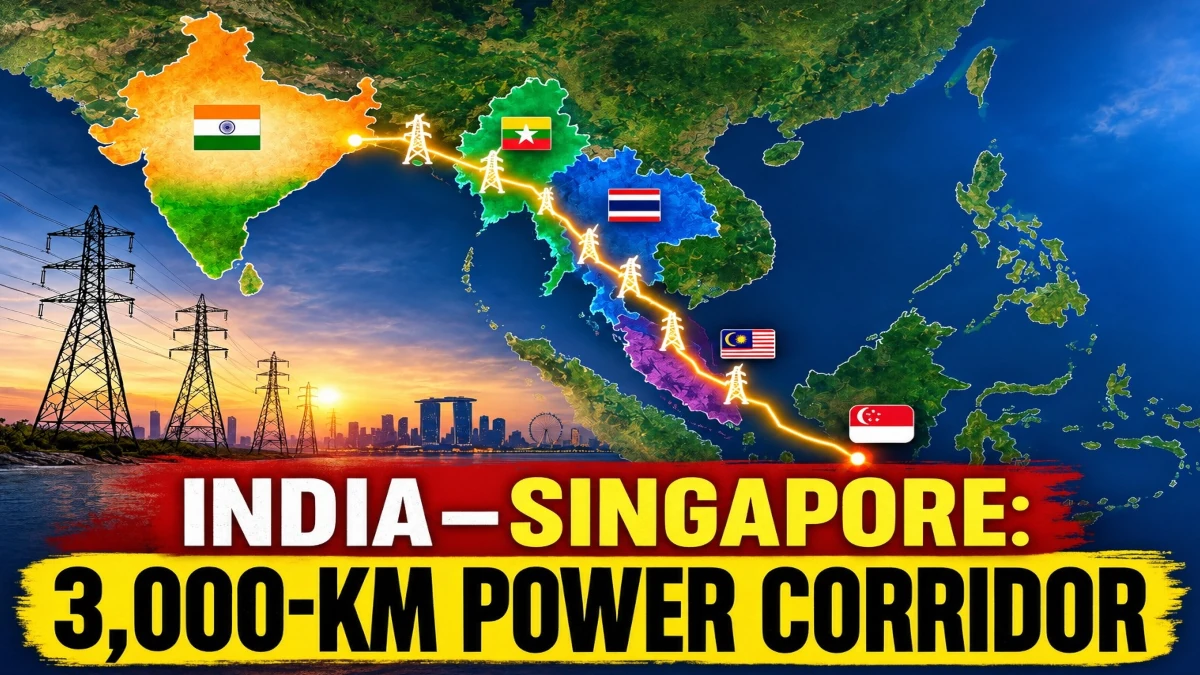
India and Singapore are exploring an ambitious 2,000-megawatt cross-border electricity interconnection that could link Imphal to Singapore through Myanmar, Thailand and Malaysia, opening a new chapter in regional energy cooperation. The proposed 3,000-km land-based transmission corridor was highlighted by Union Minister of State for Power and New & Renewable Energy Shripad Yesso Naik at the 20th East Asia Summit Energy Ministers’ Meeting in Manila, placing cross-border electricity trade and regional grid connectivity firmly on the agenda.
Imphal to Singapore: The proposed route
The proposed corridor would connect Imphal in Manipur with Singapore through Myanmar, Thailand and Malaysia. One of the options under consideration, the project is envisioned as a 2,000 MW interconnection capable of facilitating electricity trade across national borders.
According to the Union Power Ministry, the proposed link could improve the reliability of cross-border electricity supplies, support the integration of clean energy and strengthen regional energy security.
If realised, the corridor could give Northeast India a more prominent role in regional energy connectivity, linking India’s power infrastructure with electricity networks across mainland Southeast Asia. However, the proposal remains under exploration, and technical feasibility, commercial arrangements, financing and cooperation among the countries along the route will need to be assessed.
🇮🇳⚡ INDIA–SINGAPORE EYE 2,000 MW POWER CORRIDOR!#India and #Singapore are exploring a major 2,000 MW cross-border electricity interconnection that could transform regional energy cooperation and strengthen India’s Act East Policy.
🔹 Proposed route: An approximately 3,000-km… pic.twitter.com/H4XcefJVem
— Zest (@Zest328117) October 10, 2026
India’s push for a connected regional power grid
The proposal comes as India expands its focus on cross-border electricity connectivity. India already has power interconnections with Bangladesh, Nepal, Bhutan and Myanmar, while discussions are underway on a possible electricity link with Sri Lanka. Further connectivity options involving Saudi Arabia and the United Arab Emirates are also being explored.
These initiatives reflect India’s broader effort to strengthen regional energy cooperation and establish more extensive electricity-trading arrangements with neighbouring countries and partners.
The proposed Imphal–Singapore corridor would extend this ambition beyond India’s immediate neighbourhood, potentially creating new opportunities for electricity exchange between South and Southeast Asia.
Renewable energy at the centre of the plan
The proposed interconnection is not limited to conventional electricity trade. It could also support the movement and integration of renewable power across interconnected grids, subject to the eventual design and operating arrangements.
Addressing the East Asia Summit energy ministers’ meeting, Naik said India was ready to share its experience in large-scale renewable energy deployment, grid integration, transmission planning, energy storage, green hydrogen and clean-energy technologies.
Greater regional connectivity could help participating countries explore ways to balance electricity demand, integrate variable renewable generation and strengthen grid resilience. The extent of these benefits would depend on the corridor’s technical configuration, available generation capacity and the commercial rules governing electricity exchanges.
India seeks stronger ASEAN energy partnerships
Alongside the proposed power corridor, Naik called for stronger institutional links between the ASEAN Centre for Energy and Indian organisations, including NTPC, Power Grid Corporation of India, the Central Electricity Authority, the National Institute of Wind Energy, the National Institute of Solar Energy and the National Power Training Institute.
Such collaboration could encourage the exchange of technical expertise, support workforce training and improve cooperation in transmission infrastructure, renewable energy and emerging clean-energy technologies.
India is also promoting the International Solar Alliance’s One Sun One World One Grid initiative, which seeks to advance international cooperation on interconnected electricity networks and renewable energy.
East Asia Summit places regional energy security in focus
The 20th East Asia Summit Energy Ministers’ Meeting was chaired by Sharon S. Garin, secretary of the Philippines’ Department of Energy. It brought together energy ministers and representatives from ASEAN member states, alongside Australia, China, India, Japan, New Zealand, South Korea, Russia and the United States.
The discussions highlighted the importance of cooperation on energy security, clean-energy deployment and regional connectivity as participating countries navigate changing energy requirements.
The Big Challenge: Turning a proposal into infrastructure
Despite its potential, the proposed 2,000 MW corridor remains an option under consideration rather than an approved or operational project. A transmission route spanning several countries would require coordination on infrastructure standards, cross-border regulations, power-purchase arrangements, investment, security and the management of electricity flows.
Political and operational cooperation among India, Myanmar, Thailand, Malaysia and Singapore would also be essential. The project’s ultimate feasibility will depend on whether the participating countries can establish workable technical and commercial arrangements.