BHUBANESWAR: Rising prominently over the historic landscape of Bhubaneswar, the Lingaraja Mandir stands as one of the finest surviving expressions of Odisha’s Kalinga school of mandir architecture. Built in the 11th century, the imposing shrine rises to about 180 feet and forms the architectural and spiritual centre of the old city of Bhubaneswar.
📍Lingaraja Temple, Odisha | A closer look 🛕✨
Here’s a sneak peek into the Lingaraja Temple in Bhubaneswar, Odisha, a remarkable example of 11th-century Kalinga temple architecture.
The temple, also known locally as Kirttivasa, has richly carved walls featuring divinities,… pic.twitter.com/L7S5liSgNw
— Ministry of Culture (@MinOfCultureGoI) September 21, 2026
The mandir is dedicated to Bhagwan Lingaraja, a form of Shiva worshipped as a Swayambhu, or self-originated, Shivling. The deity is also known as Harihara, reflecting the mandir’s distinctive association with both Shaivism and Vaishnavism. Odisha Tourism describes the shrine as a symbol of the syncretisation of these traditions in Odisha.
An architectural landmark of Kalinga style
Lingaraja Mandir represents a mature stage of Kalinga Mandir architecture, a tradition that developed in Odisha from the early medieval period. The architectural character of these temples is distinguished by carefully planned proportions, soaring forms and extensive stone carvings. Odisha Tourism notes that Kalinga architecture evolved over several centuries while retaining its distinctive structural details, elevation and sculptural ornamentation.
The principal mandir complex is organised around four major spaces: the Garbhagriha, or sanctum; the Yajna Mandapa, associated with prayer and ritual; the Natya Mandapa, traditionally connected with dance and music; and the Bhoga Mandapa, where offerings are presented. Together, these structures create an architectural progression from the outer areas towards the principal shrine.
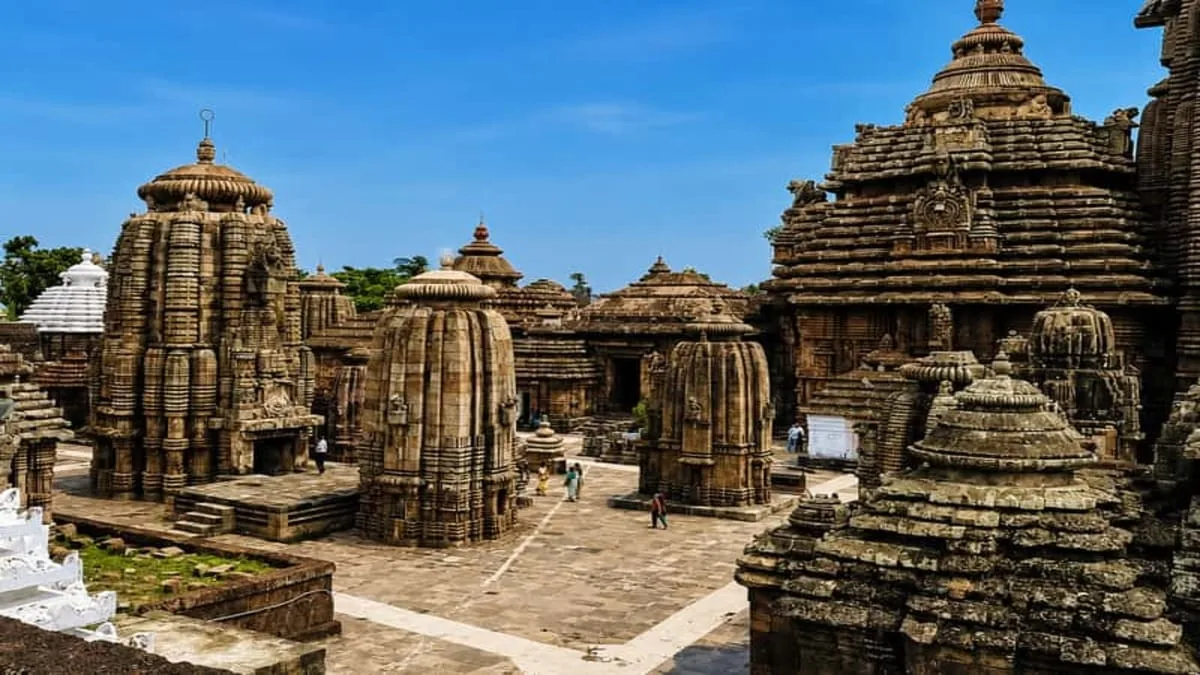
The towering main shrine, with its distinctive curvilinear form, dominates the surrounding skyline. Its monumental scale is complemented by intricate sculptural work across the exterior, demonstrating the remarkable skill of the craftsmen who worked on Odisha’s medieval temples.
Stories carved into stone
One of the most striking features of Lingaraja Mandir is its sculptural richness. The exterior walls contain finely executed figures of divinities, dikpalas or guardians associated with the directions, celestial and female figures, along with a variety of ornamental motifs. These carvings are not merely decorative elements. They form part of the larger visual language of Kalinga Mandir architecture, in which religious imagery, symbolic figures and representations of life were incorporated into the architecture itself. Odisha Tourism notes that the sculptural traditions of Odisha’s monuments include depictions connected with daily life as well as religious themes.
The precision of the carvings becomes particularly striking when viewed against the enormous scale of the structure. Delicate figures and ornamental details appear across massive stone surfaces, creating a contrast between monumentality and intricate craftsmanship.
A mandir complex with numerous shrines
The Lingaraja complex is much larger than the towering central shrine. It contains a large number of subsidiary shrines, creating an extensive sacred architectural landscape around the principal temple.
Odisha Tourism currently describes the complex as having around 150 subsidiary shrines, while some other descriptions and popular references give lower numbers. Therefore, the commonly cited figure of around 120 should not be presented as a definitive count. The presence of these smaller shrines adds another dimension to the complex. Rather than functioning as an isolated monument, Lingaraja developed as a larger sacred precinct containing multiple shrines and spaces associated with worship and ritual activity.
An important feature of Lingaraja is the identity of the presiding deity as Harihara. The name combines Hari, associated with Vishnu, and Hara, associated with Shiva.
According to Odisha Tourism, this association reflects the mandir’s syncretic character and the coexistence of Shaiva and Vaishnava traditions in Odisha. The development of the Lingaraja tradition also coincided with the growing prominence of the Jagannath tradition in the region. This aspect makes the mandir significant not only from an architectural perspective but also for understanding Odisha’s religious and cultural history.
Lingaraja and the mandir city of Bhubaneswar
Bhubaneswar is widely recognised as one of the major centres of Kalinga Mandir architecture. Odisha Tourism describes the city as the cradle of the Kalinga school and notes that it was once home to more than 1,000 mandirs, with hundreds still surviving.
Within this historic landscape, Lingaraja occupies a central position. Other important monuments, including the Mukteswar, Rajarani and Parasurameswar Mandirs, illustrate different stages in the evolution of Odisha’s temple architecture.
The Lingaraja complex is also closely associated with Bindusagar Lake, located to its north. The lake has traditionally been connected with religious activities and mandir festivities, further demonstrating how the temple was integrated into the wider sacred geography of old Bhubaneswar.
Despite its immense historical and architectural importance, Lingaraja remains a living mandir rather than merely a heritage monument. Major festivals, including Mahashivaratri and Rukuna Ratha Yatra, continue to attract large numbers of devotees.
The Rukuna Ratha Yatra, held on Ashokastami, is particularly associated with the representative deity of Lingaraja, Chandrashekhara. The procession forms an important part of the religious calendar of Bhubaneswar. The mandir’s continuing ritual traditions also underline an important characteristic of Odisha’s heritage: its historic temples remain connected to contemporary religious and cultural life.
A closer look at an enduring heritage
From its towering 180-foot vimana and elaborately carved walls to its numerous subsidiary shrines and continuing traditions of worship, Lingaraja Mandir represents the extraordinary architectural heritage of Odisha.
More than nine centuries after its construction, the mandir continues to dominate Bhubaneswar’s historic landscape. Its stone sculptures preserve an artistic vocabulary developed by generations of craftsmen, while its rituals and festivals keep the complex connected to living traditions. Lingaraja therefore stands not simply as an example of medieval architecture, but as a continuing expression of Odisha’s temple culture, Kalinga craftsmanship and the enduring traditions surrounding Bhagwan Shiva.