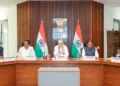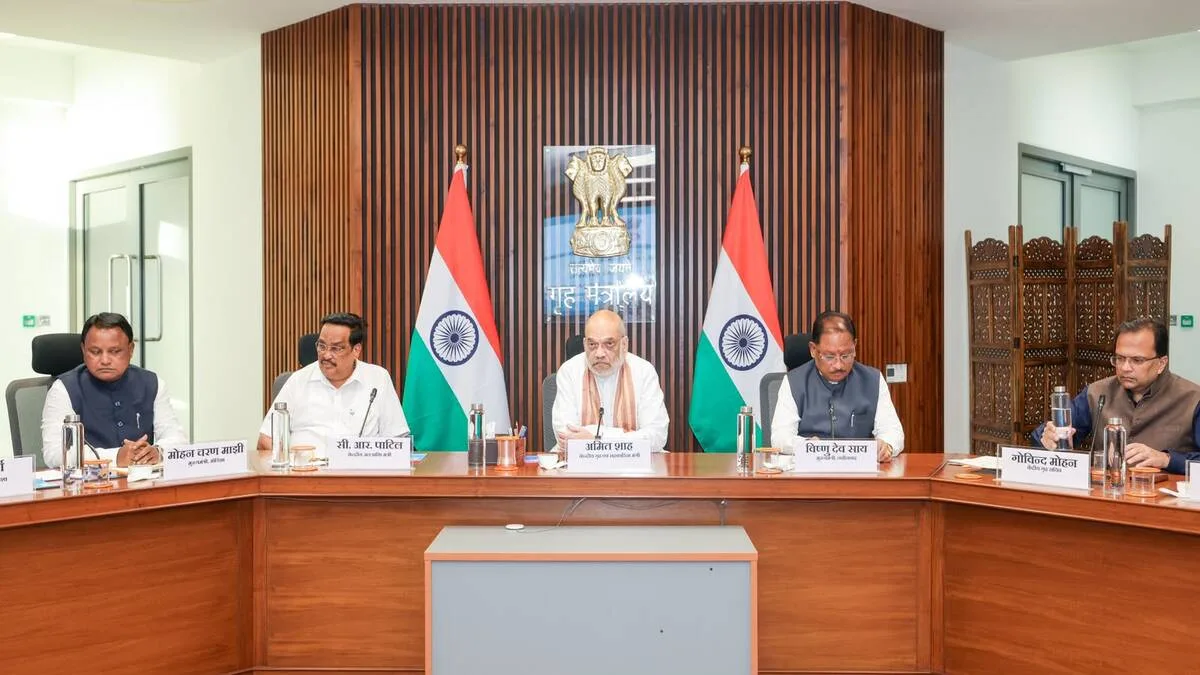
NEW DELHI: Efforts to resolve the long-pending Mahanadi water dispute between Odisha and Chhattisgarh received a fresh impetus on Thursday, with Union Home and Cooperation Minister Amit Shah chairing a high-level meeting involving the two states at Kartavya Bhawan in New Delhi.
Union Minister for Jal Shakti C. R. Patil, Odisha Chief Minister Mohan Charan Majhi and Chhattisgarh Chief Minister Vishnu Deo Sai participated in the meeting, along with the Chairman of the Central Water Commission (CWC), Chief Secretaries of both states and senior officials from the Union Ministry of Jal Shakti, CWC and the two state governments.
The discussions focused on finding an amicable, equitable and sustainable framework for resolving the dispute while taking into account the water requirements and interests of both Odisha and Chhattisgarh.
Closer to a resolution, expecting a final framework soon – CM Majhi
Speaking to the media after the meeting, Odisha Chief Minister Mohan Charan Majhi described the discussions as cordial and positive and said the two states were gradually moving closer to a resolution.
“We are gradually moving closer to a resolution,” Majhi said, expressing hope that a final framework would be worked out soon. He said any settlement would have to balance the interests of both states and address the concerns associated with irrigation, flood management, hydropower generation, drinking water and environmental protection.
The Mahanadi is Odisha’s lifeline and a source of sustenance for crores of our people. Today, I participated in a crucial meeting in New Delhi on the sharing and management of Mahanadi waters, chaired by Hon’ble Union Home Minister Shri Amit Shah Ji, in the presence of Hon’ble… pic.twitter.com/DPLs51OwmG
— Mohan Charan Majhi (@MohanMOdisha) October 1, 2026
Majhi said the Mahanadi was the lifeline of Odisha and supported the livelihoods of crores of people in the state. He emphasised the need to ensure that Odisha receives an adequate quantity of water while pursuing a solution through dialogue and institutional mechanisms.
The Odisha Chief Minister also expressed gratitude to Amit Shah for personally taking up the issue and facilitating efforts towards a resolution.
According to Majhi, the process of addressing the dispute has gathered momentum in recent months, with political, administrative and technical-level discussions being pursued alongside the legal proceedings before the Mahanadi Water Disputes Tribunal.
He said the two Chief Ministers had held discussions during July-August 2025, followed by several meetings between the Chief Secretaries and Water Resources Secretaries of Odisha and Chhattisgarh. Another meeting was held in July this year under the chairmanship of the Union Jal Shakti Minister in the presence of the two Chief Ministers.
At the July meeting, both states agreed to continue technical discussions and provide relevant data and information concerning their respective water requirements to the Central Water Commission. Majhi said a provisional understanding had been reached to work towards a resolution within three months.
“Two months have passed and satisfactory progress has been made,” he said.
The Chief Minister expressed confidence that the ongoing discussions would help establish a mutually acceptable framework. He also said the resolution of the Mahanadi dispute could potentially provide a model for addressing other inter-State disputes through dialogue and cooperative federalism.
Chhattisgarh CM Vishnu Deo Sai seeks equitable resolution, says no state should lose
Chhattisgarh Chief Minister Vishnu Deo Sai, while presenting his state’s position, described the Mahanadi as a river that should unite Odisha and Chhattisgarh rather than become a source of division.
Sai called for a “win-win” solution based on fairness, scientific assessment, transparency and long-term sustainability. He stressed that the interests of farmers, local communities and future generations in both states should be protected.
The Chhattisgarh Chief Minister pointed out that the Mahanadi originates in Chhattisgarh and that more than half of its catchment area lies within the state. He said the water requirements of Chhattisgarh’s farmers, irrigation sector and tribal regions should therefore be appropriately considered in any settlement.
At the same time, Sai reiterated his state’s commitment to safeguarding Odisha’s interests. He specifically referred to the importance of the Hirakud Dam for Odisha and said Chhattisgarh would extend cooperation for its smooth functioning while taking Odisha’s concerns into account.
महानदी हमारी जीवनधारा और हमारी समृद्धि का आधार…
माननीय केंद्रीय गृह एवं सहकारिता मंत्री श्री अमित शाह जी की अध्यक्षता एवं आदरणीय केंद्रीय जलशक्ति मंत्री श्री सी. आर. पाटिल जी की उपस्थिति में आज नई दिल्ली में महानदी के बेहतर जल प्रबंधन और छत्तीसगढ़ व ओडिशा के हितों के अनुरूप… pic.twitter.com/TiNgahYDvd
— Vishnu Deo Sai (@vishnudsai) October 1, 2026
Sai welcomed the initiative taken by Amit Shah and invoked the legacy of Sardar Vallabhbhai Patel, saying the spirit of national integration could also guide the resolution of long-standing inter-State disputes.
He argued that river-water disputes should not be viewed merely as administrative or technical matters, but also as an opportunity to strengthen cooperation and unity among states.
Dialogue and cooperative federalism
Sai referred to recent efforts to resolve water-related issues involving different states, including discussions concerning the Yamuna, Narmada and Sone river systems. He said these developments showed that complex and long-standing disputes could be addressed through sustained dialogue, political will and cooperative federalism.
Drawing a parallel with the Centre’s efforts to address the security situation in Bastar, Sai said the same political resolve and sustained engagement could contribute to finding a lasting solution to the Mahanadi dispute.
“The same resolve that transformed Bastar will also lead to a resolution for the Mahanadi issue,” he said.
Sai said the focus in Bastar had increasingly shifted towards development following sustained efforts to address the Naxal challenge. He expressed confidence that a similar approach based on dialogue and political commitment could help resolve the decades-old water dispute.
The Chhattisgarh Chief Minister also highlighted the close social, cultural and historical ties between Odisha and Chhattisgarh. Referring to Majhi as his “younger brother”, he said the people of the two states shared strong cultural and social bonds, particularly in forest and tribal regions.
He emphasised that both governments understood the importance of adequate water availability for farmers and local communities.
Sai also referred to the cultural association with Lord Jagannath and the tradition connecting Shivrinarayan in Chhattisgarh with Puri in Odisha. He said the Mahanadi should become a bridge for cooperation, development and mutual trust rather than remain a source of disagreement.
Confidence in CWC’s technical assessment
Sai expressed confidence in the mediation efforts of the Ministry of Jal Shakti and the scientific and transparent assessment being undertaken by the Central Water Commission.
He said Chhattisgarh would extend full cooperation to the technical process and approach any outcome emerging from consultations between the two states in a positive spirit.
The Centre has been emphasising dialogue, technical cooperation and cooperative federalism as the basis for an equitable and sustainable settlement. Following the July meeting between the two Chief Ministers, an expanded technical committee headed by the CWC Chairman began examining the pending technical aspects of the dispute.
The technical assessment is expected to provide the two states with a common factual basis for discussions on water availability, utilisation and future requirements.
Tribunal proceedings and recent engagement
The Mahanadi water-sharing dispute has remained before the Mahanadi Water Disputes Tribunal since 2018. Alongside the legal proceedings, political and administrative engagement between Odisha and Chhattisgarh has intensified in recent months.
The issue was also discussed during a meeting between Sai and Majhi in Bhubaneswar on September 20. Both Chief Ministers had expressed the hope that continued dialogue and technical consultations would help create conditions for an amicable settlement.
The latest meeting in New Delhi marks another significant step in this process, bringing together the political leadership of both states with the Union government and technical institutions responsible for assessing inter-State water issues.
For Odisha, the principal concerns include ensuring adequate water availability for irrigation, drinking water, flood management, hydropower and ecological requirements. Chhattisgarh, meanwhile, has emphasised its own requirements arising from its geographical position as the upper-riparian state, particularly for agriculture, irrigation and tribal regions.
The challenge before the ongoing process is therefore to reconcile the requirements of both states within a framework based on available hydrological data, technical assessment, legal principles and sustained political dialogue.
Towards a framework for settlement
Majhi said the progress achieved during the recent consultations had created greater optimism about finding a solution. He said the objective was not merely to settle a long-standing dispute but to establish a framework that adequately protects the legitimate interests of both states.
The involvement of the Union Home Ministry, Ministry of Jal Shakti and the Central Water Commission has brought political and technical dimensions of the dispute together on a common platform.
Both Odisha and Chhattisgarh have indicated their willingness to continue discussions, while the CWC’s technical assessment is expected to play an important role in the next stage of the process.
The latest meeting has thus shifted the focus further towards finding common ground rather than merely reiterating competing positions. While the final contours of any settlement are yet to emerge, the emphasis on dialogue, scientific assessment, transparency and cooperative federalism has provided a fresh basis for negotiations.
Officials attending the meeting included Chhattisgarh Chief Secretary Vikas Sheel, Principal Secretary to the Chief Minister Subodh Kumar Singh and Water Resources Department Secretary Rajesh Sukumar Toppo, besides senior officials from the Union government, CWC, Odisha and Chhattisgarh.
With both Chief Ministers expressing optimism over the progress made so far, the next phase of technical consultations and inter-State discussions is expected to determine the contours of a final framework for resolving the Mahanadi water dispute.