The death of 20-year-old IIT Bombay BTech student Sahil Wakode has become far more than a dispute over an examination rule.
It has triggered protests, allegations of caste-based harassment, a police case, administrative action against Professor Suryanarayana Doolla and an unusually public confrontation between students and faculty. It has also forced an uncomfortable question into the open: Have institutions understood how differently today’s students experience failure, humiliation and academic pressure?
The facts surrounding the immediate incident are still being investigated.
According to the IIT Bombay Faculty Forum, Doolla was invigilating a mid-semester examination on September 18 when he observed Wakode in unauthorised possession and use of a smartphone. The forum says Doolla followed institute-approved procedure by reporting the alleged academic malpractice.
Wakode was later found dead in his hostel room.
His family subsequently alleged caste-based harassment and named Doolla and others in their complaint. Police registered a case including provisions concerning abetment of suicide and the Scheduled Castes and Scheduled Tribes (Prevention of Atrocities) Act. These allegations remain matters for investigation and cannot be treated as established findings.
IIT Bombay, meanwhile, removed Doolla from his administrative position as Dean while he continued as a faculty member. The institute also apologised for an earlier communication and accepted a student charter containing demands concerning student welfare and institutional processes.
Against this backdrop, the Faculty Forum has publicly defended Doolla, arguing that he was carrying out his responsibilities under established academic rules. Faculty bodies at other IITs have also expressed support. That institutional defence has brought the generational question into sharp focus.
The old disciplinary equation
For many members of Gen X, older Millennials and the generations before them, the equation was comparatively straightforward. You did something wrong. A teacher corrected you. You faced the consequence. You moved on.
Being reprimanded in front of classmates was hardly considered extraordinary. Parents could be strict. Teachers could be intimidating. Academic failure could result in punishment, disappointment or embarrassment.
The underlying philosophy was that adversity was part of education. A child who was caught cheating was expected to understand the mistake, accept the consequences and return the next day. That worldview helps explain the reaction of faculty members who have rallied behind Professor Doolla.
From this perspective, examination integrity cannot become negotiable because a student may react badly to being caught. If a student is using an unauthorised device during an examination, an invigilator has a responsibility to act. Treating different students differently could itself undermine fairness toward those who followed the rules.
IIT Bombay’s Faculty Forum has essentially taken this position, saying Doolla was discharging his duties according to Senate-approved academic policies. There is an important principle behind that argument.
Rules cannot disappear because enforcement has become emotionally difficult. An examination system that does not enforce its rules risks punishing precisely the students who complied with them. But that cannot be the end of the conversation.
The world Gen Z inherited is different
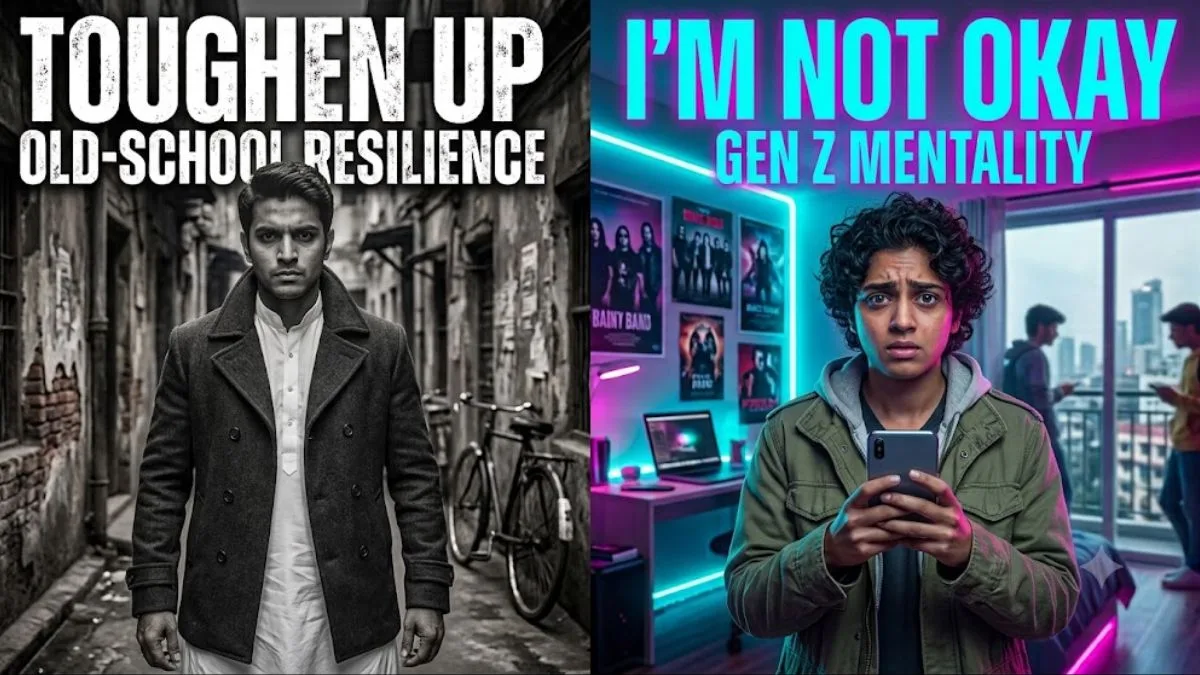
The mistake would be to conclude that today’s students are simply less resilient. The more useful question is whether the environment surrounding them has changed so dramatically that older definitions of resilience no longer tell the whole story.
Gen Z grew up in a world of permanent visibility. A poor examination result is not necessarily experienced as a private setback. Academic performance can become part of a student’s identity, social standing and perceived future.
At institutions such as IIT Bombay, students have already cleared extraordinarily competitive entrance examinations. Many arrive having spent years being among the highest performers in their schools.
Then they enter a campus where almost everybody was once a topper. The psychological equation changes. Being average can suddenly feel like failure. Failure can feel like identity collapse. And a mistake can feel much larger than the mistake itself.
That does not make cheating acceptable. It does mean that institutions have to understand the psychological environment in which discipline is being administered.
The “last straw” problem
No single event can automatically explain a suicide. That distinction matters enormously.
It would be wrong to conclude simply that being caught using a phone or an AI tool caused Wakode’s death. Suicide is complex, and the investigation must establish the circumstances rather than reducing a young person’s life to one examination incident.
But the incident can still raise an important institutional question. What happens when a disciplinary event becomes the last straw for a student who may already be carrying pressures nobody else can see?
A student may be dealing with academic anxiety, loneliness, financial pressure, identity struggles, family expectations, discrimination concerns or an overwhelming fear of failure.
The teacher sees an examination violation. The student may experience something much larger. That difference in perception can become the missing link between generations.
The caste allegation cannot simply be dismissed
The family’s allegation of caste-based harassment has added another dimension to the controversy. The IIT Bombay Faculty Forum has pointed out that, according to its account, Wakode had not previously approached the institute’s SC/ST Cell with a complaint. Faculty representatives have cited this as part of their defence of Doolla and their questioning of the allegations.
But the absence of a previous formal complaint does not, by itself, establish that harassment did not occur.
Students may report grievances through formal channels, informal channels or not at all. Whether any caste-based discrimination occurred, whether it contributed to the student’s distress and whether particular individuals were responsible are questions for the investigation.
The appropriate response is therefore neither automatic dismissal nor automatic acceptance. Investigate the allegation. Establish the evidence. Protect the rights of everyone involved. That is what due process is supposed to accomplish.
Gen Z’s distrust of institutions
There is another generational difference worth examining. Older institutional culture often assumes that if a student has a grievance, the student will use the designated mechanism.
Gen Z is far more likely to question whether that mechanism will actually protect them. Students protesting at IIT Bombay have demanded an independent inquiry and major reforms in student welfare and grievance redressal. Their demands have included stronger healthcare services and round-the-clock psychiatric support.
That tells us something important. The student protests are not only about one professor. They have become a vehicle for a much broader conversation about trust.
Resilience cannot mean suffering silently
There is a dangerous misconception on both sides of this debate. One side can romanticise the past. “We were scolded too, and we survived.”
But survival does not prove that every form of harshness was harmless. At the same time, the modern response cannot be that students should never experience failure, criticism or consequences.
That would also be a disservice to young people. Resilience is not the absence of consequences. Resilience is the ability to experience consequences without believing that life itself has ended.
A university therefore has two responsibilities that should never be treated as contradictory. It must maintain academic standards. And it must make sure that a student facing those standards understands that one mistake does not define an entire human life.
The IIT Bombay tragedy should not become a contest between “weak Gen Z” and “tough older generations.”
Earlier generations had forms of resilience that today’s students can learn from persistence, accepting criticism, recovering from failure and understanding that consequences are part of life.
Gen Z, meanwhile, has forced institutions to confront realities that were often less visible in earlier decades mental-health crises, social isolation, identity-related pressures, digital scrutiny and the need for professional psychological support.
Both perspectives contain lessons.