The National SC-ST Hub is expanding support for entrepreneurs from Scheduled Caste and Scheduled Tribe communities through training, finance, technology assistance and market access.
The initiative has also recorded a sharp rise in government procurement from SC/ST-owned micro and small enterprises, with purchases increasing from Rs 99.37 crore in 2015-16 to Rs 4,013.42 crore in 2025-26.
A push beyond financial assistance
For a small business, getting access to finance is only one part of the challenge. Finding customers, understanding government procurement rules, meeting quality standards and competing for larger contracts can be equally difficult.
The National SC-ST Hub, or NSSH, has been designed around this wider challenge. Launched on October 18, 2016, and implemented through the National Small Industries Corporation, or NSIC, the initiative seeks to strengthen the participation of SC/ST-owned enterprises in India’s MSME ecosystem.
The scheme brings together several forms of support, including entrepreneurship development, mentoring, training, technology assistance, financial support and market linkages.
One of its key areas of focus is government procurement, where small businesses can get opportunities to supply products and services to government departments and public sector enterprises.
This approach is important because entering institutional markets can help small enterprises move beyond local customers and develop a more stable business base.
More than 1.90 lakh beneficiaries assisted
The reach of the programme has expanded considerably since its launch.
As of July 31, 2026, the National SC-ST Hub had assisted 1,90,414 beneficiaries, while 54,499 candidates had been trained through various programmes.
The increase in government procurement is another indication of the growing participation of SC/ST-owned enterprises.
Procurement from SC/ST-owned micro and small enterprises increased nearly 39 times, rising from Rs 99.37 crore in 2015-16 to Rs 4,013.42 crore in 2025-26.
During 2025-26 alone, procurement worth Rs 4,013.42 crore was recorded from 12,524 MSEs.
Uttar Pradesh, Maharashtra, Karnataka, Tamil Nadu and Assam emerged as the five leading States under the initiative, reflecting the growing geographical spread of the programme.
Training has also been increasingly connected with actual market opportunities. During 2025-26, 10,717 candidates were trained through 47 institutions across 27 States, including 24 Aspirational Districts.
Women accounted for 55 per cent of those trained, making their participation an important feature of the programme.
Training linked to real business opportunities
The training programmes under NSSH are not limited to general lessons in entrepreneurship. Several courses are linked to areas where there are opportunities in public procurement and on platforms such as the Government e-Marketplace, or GeM.
The areas covered include cafeteria management and food production, welding, CAD/CAM, laundry services, fashion designing and tailoring, as well as bamboo-based work.
For entrepreneurs who may have technical skills but limited experience of dealing with government buyers, such training can be particularly useful.
Understanding how to register on procurement platforms, participate in tenders, calculate competitive prices and meet quality requirements can be as important as having the ability to produce a particular product or provide a service.
The focus on procurement-oriented training is therefore aimed at helping entrepreneurs convert their skills into actual business opportunities.
Capital subsidy to help enterprises expand
Access to affordable capital remains one of the major challenges for micro and small enterprises. The National SC-ST Hub addresses this through the Special Credit Linked Capital Subsidy Scheme, or SCLCSS.
Under the scheme, eligible new and existing SC/ST-owned MSEs can receive a 25 per cent capital subsidy, subject to a maximum of Rs 25 lakh, for investment in plant, machinery and equipment financed through institutional credit.
Between the launch of the scheme and March 2026, 3,160 MSEs received support amounting to Rs 356.10 crore.
The assistance has extended across 233 districts in 27 States and Union Territories.
For businesses looking to modernise their production facilities or increase capacity, such support can reduce the upfront financial pressure involved in purchasing machinery and equipment.
Upgrading technology can also make it easier for small enterprises to meet the quality and production standards required for larger institutional orders.
Creating opportunities through government procurement
Public procurement is one of the most important components of the National SC-ST Hub.
The Single Point Registration Scheme, or SPRS, enables eligible MSEs to register with NSIC and access government procurement opportunities.
Registered enterprises receive benefits such as free tender sets and exemption from payment of Earnest Money Deposit, subject to applicable conditions.
The wider Public Procurement Policy also provides a specific target for purchases from MSEs.
Central Ministries, Departments and Central Public Sector Enterprises are required to procure 25 per cent of their annual purchases from MSEs. Within this overall target, 4 per cent of total procurement is earmarked for SC/ST-owned MSEs.
This provides a defined opportunity for smaller enterprises to participate in the government purchasing system.
For a growing business, securing a government contract can provide more than immediate revenue. It can help establish credibility, increase production and create a track record that can be useful when competing for future institutional contracts.
Helping enterprises find wider markets
Having a good product or service does not necessarily guarantee that customers will find a business. Marketing and visibility are therefore another important part of the NSSH framework.
The Special Marketing Assistance Scheme, or SMAS, supports SC/ST enterprises through exhibitions, trade fairs, vendor development programmes, workshops and awareness campaigns.
During 2025-26, the scheme facilitated the participation of 141 SC/ST MSEs in four domestic exhibitions.
At the same time, 247 Special Vendor Development Programmes were organised with Central Public Sector Enterprises.
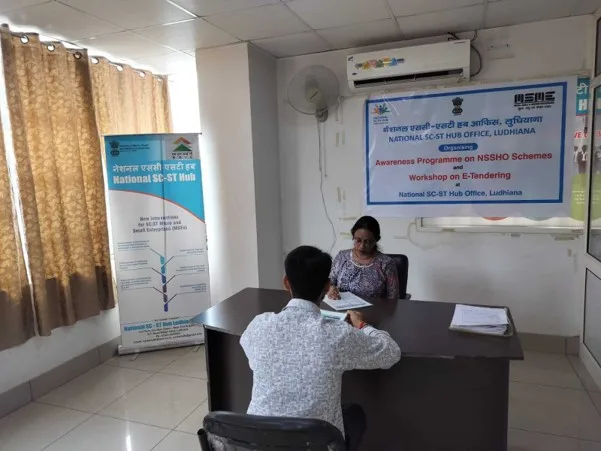
The initiative also conducted 197 e-tendering workshops and 230 awareness workshops with CPSEs and government departments.
These programmes give entrepreneurs an opportunity to understand procurement procedures while also connecting them with potential institutional buyers.
For many small enterprises, direct interaction with government departments and public sector companies can help them understand what buyers are looking for and how their products or services can fit into existing procurement requirements.
Reducing some of the costs of doing business
Running a small enterprise involves several costs that can become significant when working capital is limited. The NSSH therefore provides reimbursement support for some business-related expenses.
Under the Bank Loan Processing Reimbursement Scheme, eligible enterprises can receive reimbursement of 80 per cent of loan processing fees or Rs 1 lakh, whichever is lower.
The Bank Guarantee Charges Reimbursement Scheme provides reimbursement of 80 per cent of eligible performance bank guarantee charges or Rs 1 lakh, whichever is lower.
Testing and certification can also add to the cost of doing business. Under the Testing Fee Reimbursement Scheme, eligible enterprises can receive reimbursement of 80 per cent of testing fees or Rs 1 lakh, whichever is lower.
For enterprises seeking to enter export markets, the scheme also provides reimbursement of 80 per cent of eligible Export Promotion Council membership charges, subject to a ceiling of Rs 20,000 per financial year.
Such assistance can reduce some of the financial barriers faced by enterprises when they attempt to meet formal business, quality and market requirements.
Building managerial and digital capabilities
Financial support alone cannot ensure the long-term growth of a business. Entrepreneurs also need managerial skills to handle pricing, operations, marketing and expansion.
The Capacity Building Management Fee Reimbursement Scheme supports short-term management training at leading institutes identified under the National Institutional Ranking Framework.
SC/ST entrepreneurs and their wards can receive support for up to two courses every year, with reimbursement of 90 per cent of course fees or Rs 1 lakh, whichever is lower, subject to the prescribed conditions.
Digital platforms have also become an important part of the market access strategy.
NSSH promotes participation on government-backed e-commerce platforms such as GeM, e-Khadi, TRIFED, Tribes India and MSME Mart.
Under the applicable conditions, eligible enterprises can receive reimbursement of 80 per cent of membership fees or Rs 25,000, whichever is lower.
The move towards digital platforms gives small enterprises another route to reach government and institutional buyers without depending entirely on traditional local markets.
Mentoring aimed at turning support into contracts
Another important component of the National SC-ST Hub is its Business Accelerator Programme, or BAP.
The programme provides structured mentoring in areas including business strategy, pricing, operational efficiency and market positioning.
The purpose is to help entrepreneurs make more informed business decisions and become better prepared to compete for larger institutional orders.
Examples from participating enterprises indicate how such mentoring can translate into procurement opportunities.
In West Bengal, Safety & Security Engineering secured tenders worth Rs 8.48 lakh from Power Grid Corporation of India Limited after strengthening its pricing, cost management and market positioning.
In Maharashtra, Sawalaram Enterprises secured a Rs 5.10 lakh SAIL tender for hydraulic cylinders after working on its business strategy and understanding of government procurement.
These cases underline an important point. Technical expertise is only one part of running a successful enterprise. Understanding pricing, tender procedures, costs and institutional requirements can also determine whether a small business is able to win a contract.
Moving from assistance to participation
The larger objective of the National SC-ST Hub is to address several challenges faced by SC/ST-owned enterprises at different stages of their growth.
Training can improve skills, but businesses also require capital to purchase machinery. Capital becomes more useful when enterprises can find customers and markets. Market access, in turn, becomes more effective when entrepreneurs understand procurement rules, quality requirements and pricing.
The NSSH model attempts to bring these elements together.
With 1,90,414 beneficiaries assisted, more than 54,000 candidates trained and procurement from SC/ST-owned MSEs reaching Rs 4,013.42 crore in 2025-26, the initiative has expanded significantly since its launch in 2016.
Its significance lies in its attempt to move beyond standalone financial assistance and create a broader support system for entrepreneurship.
By combining training, finance, technology, mentoring and access to public procurement, the National SC-ST Hub is creating pathways for SC/ST-owned enterprises to enter larger markets, strengthen their businesses and compete for institutional opportunities.
For entrepreneurs, the ultimate test will be whether these opportunities translate into sustained businesses, larger orders, better productivity and new employment. The expansion in procurement and participation so far suggests that public procurement is becoming an increasingly important route for bringing SC/ST enterprises into the mainstream of India’s growing MSME economy.