As a student, while studying in Class 4 or 5, I was obsessed with news, Parliament, politicians, elections and political arguments that most children my age would have found boring. I wanted to know why governments fell, why people shouted across Parliament, and I never missed a debate between late Arun Jaitley Ji and Sheila Dixit Ji. So when my parents told me that good marks could eventually take me to Delhi University (DU), they had accidentally discovered the perfect bribe to turn a seven-year-old into a politically obsessive student.
In my childhood imagination, DU was the hub of Bharatiya politics, with student elections, political organisations, debates and leaders, where students could attend a lecture in the morning and argue about the country’s future over chai in the afternoon.
Obsessed with Student Activism
Years later, when I became a DU student, I got involved in student activism. I have seen this world from the inside and participated in student activism from both sides.
For months this year, a particular narrative was being built around Gen Z: that young people were done with Bharat’s political system, had lost faith in the present Government, and were expressing their politics through street protests, Instagram outrage, abuses, slang, and provocative slogans like “Nepal like revolution is coming.”
The Cockroach Janta Party’s high-decibel demonstrations were presented as evidence of this new political consciousness. The CJP increasingly appeared comfortable claiming the moral authority to speak for young people, as though occupying the loudest corner of the political internet made them representative of an entire generation. Then came the “cool” abuses, slang, chaos creation and endless online outrage.
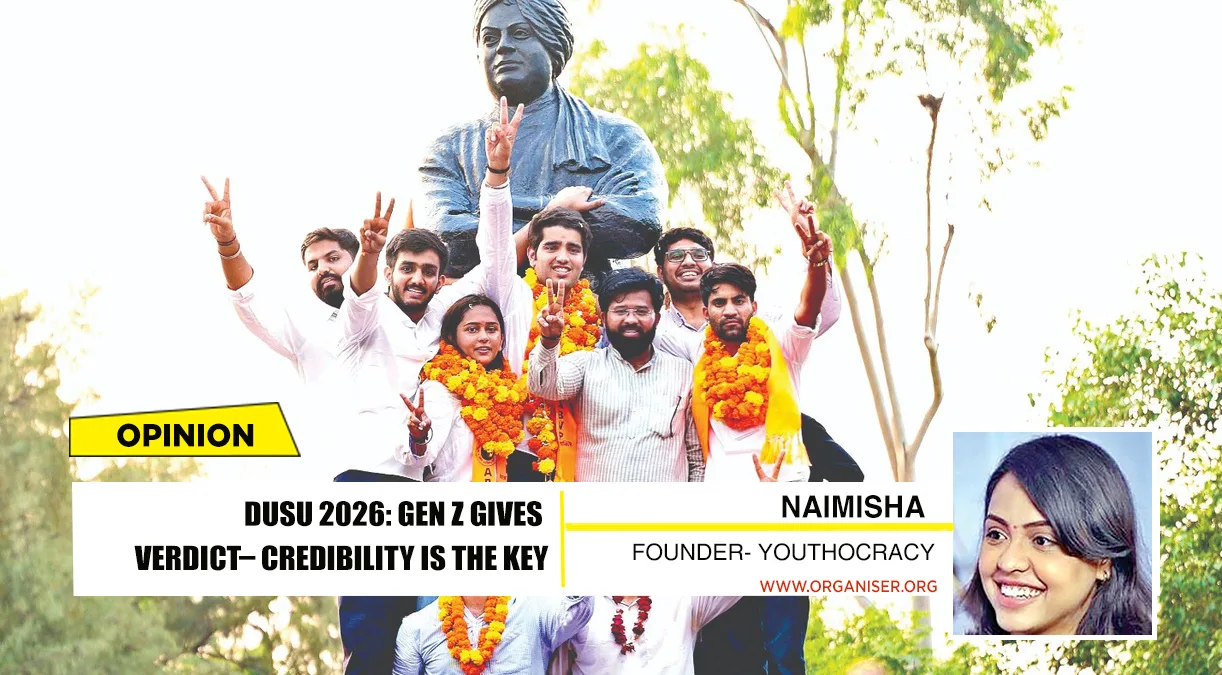
Verdict of DUSU Polls
And then came the 2026 DUSU election. The verdict did not merely complicate the narrative that Gen Z had become apolitical. It tore it apart. More than 60,000 students participated, with turnout reaching 40.46 per cent. While the “Gen-Algo” crowd farmed engagement, turning the Satya Niketan tragedy into Instagram reels and staging confrontations with law enforcement for the camera, a much quieter section of Gen Z did something that does not always go viral: voting.
What followed was not a simple ABVP versus NSUI story. ABVP won three of the four central DUSU positions, while the fourth went to independent candidate Deepanshu Shokeen.
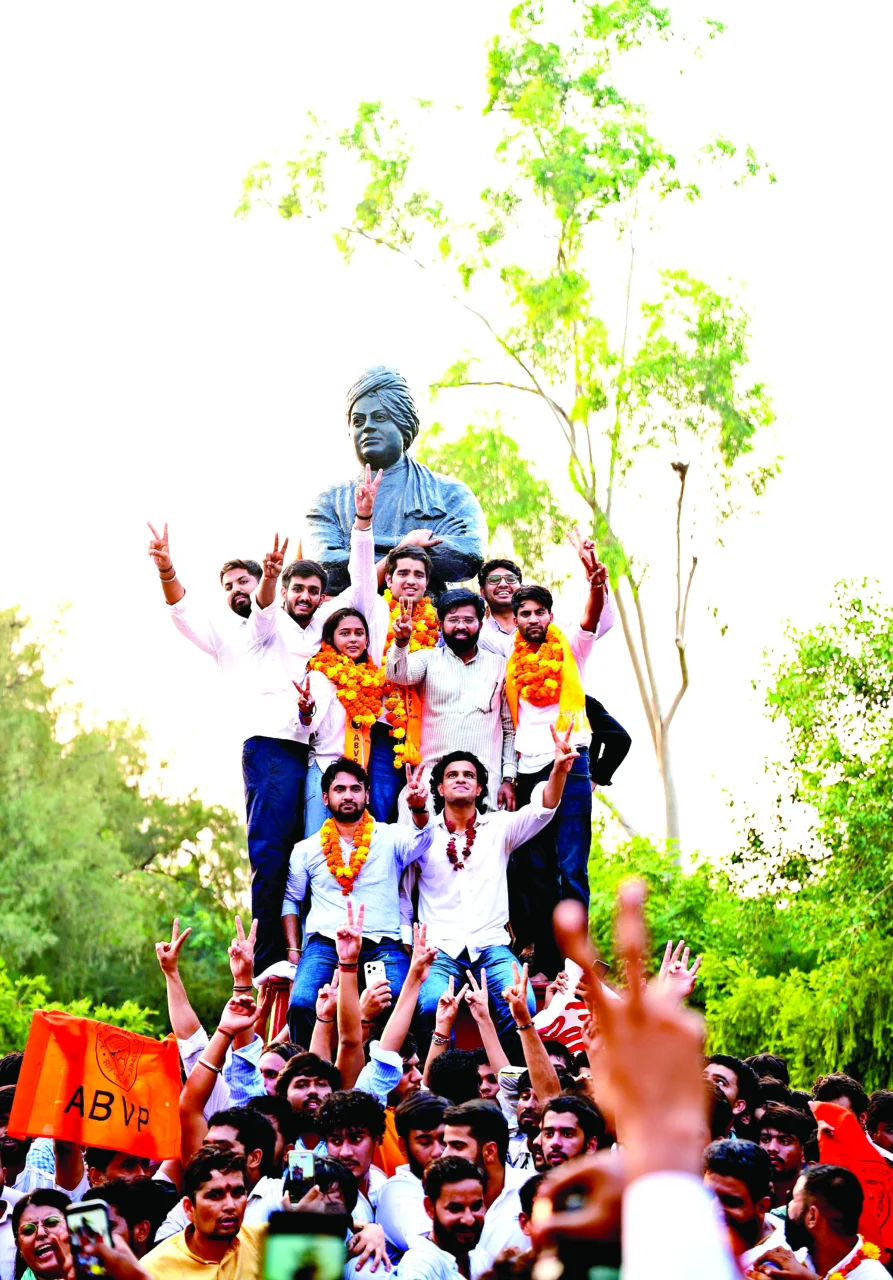
Shokeen had sought an NSUI ticket but eventually contested independently after being asked to withdraw his nomination. He took his campaign directly to students, ran it on the ground, addressed grassroots student grievances and positioned himself against what he saw as the toxicity of “high-command” culture. He defeated the official NSUI candidate, winning the Vice-President’s post with 30,615 votes against 16,910 for ABVP’s Ishu Maurya and 4,313 for NSUI’s Vir Chatrath. NOTA also reportedly received more votes than NSUI’s Vice-President candidate.
Rejecting Congress
Deepanshu’s victory rejected the assumption that Congress’s nepotism, party lobby, centralised ticket distribution, money and muscle power can substitute for grassroots credibility. For me, his victory was less about defeating ABVP and more about what it said to Congress and NSUI.
Lesson in Political Communication
The presidential contest was much closer than some post-election rhetoric suggests. ABVP’s Yash Dabas won with 24,576 votes against NSUI’s Vijay Shankar Meena, who secured 22,523. This poll offered an important lesson in political communication and personalised politics, which we have seen Prime Minister Narendra Modi use over the years: translating a larger political narrative into a more charismatic, relatable relationship with the voter.
The voter wants to know who you are, what you understand about their life, whether you will listen, whether they can approach you and whether you feel like someone they can actually talk to. That connection matters. Importantly, Yash Dabas had something you cannot manufacture in the final weeks of an election. He had worked on the ground for years and built relationships with students beyond the social-media frenzy. An Instagram campaign can make you visible; it cannot necessarily make you trusted.
Congress: Underestimating Voters
The Joint Secretary election demonstrated political arithmetic even more clearly. ABVP’s Lakshay Raj Singh won with 16,615 votes, while Samajwadi Chhatra Sabha’s Vishesh Yadav received 15,778 and NSUI’s Gopal Choudhary received 15,206. The difference between Vishesh and Gopal was only 572 votes, making it a genuinely triangular contest.
Vishesh Yadav himself was an NSUI rebel candidate who had been replaced by Gopal Choudhary. I personally believe Vishesh could have been in a much stronger position had he not eventually moved into the Samajwadi student organisation. He already had consolidated support among a section of Yadav and Purvanchal voters, and the arithmetic could have been considerably more favourable had those votes remained within a broader NSUI arrangement.
Congress is repeatedly making political miscalculations. It is unfortunate to see an organisation with such a long history in Bharatiya politics repeatedly underestimate the voter and grassroots politics. At some point, when the same mistake keeps happening, perhaps the problem is not the voter but the mindset and people behind it.
In ABVP, no single person is supposed to be the sole decision-maker. The organisation has layers of cadre formation, from college unit presidents to zonal presidents and beyond. Candidates are often selected after years of contribution rather than appearing during election season.
Reality is that there are many students who have worked for years and never received a ticket despite demonstrating enormous organisational commitment and, in some cases, the ability to mobilise significant resources. That may not always be a perfect system, but it creates something political organisations cannot buy overnight: cadre. This is one lesson that NSUI needs to learn from ABVP. Cadre building has to happen from the grassroots. You cannot build an organisation during election season. You build it when nobody is watching. Some will argue that the DUSU central election cannot meaningfully indicate student sentiment because students vote on specific college issues and local concerns. I understand the argument, but it becomes difficult to make it absolute when we look at the wider college-level results.
ABVP also swept several Delhi University college union polls. It won all contested posts at Shri Ram College of Commerce, Aditi Mahavidyalaya and Bharti College. At SRCC, ABVP won all four contested positions, including President and Secretary. It also won most of the college unions.
The results do tell us that Gen Z cannot be swayed away by rhetoric of reels and abuses manufactured by the self-appointed voice of Gen Z. Young voters can reject political chaos without rejecting politics itself. They can dislike street anarchy and still demand accountability; they can be culturally conservative on some questions and socially liberal on others. They can admire a leader and disagree with a party.
Perhaps that is what the DUSU election really teaches us. Young voters are not waiting for someone to tell them what to think about India. They are forming their own view of the country, its politics and its future. The megaphones may still belong to the loudest corners of the internet. But in Delhi University, at least, the ballot paper just had the last word, and it wasn’t the one anyone
had scripted or funded; it belonged to the youth, and the youth gave the mandate.