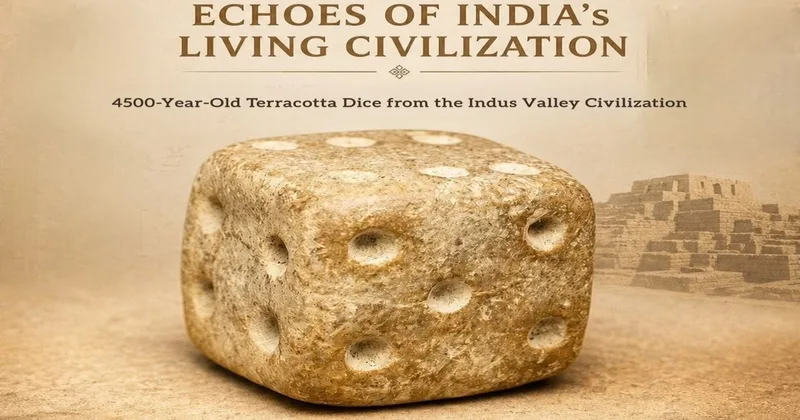
A 4,500-year-old terracotta dice from the ancient Indus-Saraswati Civilisation has once again brought attention to one of the most significant debates in Indian history, the relationship between the Indus Civilisation and the Vedic tradition. Highlighted recently by India’s Ministry of Culture, the artefact serves as a reminder that many cultural practices described in ancient Indian texts may have deeper roots than previously assumed.
Culture Ministry is playing on front foot now, this post will also fire the ass of leftist and Pakistani puppets😂
1. Simple Explanation: Why This Discovery Matters
For decades, colonial historians and leftist academics pushed the Aryan Invasion Theory (AIT), the idea that:
-… https://t.co/WzN7rdaqI4— STAR Boy TARUN (@Starboy2079) May 31, 2026
The terracotta dice, dating back roughly 4,500 years, are among numerous gaming objects recovered from archaeological sites associated with the Indus Civilisation. Dice and gaming boards have been found at major urban centres such as Harappa, Mohenjo-daro, Lothal, Dholavira, and several other settlements spread across northwestern India and present-day Pakistan. What makes the artefact particularly intriguing is that dicing and gambling are also mentioned in ancient Vedic literature, including the Rigveda and Atharvaveda.
The Aryan Invasion Theory: A Historical Background
For much of the nineteenth and twentieth centuries, many Western scholars promoted what became known as the Aryan Invasion Theory (AIT). According to this interpretation, Indo-Aryan-speaking groups entered the Indian subcontinent around 1500 BCE, bringing Vedic culture with them after the decline of the Indus Civilisation.
Over time, this theory influenced colonial understandings of Indian history and was often presented as a sharp divide between the urban Indus Civilisation and later Vedic society.
However, modern scholarship has significantly revised these earlier models. Most contemporary historians and archaeologists no longer support the notion of a large-scale violent invasion. Instead, many researchers discuss more complex scenarios involving migrations, cultural interactions, and gradual transformations over long periods. Importantly, archaeological evidence has not revealed signs of widespread destruction or warfare across Indus cities that would indicate a sudden civilizational overthrow.
Evidence for Cultural Continuity
Over the past several decades, numerous discoveries have encouraged scholars to explore the possibility of continuity between the Indus Civilisation and later Indian traditions.
These include:
Ritual Practices
Archaeologists have identified fire altars at several sites, including Kalibangan and Lothal, which some researchers believe resemble later Vedic ritual traditions.
Symbolism
Certain motifs found on seals and artefacts continue to attract attention. Some scholars have pointed to similarities between ancient symbols and those that remain significant in Indian religious and cultural life.
Water-Centred Sacred Spaces
The importance of ritual bathing, water reservoirs, and sacred water structures appears repeatedly in both archaeological remains and later Indian traditions.
Yoga-Like Imagery
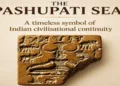
A famous seal depicting a seated figure in a meditative posture has often been cited as evidence of early yogic practices, although interpretations remain debated.
Traditional Games
The discovery of dice, gaming boards, and other recreational objects reflects practices that continued to exist in later Indian society and are mentioned in ancient Sanskrit texts.
Together, these findings suggest that many cultural elements may have evolved over time rather than emerging suddenly from external influences.
The term “Indus Valley Civilisation” was coined because the earliest major excavations took place near the Indus River. However, archaeological surveys conducted over the past several decades have identified hundreds of sites along the Ghaggar-Hakra river system, which some scholars associate with the Saraswati River mentioned in the Rigveda.
India as a Living Civilisation
Unlike many ancient civilisations that survive primarily through ruins and historical records, India’s cultural heritage remains visible in living traditions, rituals, festivals, languages, symbols, and social practices. The significance of artefacts such as the terracotta dice lies not merely in their age but in the questions they raise about how civilisations endure. They encourage a deeper examination of the links between archaeological discoveries and cultural practices that continue to shape everyday life.
While historical debates about the origins of Vedic culture, migration patterns, and linguistic development remain subjects of ongoing research, discoveries from the Indus-Saraswati Civilisation increasingly point toward a complex story of continuity, adaptation, and resilience.
The 4,500-year-old terracotta dice serve as more than an archaeological curiosity. It symbolises a broader conversation about India’s past, the interpretation of ancient history, and the enduring nature of one of the world’s oldest civilizational traditions.
As new discoveries continue to emerge, the picture that unfolds is increasingly nuanced—one that moves beyond simplistic invasion narratives and highlights the possibility of deep cultural continuity across millennia. Whether viewed through archaeology, literature, ritual practice, or collective memory, the story of the Indus-Saraswati Civilisation remains central to understanding the origins and evolution of Indian civilisation.