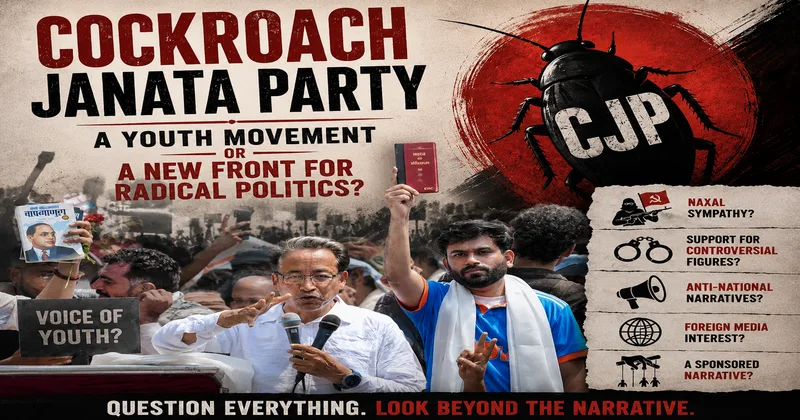
The ‘Cockroach Janata Party’ (CJP), which suddenly emerged from the world of social media, portrays itself as the voice of the nation’s youth and a symbol of systemic change. However, as details regarding its leadership, spokespersons, and supporters come to light, a deepening question arises: is this truly a youth movement, or is it an organized attempt to give a new face to Leftist, Naxal-sympathizing, and anti-India narratives?
In fact, the CJP attempted to enter the realm of street politics by announcing a protest at Jantar Mantar on Saturday, June 6. Yet, the track record and past public statements of the individuals behind this movement suggest that it serves more as a platform to advance an ideological agenda than to address issues like unemployment or educational reform.
Spokesperson or a bundle of controversies?
The biggest controversy surrounds CJP’s official spokesperson, Saurabh Das. While the party has positioned him as one of its key faces, his past statements and writings have consistently come under scrutiny. Das defended slogans raised in support of “Maoist commander Madvi Hidma” during anti-pollution protests in Delhi. When national security agencies and the police took action against slogans such as “How many Hidmas will you kill? A Hidma will emerge from every home,” Das sided with the protesters.
The country’s security forces have been battling Naxalism for the past two decades. Given this context, if an official spokesperson of a political organisation is seen supporting such slogans, it is natural for questions to be raised about their ideology and indeed, it appears to be presenting itself in a new avatar. Furthermore, following the death of G.N. Saibaba, Das described him as a “courageous individual.” Saibaba had been convicted on charges of having links with Maoist organizations. This stance cannot simply be termed a debate on human rights; it directly signals sympathy for Naxalite ideology.
Just look at the supporters of the Cockroach Janta Party in the video.
From which angle do they look like Gen Z youth?
They look like leftists from JNU, not Gen Z supporters. 😂 pic.twitter.com/u8k4KGdjpp
— Saffron Chargers (@SaffronChargers) June 6, 2026
Delhi Riots, Umar Khalid, and Gulfisha Fatima
Saurabh Das has consistently appeared in support of individuals whose names surfaced in connection with the Delhi riots and related investigations. He repeatedly criticized the judiciary and investigative agencies regarding the detention of Umar Khalid. Similarly, he consistently raised the issue of Gulfisha Fatima. In a sense, Das’s entire public record shows him standing with individuals accused of offenses related to national security, communal violence, or radical political activities.
From the Ram Mandir to Arundhati Roy
Saurabh Das’s public statements are not limited to Naxalism or the Delhi riots. Following the consecration ceremony of the Ram Mandir, he opposed the demands made by the Hindu side regarding other disputed religious sites. He objected to holding the current generation of Muslims responsible for historical disputes. Furthermore, when sanction was granted to prosecute Arundhati Roy under the UAPA, he described her as one of the country’s “best intellectuals.”
In other words, the ideological track record of this key CJP spokesperson revolves around issues that have long been points of contention between Leftist and nationalist discourses, issues involving the justification of Naxalism, support for alleged terrorism, opposition to security forces in Kashmir and so on.
The Dhruv Rathee Connection and Ideological Network
Serious allegations have also been leveled against another spokesperson of the organization, Vijeta Dahiya. According to claims circulating on social media, she was long associated with YouTuber Dhruv Rathee in research and scriptwriting roles. Notably, her name has been linked to the script of a controversial video that portrayed Lord Ram as a non-vegetarian. It is surprising that within the Indian knowledge tradition and the entire body of literature, not a single instance can be found that directly establishes Lord Ram as a non-vegetarian; yet, through figures like Dhruv Rathee, a narrative is being created that opposes Lord Ram, or rather, one that sows discord within Hindu religion and society. The point is that the leadership of this so-called ‘Cockroach Janata Party’ (CJP) is promoting individuals who have long been, or currently are, associated with anti-Hindutva discourse.
Cockroach Janta Party founder Abhijeet Dipke tried to escape his own protest due to the heat, sunlight, and exhaustion.
The public stopped him and asked, “Where are you running away?”
Forced to get out of his car, Dipke’s great revolution ended before it could even leave the… pic.twitter.com/brpDAU5SsO
— Tajinder Bagga (@TajinderBagga) June 6, 2026
The list of supporters also raises questions
Supporters of the ‘Cockroach Janata Party’ (CJP) include Prakash Raj, Prashant Bhushan, Sonam Wangchuk and certain student leaders affiliated with the Congress party. Many of these figures are already known for their past criticism of the central government and Prime Minister Narendra Modi. Prashant Bhushan openly described the CJP as a “genuine Gen-Z movement,” while Prakash Raj appealed to the youth to join the cause.
A natural question arises here: if this is truly a spontaneous youth movement, why are the same familiar political and ideological faces, who have long been part of anti-Modi, anti-BJP and anti-Sangh campaigns, visible behind it?
Is this movement truly apolitical?
Consider this as well; while the CJP describes itself as a non-traditional and non-partisan movement, questions are being raised regarding the press conference held at the Constitution Club, as it required the recommendation of an opposition MP. Claims have also circulated on social media suggesting that the movement’s actual objective is to benefit anti-BJP politics in certain states and to indirectly extend support to the Aam Aadmi Party (AAP) from behind the scenes. Naturally, this has cast doubt on the movement’s political neutrality.
Unusual interest from international media
Another interesting aspect is the support from international media. Turkey’s state-run media outlet, TRT World, portrayed the CJP as an emerging youth revolution in India. This is the same Turkey that openly supported Pakistan during ‘Operation Sindoor’ and has frequently adopted an anti-India stance. Meanwhile, Bloomberg also presented the CJP as the voice of unemployed and disgruntled youth. Similarly, various media organisations in Europe and the US are characterizing it as a voice of youth discontent within the Indian context. Naturally, when foreign platforms known for anti-India stances begin to attach extraordinary importance to a movement, the underlying political implications warrant scrutiny.
Dafli Gang joins the Cockroach Janta Party protest and kicks off Umar Khalid style sloganeering at JANTAR MANTAR.
Andolanjeevis from SFI, AISA, and AISF are trying to engage in momentum trading at the protest site.#YouthForViksitBharat #cjp_पार्टी #CongAAPkeCockroach pic.twitter.com/jtMW0V5Ezh
— First Post (@TrishulTactics) June 6, 2026
A movement or a sponsored narrative?
These developments clearly indicate that the ‘Cockroach Janata Party’ (CJP) is not a spontaneous grassroots movement but a carefully orchestrated political narrative. The entire campaign exhibits a blend of social media branding, controversial figures, media management and the politics surrounding potential arrests.
Had the objective truly been to address the issues faced by the youth, the organization would have by now presented concrete policy documents regarding education, employment, economic reform and administrative accountability; instead, its defining characteristics remain its controversial figures and inflammatory statements.
In this context, regarding Abhijit Dipke, the founder of the social media-born Cockroach Janata Party (CJP) and his associates, one must observe that while the CJP may portray itself as a youth revolution, its faces, supporters and ideological leanings tell a different story. Indeed, a host of factors, ranging from the defense of pro-Naxal slogans and support for those accused in the Delhi riots to the backing of controversial writers and activists, as well as the unusual interest shown by foreign media, have cast a shadow of suspicion over the organization.
Cockroach Janata Party has more than 2.5 crore followers on Insta. But on the ground even 2,500 people have not come together.
That is why people say: social media can give you claps and likes. But for a real protest, you need people who walk and come on foot.
At Jantar Mantar,… pic.twitter.com/Z4N3ks8Ij5
— AnuCreate.in_ (@Imdead108_ybc) June 6, 2026
Consequently, the most critical question today is not how rapidly the CJP has gained popularity, but rather whether it genuinely represents the voice of the youth or is an attempt to establish a new ideological front in India. Its underlying objective appears to be the creation of an atmosphere of widespread alienation to weaken the state apparatus, thereby enabling the pursuit of vested interests within that weakened system.