
For generations, many people assumed that the Vedas, the oldest sacred texts of Hindu civilisation, were composed exclusively by men. However, a closer examination of Vedic literature reveals a remarkable truth: women played an active and respected role in the intellectual, philosophical, and spiritual life of ancient Bharat.
For centuries, people assumed the Vedas were written only by men.
But ancient Bharat tells a very different story.
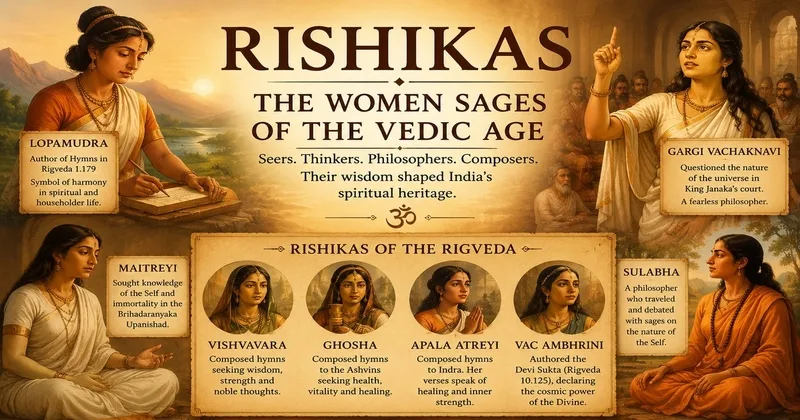
The Rigveda preserves the voices of extraordinary women known as:
Rishikas…female seer-poets of the Vedic age.Women like: Maitreyi, Lopamudra, Ghosha, Apala… pic.twitter.com/IslaeUztj0
— Shermy (@ShermyVibes) June 1, 2026
The Rigveda preserves the voices of several women sages known as Rishikas, female seers who composed hymns, engaged in philosophical debates, explored profound metaphysical questions, and contributed directly to humanity’s oldest surviving spiritual literature. These women were not merely participants in religious life; they were thinkers, teachers, poets, and seekers of truth whose wisdom continues to inspire even today.
The Concept of the Rishika
In Vedic tradition, a Rishi is not simply an author but a seer who “perceives” divine truth. A Rishika is the female equivalent, a woman who attained spiritual realisation and expressed her insights through sacred hymns and philosophical discourse. Several hymns of the Rigveda are attributed to women sages. Their compositions address topics ranging from devotion and healing to self-realisation, cosmic order, and the ultimate nature of reality. The existence of these women in the Vedic canon demonstrates that intellectual and spiritual authority was not restricted to men alone.
Lopamudra: The Philosopher of Harmony
Among the most celebrated Vedic women is Lopamudra, the wife of Sage Agastya and a revered Rishika. Her hymn in Rigveda 1.179 presents a thoughtful dialogue between husband and wife. Far from being a passive figure, Lopamudra articulates her views with clarity and confidence. Her verses emphasise the importance of balancing spiritual pursuits with worldly responsibilities.
Lopamudra’s contribution is significant because it illustrates a central Vedic ideal: spirituality need not require rejection of family life. She demonstrated that household duties and spiritual growth could coexist harmoniously. Her wisdom continues to serve as an example of integrating material and spiritual dimensions of life.
Gargi Vachaknavi: The Fearless Debater
Few figures in Indian philosophy command as much respect as Gargi Vachaknavi. Mentioned prominently in the Brihadaranyaka Upanishad, Gargi participated in a famous philosophical assembly convened by King Janaka. The gathering included some of the greatest scholars and sages of the age.
Gargi challenged the renowned sage Yajnavalkya with profound questions concerning the nature of existence. She inquired into the fundamental reality that supports and permeates the universe, probing concepts that remain central to metaphysical philosophy even today. Her fearless questioning earned admiration from the assembled scholars. Gargi’s intellectual courage exemplifies the spirit of inquiry that characterised the Upanishadic age. She remains one of the earliest recorded women philosophers in world history.
Maitreyi: The Seeker of Immortality
Another extraordinary woman associated with the Brihadaranyaka Upanishad is Maitreyi, the wife of Yajnavalkya. When Yajnavalkya prepared to renounce worldly life, he offered to divide his wealth between Maitreyi and his other wife, Katyayani. Maitreyi responded with a question that has echoed through centuries:
Vishvavara: Voice of Wisdom and Noble Thought
Vishvavara Atreyi is among the women seers credited with composing hymns in the Rigveda. Her verses invoke divine blessings for wisdom, strength, and righteous living. They emphasise the cultivation of noble thoughts and virtuous action. Vishvavara’s hymns reveal a deep awareness of the relationship between spiritual insight and ethical conduct. Her compositions remind readers that wisdom is not merely intellectual understanding but a force that shapes character and society.
Ghosha: The Rishika of Healing and Hope
Ghosha occupies a special place among Vedic women sages. Tradition holds that she suffered from a prolonged illness and composed hymns dedicated to the Ashvins, the divine twin healers of Vedic mythology. The hymns attributed to Ghosha express hope, devotion, and a yearning for health and fulfilment. They reveal a deeply personal dimension of Vedic spirituality, where faith and prayer become sources of strength during adversity.
Apala Atreyi: The Symbol of Inner Strength
Apala Atreyi is another prominent Rishika whose hymns are found in the Rigveda. According to tradition, Apala endured physical suffering yet remained steadfast in her devotion. Her hymns addressed to Indra speak of transformation, healing, and spiritual resilience. Beyond their historical significance, Apala’s verses symbolise the power of inner strength and the human capacity to transcend hardship through faith and determination.
Sulabha: The Wandering Philosopher
Though belonging to a slightly later tradition, Sulabha is remembered as one of ancient India’s most remarkable women philosophers. She travelled widely and engaged in philosophical debates with learned scholars and rulers. Her discussions focused on the nature of the Self, liberation, and spiritual freedom. Sulabha’s life reflects a tradition in which women could pursue intellectual inquiry independently and participate actively in philosophical discourse.
Romasha: A Seer of Spiritual Realisation
Romasha is remembered in Vedic tradition as a woman associated with profound spiritual insight. The hymns linked to her express contemplative wisdom and an awareness of higher truths. Though less widely known than Gargi or Maitreyi, Romasha represents the broader tradition of women who contributed to India’s spiritual heritage.
Vak Ambhrini: The Voice of Divine Consciousness
One of the most celebrated hymns in the Rigveda is the Devi Sukta (Rigveda 10.125), attributed to Vak Ambhrini. In this extraordinary composition, the seer identifies herself with the cosmic power underlying creation. The hymn presents speech (Vak) as the divine force that sustains gods, humans, and the universe itself. The Devi Sukta stands as one of the earliest and most powerful expressions of feminine spiritual authority in world literature.
Indrani and Other Female Voices
Vedic literature also contains hymns associated with Indrani, who is portrayed as possessing wisdom, confidence, and divine insight.
These compositions further demonstrate that female voices were woven into the spiritual and literary fabric of Vedic culture.
The presence of multiple women composers across different sections of Vedic literature indicates that their contributions were neither isolated nor accidental.
The Rishikas of the Vedic age stand among the earliest known women philosophers, theologians, and poets in human history. From Gargi’s fearless debates and Maitreyi’s quest for immortality to Lopamudra’s wisdom, Ghosha’s devotion, Apala’s resilience, and Vak Ambhrini’s cosmic vision, these women helped shape the spiritual foundations of Indian civilization.
Their voices continue to echo through the Vedas and Upanishads, reminding us that the search for truth belongs to every human being. Far from being silent spectators, the women of the Vedic world were active participants in the creation of one of humanity’s greatest intellectual and spiritual traditions.