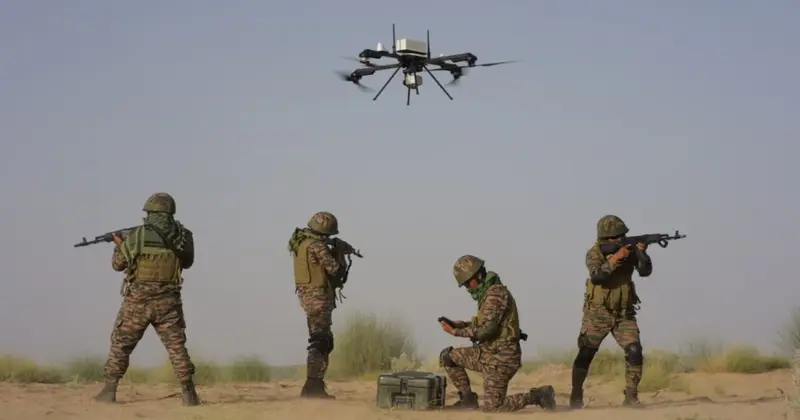
In an overarching attempt to modernise and upgrade the Indian defence apparatus and align it with the strategic demands of the emerging or modern warfare, Indian Army is aiming to train 5 lakh personnel in drone operations. In this direction, 50,000 of the Army men have already been trained and are specialised in drone technology and operations. This will help India yield a strategic edge against intruding adversaries or multifront confrontation in an era where the battlefield tactics are being rigorously redefined with low-cost drone technology.
This fact regarding the next generation war strategy, where drones are being extensively used in warfare is witnessed in the Russia-Ukraine conflict, Iran & US-Israel confrontation etc. Thus, drone warfare and specialisation in it is a geopolitical reality and strategic compulsion to consolidate offensive and defensive capabilities. In this backdrop, Lt. General Devendra Sharma, General Officer, Commanding-in-Chief, Army Training Command said that the Army has already trained around 50,000 jawans and officers within the last year for operating Remotely Piloted Aerial Systems(RPAS).
“The push for widespread drone literacy follows strategic assessments of recent global conflicts where low cost commercial grade drones have neutralised multi-million dollar legacy systems, changing the arithmetic of combat across the world”, the Army officer explained the importance of specialising in drone warfare amidst changing modern warfare dynamics. In the ongoing US-Iran conflict, American world-class missiles and air defence systems including the F-35 have been struck down by cheap Iranian drones.
To fully integrate drone warfare capabilities into the Indian Army, a specialised drone warfare framework has been rolled out across 19 training establishments. The training includes specialisation in drone precision, wing plans, drone manoeuvre areas and advanced drone simulators. “Beyond surveillance, drones assist the army in precision strikes, target destruction and autonomous logistical re-supplies especially in high-altitude or hostile terrains.These capabilities effectively hold a significant advantage and helps for possessing superior information and aids for swift decision making”, General Devendra Sharma further added.
The institutionalisation of drone warfare in India, thus helps to gain strategic superiority in emerging warfare mechanisms. Specialisation in operating low-cost commercial and military drones help to neutralise expensive military aircrafts and missile systems as witnessed in recent geopolitical confrontations. Even during Operation Sindoor, Pakistan vented out cheap Turkish drones against India from the western frontier. However, India was successful in neutralising these intruding Pakistani drones. This experience further necessitated the urgency to India to gain competence in drone warfare.
Gaining critical military skills and efficiency in drone technology and operations gained further push when the Chief of the Indian Army General Upendra Dwivedi announced the creation of a dedicated drone unit called Ashni Platoons. As per the sources, this drone unit of the Indian Army is now fully established and operationalised and has been deployed across infantry battalions. According to the latest upgradation, now 380 infantry battalions of the Indian Army have Ashni drone platoons each having 25 men, who are expert in drone operations.
These platoons operate all types of drones, including surveillance, combat, logistics and kamikaze or suicide drones. The Indian Army’s decision to further train 5 lakh personnel in drone operations mark a doctrinal shift in India’s warfare or military strategy to strengthen national security and territorial integrity amidst unpredictable geopolitical landscape.