For decades, Turkey viewed itself as a pivotal power straddling Europe, West Asia, the Black Sea and the Eastern Mediterranean. Today, however, a new strategic reality is beginning to challenge Ankara’s calculations. India’s rapidly expanding defence diplomacy, from the Indo-Pacific to the Mediterranean, is creating discomfort in Turkish strategic circles, particularly because it increasingly intersects with Turkey’s own geopolitical interests and its long-standing partnership with Pakistan.
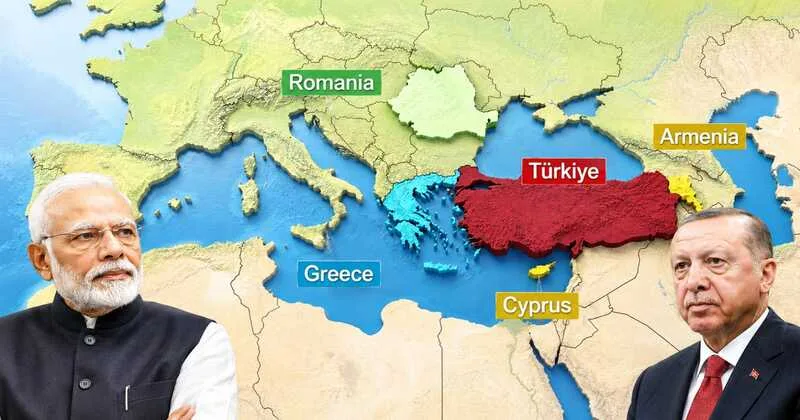
What makes the situation particularly significant is that India’s engagements are not confined to one theatre. While New Delhi is strengthening security cooperation across the Indo-Pacific with partners such as the United States, Australia, Vietnam and the Philippines, it is simultaneously building deeper defence and strategic partnerships in the Eastern Mediterranean with Greece, Cyprus and Armenia, three countries that have their own disputes and tensions with Turkey.
This widening network is gradually placing Ankara in an unfamiliar position. For years, Turkey openly backed Pakistan on Kashmir, supplied military platforms to Islamabad during Operation Sindoor, and frequently used multilateral forums such as the Organisation of Islamic Cooperation (OIC) to amplify anti-India narratives. India largely avoided direct geopolitical responses. That phase appears to be ending. New Delhi is increasingly demonstrating that strategic partnerships can also be leveraged to impose costs on countries that challenge Indian interests.
Turkey’s Pakistan policy meets India’s strategic pushback
The immediate source of Turkish anxiety is Ankara’s close military relationship with Pakistan. Turkey has emerged as one of Islamabad’s most important defence partners, supplying combat drones, sensors and military technologies. Indian security agencies remain concerned about Turkish-origin systems that Pakistan employed during Operation Sindoor. Although Turkish Foreign Minister Hakan Fidan has argued that military cooperation with Pakistan stems from long-standing agreements and is not directed against India, New Delhi’s concerns remain substantial. Indian policymakers view Ankara’s continued political support to Pakistan, particularly in the OIC and on Kashmir-related issues, as incompatible with claims of neutrality.
Recent reports citing Turkish intelligence sources indicate that Ankara is now attempting to separate its Pakistan relationship from its ties with India. Turkish officials reportedly want economic and diplomatic engagement with India to continue unhindered despite political disagreements.
This apparent policy recalibration reflects growing concern within Turkey. Relations with India have become strategically important at a time when Ankara is grappling with domestic economic challenges and wider geopolitical pressures. Turkish policymakers increasingly recognise that continued deterioration in relations with India could carry economic and diplomatic consequences. Yet India’s strategic response has already begun taking shape. Rather than engaging in rhetorical confrontation, New Delhi has expanded defence and security ties with countries that sit directly within Turkey’s geopolitical neighbourhood. The most visible examples are Greece, Cyprus and Armenia.
The Greece-Cyprus factor and the BrahMos anxiety
Few developments have generated more concern in Turkish strategic circles than reports regarding possible Indian defence exports to Greece and Cyprus. Reports suggest that Turkish military analysts have expressed alarm over the possibility of BrahMos supersonic cruise missiles being deployed in the Eastern Mediterranean. The concern is not difficult to understand. The BrahMos, developed jointly by India and Russia, travels at speeds between Mach 2.8 and Mach 3.0 and can fly at extremely low altitudes, skimming as low as 10 metres above sea level. Turkish analysts have argued that such capabilities could significantly complicate interception efforts and potentially overwhelm existing air defence networks.
Some Turkish commentators have gone even further. Analysts cited in Turkish media have suggested that BrahMos deployments in Greece or Cyprus could challenge Turkey’s strategic military posture and undermine the effectiveness of the Russian-made S-400 Triumf air defence systems that Ankara acquired despite Western objections. For Turkish nationalists, the issue goes beyond missiles. It touches the core of Turkey’s “Blue Homeland” (Mavi Vatan) doctrine, which seeks to assert Turkish maritime influence across the Eastern Mediterranean and surrounding waters.
The possibility of Indian-origin missiles operating near Turkish maritime zones is therefore viewed not merely as an arms transfer but as a direct strategic challenge.
Delighted and honoured to arrive in New Delhi for the second part of my State Visit to India.
Together we paved a path. With strategic vision, for an evolving partnership that delivers for Cyprus and India.
From security and defence to technology, innovation, maritime… pic.twitter.com/S8x4Gx0Zr4
— NikosChristodoulides (@Christodulides) May 21, 2026
These anxieties intensified after Cypriot President Nikos Christodoulides visited India in May 2026 and both countries elevated bilateral relations to a strategic partnership. During the visit, India and Cyprus launched a defence cooperation roadmap covering the period from 2026 to 2031. The framework includes cooperation on cybersecurity, counterterrorism and defence capabilities, while discussions have also involved potential procurement of Indian military platforms, including BrahMos missiles and advanced drones.
Turkish media outlets close to President Recep Tayyip Erdogan reportedly described the partnership as “insidious” and likened it to a declaration of war, an indication of how seriously Ankara views the emerging India-Cyprus relationship.
Turkey’s sensitivity is also rooted in the Cyprus dispute itself. Ankara has maintained a military presence in Northern Cyprus since 1974, making any external military engagement with Cyprus particularly significant from the Turkish perspective. At the same time, Cyprus offers India something strategically valuable: a gateway into the Eastern Mediterranean and Europe.
New Delhi’s objective extends beyond defence sales. India seeks to integrate Cyprus into the India-Middle East-Europe Economic Corridor (IMEC), thereby enhancing connectivity between Asia and Europe while strengthening alternative trade routes. What Turkey sees as encirclement, India sees as strategic diversification.
Armenia: Expanding India’s defence footprints in the Caucasus
India’s growing defence partnership with Armenia represents another major source of Turkish unease. Since 2020, Armenia has signed defence contracts worth nearly $2 billion with India. These acquisitions include Pinaka multi-barrel rocket launchers, ATAGS and other 155mm artillery systems, Swathi weapon-locating radars, Akash air defence systems and advanced anti-drone technologies. Several of these systems have already been publicly displayed by Armenia, signalling their successful induction into the country’s armed forces. The relationship is no longer limited to defence exports.
🇮🇳🇦🇲 𝐈𝐧𝐝𝐢𝐚𝐧-𝐌𝐚𝐝𝐞 𝐏𝐢𝐧𝐚𝐤𝐚 𝐌𝐁𝐑𝐋𝐬 𝐃𝐞𝐛𝐮𝐭 𝐢𝐧 𝐀𝐫𝐦𝐞𝐧𝐢𝐚𝐧 𝐌𝐢𝐥𝐢𝐭𝐚𝐫𝐲 𝐏𝐚𝐫𝐚𝐝𝐞
Pinaka Multi-Barrel Rocket Launcher (MBRL) systems, acquired by Armenia from India, were displayed under Armenian military colours during the country’s military… pic.twitter.com/GC1y36aA55
— South Asia IntelWire (@SouthAsiaIntel) May 28, 2026
On 21–22 May 2026, a three-member Armenian military delegation led by Colonel Aram Khachatryan, Deputy Chief of the Artillery Department and recipient of the Combat Cross First Class honour, visited India’s School of Artillery at Devlali in Maharashtra. The delegation received briefings on advanced training infrastructure, modern instructional practices and sustainment procedures employed by the Indian Army. They also witnessed live artillery firing demonstrations showcasing the capabilities and operational employment of Indian artillery systems. Discussions focused on joint training programmes, maintenance and overhaul expertise, artillery capability development and broader military cooperation.
Lieutenant General N.S. Sarna, Commandant of the School of Artillery, personally interacted with the Armenian delegation, underlining the importance India attaches to the partnership.
For Armenia, India has emerged as a reliable supplier of advanced weaponry and professional military education. For Turkey, however, India’s growing military role in the Caucasus intersects directly with Ankara’s strategic partnership with Azerbaijan. The Armenia dimension, therefore, reinforces a broader perception within Turkey that India is steadily building influence in regions where Turkish interests are deeply entrenched.
The Indo-Pacific dimension and Washington’s backing
Turkey’s concerns are not confined to the Mediterranean. India’s expanding profile across the Indo-Pacific is also reshaping regional power equations. Equally significant is the continued support India enjoys from the United States.
Speaking at the Shangri-La Dialogue in Singapore, US Secretary of War Pete Hegseth described India as a key pillar of Washington’s Indo-Pacific strategy. He highlighted India’s military modernisation efforts, growing industrial capacity and expanding logistics infrastructure.
Hegseth also emphasised that the United States had committed to pursuing defence co-production with India to advance military capabilities. His remarks came within the context of Washington’s broader objective of maintaining a favourable balance of power in the Indo-Pacific and preventing any single country, particularly China, from achieving regional hegemony.
America just admitted that a stronger India acting in its own interests is good for the balance of power in Asia. 🇮🇳
Speaking at the Shangri-La Dialogue, US Defence Secretary Pete Hegseth called India a "critical anchor" in South Asia.
Then came the more important line.
— Military Observer (@TheMilObserverr) May 30, 2026
For Turkey, these developments are noteworthy because Ankara itself remains an important US ally despite periodic tensions with Washington. The reality emerging today is that India occupies an increasingly central position in American strategic thinking, particularly in the Indo-Pacific. This enhances New Delhi’s diplomatic leverage and strengthens its ability to pursue security partnerships across multiple regions simultaneously.
The India-US relationship, therefore, indirectly contributes to Turkey’s strategic calculations. Ankara understands that India’s growing influence is being supported by wider geopolitical trends rather than existing in isolation.
From the Mediterranean to the Indo-Pacific: India’s strategic convergence
The most important aspect of India’s recent engagements is that they are part of a coherent strategic framework rather than disconnected bilateral relationships. India and Greece continue to deepen political and defence cooperation. During the 14th India-Greece Foreign Office Consultations held in New Delhi on 5 June 2026, both countries reaffirmed their commitment to combating cross-border terrorism.
The consultations reviewed cooperation in defence, trade, investment, culture and people-to-people exchanges while also addressing regional and global issues. Earlier, Prime Minister Narendra Modi and Greek Prime Minister Kyriakos Mitsotakis had discussed strengthening connectivity through IMEC and expanding cooperation across defence, security, commerce and emerging technologies.
Defence Secretary Rajesh Kumar Singh’s discussions with Hellenic Navy Chief Vice Admiral Dimitrios Eleftherios Kataras further highlighted growing cooperation in maritime security, shipbuilding and autonomous systems. Simultaneously, India benefits from strong ties with Israel, another country that maintains close strategic relationships with Greece and Cyprus. Israel supplies India with critical defence technologies, including advanced radar and electronic warfare systems. The broader India-Israel-Greece-Cyprus convergence naturally strengthens India’s position in the Mediterranean without requiring overt confrontation with Turkey.
At its core, India’s Mediterranean engagement is not about territorial ambitions or military domination. It is about securing energy interests, protecting trade routes, diversifying strategic partnerships and ensuring long-term geopolitical flexibility. The Eastern Mediterranean’s emerging energy resources, the IMEC project, maritime connectivity and defence cooperation all fit into this larger vision. For Turkey, however, the implications are difficult to ignore. Ankara’s support for Pakistan, military cooperation with Islamabad and persistent interventions on Kashmir have created conditions in which India increasingly sees value in strengthening ties with Turkey’s regional rivals. The result is a new geopolitical reality.
From the Indo-Pacific to the Mediterranean, India is steadily building a network of strategic partnerships that enhance its influence, strengthen its security architecture and expand its defence footprint. Turkey’s growing unease is not merely about BrahMos missiles, Cyprus or Armenia. It reflects recognition that India is no longer operating solely within South Asia. New Delhi is emerging as a power capable of shaping strategic outcomes across multiple theatres simultaneously.