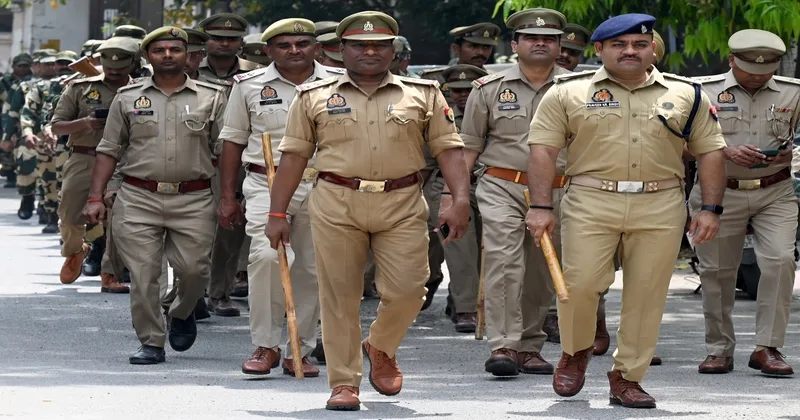
Most Indians are familiar with terms such as SHO, SP, and DGP. However, very few understand how the country’s police system is structured, who reports to whom, how officers are recruited, and what responsibilities each rank carries.
🚨 Ever wondered who controls India’s Police System — from Constable to DGP?
Most people know “SP” and “SHO”…
But very few understand the real chain of command, insignia, powers, area control & recruitment path.Here is the clean hierarchy 👇 (Top to bottom)
🇮🇳 INDIA POLICE… pic.twitter.com/Q3a5gjYYg0
— Sarfarosh 🚩🕉️ (@Sarfarosh_IND) May 31, 2026
India’s policing system follows a well-defined chain of command designed to maintain law and order, investigate crimes, manage public safety, and enforce the law. From the constable patrolling the streets to the Director General of Police overseeing an entire state, every rank has a distinct role in the functioning of the police force.
The Structure of India’s Police System
The police administration generally follows a hierarchical structure:
State → Zone → Range → District → Subdivision/Circle → Police Station → Beat/Outpost
This chain ensures effective command, supervision, accountability, and coordination across different levels of law enforcement.
1. Director General of Police (DGP)
At the top of the state police hierarchy stands the Director General of Police (DGP), the highest-ranking police officer in a state.
Responsibilities
Heads the entire state police force.
Advises the state government on law and order matters.
Oversees crime prevention, intelligence gathering, security arrangements, and police modernisation.
Coordinates with the Chief Minister and Home Department on policing policies and major security issues.
The DGP controls the entire state police force. The position is held by a senior Indian Police Service (IPS) officer who reaches the rank through decades of service and promotions.
2. Additional Director General of Police (ADGP) / Special DGP
ADGPs and Special DGPs assist the DGP in managing specialised branches and statewide operations.
Responsibilities
Head departments such as:
Law and Order
Crime Branch
Intelligence
Traffic
Training
Anti-Terror Operations
Cyber Crime
An ADGP or Special DGP controls the entire state or specialised statewide departments. The rank is held by senior IPS officers who are promoted through the service hierarchy.
3. Inspector General of Police (IGP)
The Inspector General of Police acts as a senior supervisory officer overseeing large geographical zones or specialised units.
Responsibilities
Supervises police ranges and districts.
Ensures implementation of state policing policies.
Reviews crime trends and operational performance.
An IGP controls police zones or major departments and is appointed from among senior IPS officers through promotion.
4. Deputy Inspector General of Police (DIG)
The DIG serves as an intermediate supervisory authority between district police chiefs and higher command.
Responsibilities
Supervises multiple districts within a police range.
Conducts inspections and reviews law-and-order situations.
Coordinates major investigations and operations.
A DIG controls police ranges consisting of several districts and is appointed from among IPS officers promoted through service.
5. Superintendent of Police (SP) / Senior Superintendent of Police (SSP)
The SP is often considered the most visible district-level police leader.
Responsibilities
Maintains law and order across the district.
Supervises crime investigations.
Manages security arrangements for VIP visits and public events.
Oversees police stations within the district.
An SP or SSP controls a district and is often the highest-ranking police officer that citizens are likely to interact with regarding district-level issues. The position is held by IPS officers or officers promoted from the State Police Services.
6. Additional SP (Addl. SP) and Assistant SP (ASP)
These officers assist the SP in managing district policing.
Responsibilities
Supervise subdivisions or specialised district units.
Handle crime, traffic, security, or administration assignments.
Coordinate operations involving multiple police stations.
An Assistant Superintendent of Police (ASP) is directly recruited through the UPSC Civil Services Examination and appointed as an IPS probationer, while an Additional Superintendent of Police (Addl. SP) is usually a promoted officer or a senior district-level officer.
7. Deputy Superintendent of Police (DySP) / Assistant Commissioner of Police (ACP)
The title varies depending on the policing system.
DySP is commonly used in district policing.
ACP is used in commissionerate cities.
Responsibilities
Supervise multiple police stations.
Monitor investigations.
Ensure proper implementation of policing procedures.
A DySP or ACP controls subdivisions or circles and is recruited either through State Public Service Commission examinations or through promotion from lower ranks.
8. Inspector / Station House Officer (SHO)
The SHO is often regarded as the most influential officer at the local level because they command a police station.
Responsibilities
Registration of FIRs.
Investigation supervision.
Crime prevention.
Arrests and enforcement actions.
Public grievance handling.
Local intelligence gathering.
An Inspector or SHO controls a police station jurisdiction and is usually the first senior police officer that ordinary citizens encounter when reporting a crime or seeking police assistance.
9. Sub-Inspector (SI)
The Sub-Inspector forms the backbone of investigative policing.
Responsibilities
Conducts criminal investigations.
Records statements.
Collects evidence.
Executes arrests.
Files charge sheets in court.
A Sub-Inspector oversees investigation units, beats, and outposts and is recruited through direct recruitment conducted by state police recruitment boards.
10. Assistant Sub-Inspector (ASI)
The ASI serves as a supervisory officer between SIs and constabulary ranks.
Responsibilities
Assists investigations.
Maintains records and station documentation.
Supports field operations.
Handles minor inquiries and administrative duties.
An Assistant Sub-Inspector is recruited either through promotion or direct recruitment, depending on the rules and recruitment policies of the respective state police force.
11. Head Constable (Havildar)
The Head Constable acts as the senior-most non-gazetted supervisory rank.
Responsibilities
Leads constables during field operations.
Assists in station administration.
Executes warrants and summons.
Supervises patrol teams.
A Head Constable is typically recruited through promotion from the constable rank based on experience, service record, and departmental criteria.
12. Constable
The constable represents the foundation of India’s policing system.
Responsibilities
Patrolling.
Crowd management.
Traffic regulation.
Guard duty.
Emergency response.
Assisting investigations.
Constables are often the first responders at accident scenes, crime locations, public gatherings, and emergencies. They are recruited through direct recruitment conducted by state police recruitment boards.
How Are IPS Officers Recruited?
The Indian Police Service (IPS) is one of India’s premier All India Services.
Selection Process
UPSC Civil Services Examination.
Preliminary Examination.
Main Examination.
Personality Test (Interview).
Training at the National Police Academy.
IPS officers typically begin their careers as Assistant Superintendents of Police and rise through the ranks to become SPs, DIGs, IGPs, ADGPs, and eventually DGPs.
India’s police force operates through a carefully structured chain of command, where each rank plays a specific role in maintaining public safety and enforcing the law. While the constable serves as the first line of response on the ground, the SHO manages police stations, the SP oversees districts, senior IPS officers supervise larger formations, and the DGP leads the entire state police force.