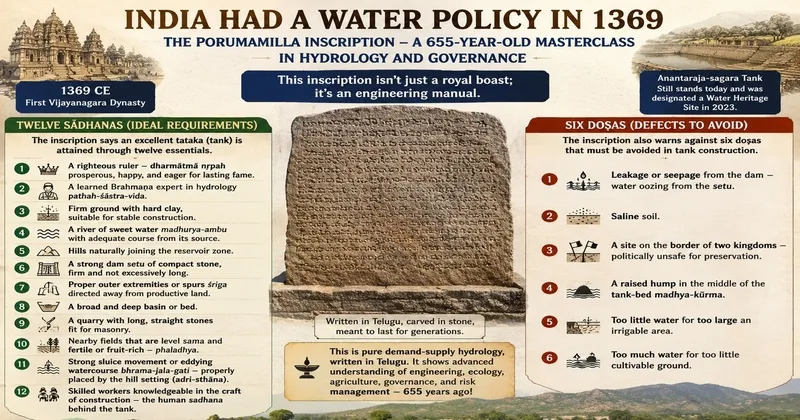
Long before modern governments drafted water policies, environmental regulations, and irrigation manuals, India had already developed a sophisticated framework for water management. Etched in stone in 1369 CE during the First Vijayanagara Dynasty, the Porumamilla Inscription from present-day Andhra Pradesh stands as a remarkable testament to India’s scientific, engineering, and administrative excellence.
India had a water policy in 1369. It was carved in stone.
A look at the Porumamilla Inscription—a 655-year-old masterclass in hydrology and governance from the First Vijayanagara Dynasty@MinOfCultureGoI pic.twitter.com/i8WBomlI5v
— Manuscripts & Inscriptions Digitization Foundation (@midf_org) May 29, 2026
Far more than a royal proclamation, the inscription serves as a detailed guidebook on reservoir construction, hydrology, governance, and sustainable resource management. It lays out clear principles for designing and maintaining water bodies, identifies potential engineering failures, and demonstrates an advanced understanding of supply-demand dynamics centuries before such concepts became formalised in modern water science.
The inscription is associated with the construction of the Anantaraja Sagara tank, a reservoir that continues to exist more than six centuries later. Its longevity is itself proof of the engineering principles described in the inscription.
A Water Management Manual in Stone
The Porumamilla Inscription was commissioned during the reign of the Vijayanagara Empire and records the construction of the Anantaraja Sagara tank. What makes it extraordinary is the level of technical detail it provides.
The inscription outlines twelve “sādhanas” or essential requirements necessary for the successful creation of a water reservoir and six “doṣas” or defects that must be avoided.
These principles reveal a comprehensive understanding of geography, hydrology, geology, engineering, agriculture, administration, and political stability.
Rather than treating water storage as a simple construction project, the inscription presents it as a multidisciplinary undertaking requiring scientific expertise, skilled labour, suitable terrain, and long-term governance.
The Twelve Sadhanas: Foundations of a Successful Reservoir
The inscription states that an ideal tank can only be achieved when twelve essential conditions are fulfilled.
A Righteous and Visionary Ruler
The first requirement is a dharmic ruler who is prosperous, responsible, and committed to public welfare. The inscription recognises that large-scale infrastructure projects require political will, financial resources, and a long-term vision. Water management was viewed not merely as an engineering activity but as a responsibility of governance.
An Expert in Hydrology
The text specifically calls for a learned Brahmana knowledgeable in “pathah-shastra,” the science of water and hydrology. This highlights the existence of specialised expertise in water sciences and demonstrates that ancient India recognised the importance of technical consultation in public works.
Stable Ground Conditions
The chosen site must possess firm and compact soil, particularly hard clay, capable of supporting massive hydraulic structures. Modern dam engineers continue to prioritise geological stability when selecting construction sites.
A Reliable Source of Sweet Water
The inscription emphasises the importance of a river carrying fresh, non-saline water with a dependable flow from its source. This requirement reflects an understanding of water quality and watershed management.
Natural Hills Supporting the Reservoir
The surrounding topography should include hills that naturally converge around the proposed reservoir area. Using existing geographical features minimises construction costs and enhances structural stability.
A Strong Stone Dam
The dam should be built from compact stone and designed to remain sturdy without being excessively long. The recommendation demonstrates an awareness of structural efficiency and material durability.
Properly Designed Extremities
The outer extensions or spurs of the reservoir should be positioned in a way that does not interfere with productive agricultural land. This reveals careful consideration of land-use planning and agricultural economics.
A Broad and Deep Basin
The tank bed should be sufficiently deep and wide to maximise storage capacity. This principle remains fundamental in modern reservoir design.
Access to Quality Building Stone
A nearby quarry containing long and durable stones suitable for masonry is considered essential. Availability of construction material was recognised as a critical factor in project sustainability.
Fertile Agricultural Land Nearby
The reservoir should serve surrounding fields that are level and agriculturally productive. The objective of irrigation infrastructure was clear: to enhance food production and economic prosperity.
Proper Water Movement and Sluice Design
The inscription refers to water flow, sluices, and eddying movement being properly integrated into the reservoir’s natural setting. This demonstrates a sophisticated understanding of hydraulic behaviour and water regulation.
Skilled Workers and Builders
No infrastructure project can succeed without trained personnel. The inscription explicitly acknowledges the importance of experienced builders and craftsmen, recognising human expertise as a critical component of engineering success.
The Six Doṣas: Avoiding Failure Before It Happens
Equally impressive is the inscription’s identification of six major defects that can undermine a reservoir project. These warnings reveal an advanced approach to risk management and preventive engineering.
Leakage and Seepage
The first danger is water escaping through the dam structure. Modern dam safety programs continue to treat seepage as one of the most serious threats to reservoir integrity.
Saline Soil
The inscription warns against constructing reservoirs on saline ground. Salt-contaminated soil can reduce agricultural productivity and compromise water quality.
Border Locations
One of the most fascinating observations is the recommendation against building reservoirs on the border between kingdoms. The reason is practical: political instability, conflict, or disputes could jeopardise maintenance and long-term preservation. This shows that the builders understood infrastructure as not merely an engineering issue but also a geopolitical one.
Uneven Tank Beds
The inscription advises against a raised hump or mound in the centre of the reservoir basin. Such irregularities reduce storage efficiency and affect water distribution.
Too Little Water for Too Much Land
A reservoir should not attempt to irrigate an area larger than its water supply can sustain. This is essentially a medieval expression of demand exceeding supply.
Too Much Water for Too Little Land
Conversely, a reservoir should not store far more water than the available agricultural land can utilise. Unused water represents wasted resources and inefficient planning. Together, these final two warnings reveal a sophisticated understanding of resource optimisation and water budgeting.
The Porumamilla Inscription of 1369 is far more than a historical artefact. It is a 655-year-old policy document, engineering handbook, and governance manual carved into stone. Through its twelve sādhanas and six doṣas, it presents a comprehensive framework for sustainable water management that remains relevant even today. At a time when water scarcity, groundwater depletion, and climate challenges dominate public policy discussions, this inscription serves as a reminder that India’s civilizational heritage contains valuable lessons in environmental stewardship. The enduring success of Anantaraja Sagara proves that when science, governance, and sustainability work together, infrastructure can survive not merely decades but centuries.