Dr Ambedka saved India from becoming a communist state
September 20, 2026
  • Read Ecopy
  • Circulation
  • Advertise
  • Careers
  • About Us
  • Contact Us
Android AppiPhone AppArattai
Organiser
  • ‌
  • Bharat
    • Assam
    • Bihar
    • Chhattisgarh
    • Jharkhand
    • Maharashtra
    • View All States
  • World
    • Asia
    • Europe
    • North America
    • South America
    • Africa
    • Australia
  • Editorial
  • International
  • Opinion
  • RSS @ 100
  • More
    • World Hindu Congress 2026
    • Op Sindoor
    • Analysis
    • Sports
    • Defence
    • Politics
    • Business
    • Economy
    • Culture
    • Special Report
    • Sci & Tech
    • Entertainment
    • G20
    • Azadi Ka Amrit Mahotsav
    • Vocal4Local
    • Web Stories
    • Education
    • Employment
    • Books
    • Interviews
    • Travel
    • Law
    • Health
    • Obituary
  • Subscribe
    • Subscribe Print Edition
    • Subscribe Ecopy
    • Read Ecopy
  • ‌
  • Bharat
    • Assam
    • Bihar
    • Chhattisgarh
    • Jharkhand
    • Maharashtra
    • View All States
  • World
    • Asia
    • Europe
    • North America
    • South America
    • Africa
    • Australia
  • Editorial
  • International
  • Opinion
  • RSS @ 100
  • More
    • World Hindu Congress 2026
    • Op Sindoor
    • Analysis
    • Sports
    • Defence
    • Politics
    • Business
    • Economy
    • Culture
    • Special Report
    • Sci & Tech
    • Entertainment
    • G20
    • Azadi Ka Amrit Mahotsav
    • Vocal4Local
    • Web Stories
    • Education
    • Employment
    • Books
    • Interviews
    • Travel
    • Law
    • Health
    • Obituary
  • Subscribe
    • Subscribe Print Edition
    • Subscribe Ecopy
    • Read Ecopy
Organiser
  • Home
  • Bharat
  • World
  • Operation Sindoor
  • Editorial
  • Analysis
  • Opinion
  • Culture
  • Defence
  • International Edition
  • RSS @ 100
  • Magazine
  • Read Ecopy
Home Bharat

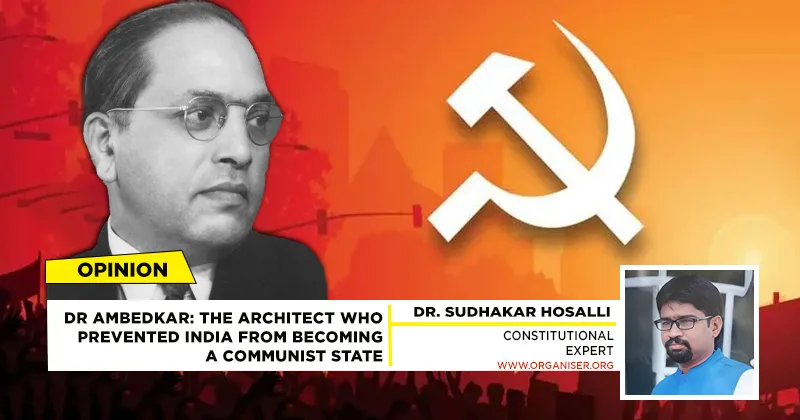
Dr Ambedkar: The architect who prevented India from becoming a communist state

Dr B R Ambedkar’s leadership in preventing the nation's shift towards a communist framework stands as a testament to his foresight. His unwavering commitment ensured the Constitution was a blend of India’s cultural heritage and modern governance

Dr Sudhakar HosalliDr Sudhakar Hosalli
Apr 14, 2026, 01:20 pm IST
inBharat, Opinion
Follow on Google News
Facebook
Twitter
WhatsAppTelegramEmail

As India celebrates 76 years of its Constitution coming into effect on January 26, it is an opportune moment to reflect on its ideals, efficacy, and brilliance. This anniversary calls upon every conscientious Indian to strengthen the foundational principles of the Constitution and ensure its enduring relevance.

Seventy-six years ago, India was primarily recognised through its rich heritage, culture, traditions, and historical records. However, the creation of a constitutional India began alongside the framing of the Constitution. This sacred mission aimed to establish a legal framework for a newly independent nation, requiring the drafting of a comprehensive document outlining the laws that would govern it. Members of the Constituent Assembly faced the colossal task of balancing India’s ancient cultural heritage with the progressive ideals of modern governance.

Certain members, including K V Kamath, Shyama Prasad Mukherjee, Govind Das, Ghanashyam Gupta, Kalluru Subbarao and Ram Sahay, emphasised that the Constitution should align with India’s historical ethos and cultural values. They frequently cited texts like the Vedas, Puranas, Ramayana and Mahabharata to underline their vision. In contrast, some members, including representatives of the Muslim League and sections of the Congress, leaned towards preserving colonial structures or disregarding India’s cultural roots. This divergence of ideologies is evident in the recorded debates of the Constituent Assembly.

Also Read: Corporate Jihad in Nashik at TCS: Another way for Jihadists to hurt Constitution, Hindus and humanity

Dr BR Ambedkar stood as a towering figure against efforts to dilute India’s identity or subjugate it to external influences. Addressing concerns in the Assembly, he firmly stated, “This Constituent Assembly, even before it commenced its work, rejected all directives from the British Parliament. None of the members here, including myself, would accept or allow British directives to become part of this Constitution.” His resolute stance shielded the Constitution from being infiltrated by colonial remnants or ideologies that sought to undermine India’s cultural and political sovereignty.

Despite Ambedkar’s firm leadership, there were attempts to steer India towards a communist framework. A glaring example was the amendment proposed on September 18, 1949, by Asaf Ali and supported by Ashraf Mohani, who had previously been associated with the Congress and later joined the Muslim League. The amendment sought to declare India a “Union of Socialist Republics,” reminiscent of the Soviet model. Mohani questioned why Ambedkar had structured India as a “Union of States” rather than a “Federation of Republics.” He argued that India should embrace socialism and called for changes to align with this vision.

Ambedkar’s response was categorical. He rejected the proposed amendment, emphasizing that it was against the nation’s foundational ethos. He argued that the Constitution’s directive principles already incorporated the essence of socialism without succumbing to extremism. He cautioned that binding future generations to rigid ideologies like socialism through constitutional mandates would stifle progress and freedom of thought.

The debates also revealed significant pressure from members like Mohani, Naziruddin Ahmad, Imam Hussain, and T. T. Krishnamachari, who advocated for radical socialism and secularism to be enshrined in the Constitution. Despite their persistence, Ambedkar held firm, declaring, “I will not allow ideas that are alien to our native culture and traditions, such as extreme socialism, to infiltrate this Constitution.”

A notable example of Ambedkar’s commitment to safeguarding India’s unity was his staunch opposition to Article 370, which granted special status to Jammu & Kashmir. Despite vehement opposition, the provision was included, creating decades of disparity and division in the nation. Ambedkar foresaw the challenges such provisions would bring and resisted them to the best of his ability.

The Constituent Assembly debates make it evident that India’s transformation into a communist state was averted due to Ambedkar’s unwavering resolve and vision. Had he not chaired the Drafting Committee with such determination, India might have drifted towards a political model that disregarded its cultural heritage and diversity. His efforts ensured that the Constitution remained a document rooted in the nation’s traditions while embracing progressive ideals.

As we celebrate 75 years of the Indian Constitution, it is imperative to acknowledge and honour the legacy of Dr B R Ambedkar. His love for the nation, coupled with his commitment to justice and equality, serves as an inspiration for every Indian. The youth of India must imbibe his patriotism and dedication, ensuring that the nation remains true to its roots while progressing towards a brighter future.


Topics: AmbedkarIndian historyDr B R AmbedkarConstituent AssemblyIndian Constitution75 years of constitution
Share
Tweet
SendShareSend
✮ Subscribe Organiser YouTube Channel. ✮
✮ Join Organiser's WhatsApp channel for Nationalist views beyond the news. ✮
Previous News

US President Donald Trump’s ‘Christ Image’ triggers outrage, cracks emerge in loyal support base

Next News

Nashik TCS Case: Islamist told Hindu woman, “Your husband is not here; If you have physical needs, will fulfil them”

Related News

The debate over the UCC has again brought questions of religious freedom, personal law, and the rights of Muslim women into focus

UCC Debate: Does Owaisi’s defence of Sharia address the rights, dignity and consent of Muslim women?

A representative image

‘Shariya Court’ cannot act as parallel court under Indian law: Chhattisgarh HC rejects triple talaq declaration

Atul Limaye, Sah Sarkaryavah, RSS, while addressing at an Akhil Bharatiya Vidyarthi Parishad (ABVP), the student wing of the RSS, event held in Chhatrapati Sambhajinagar in Maharashtra, on August 2

Independence Day 2026: Youth and Nation – The Anarchic alternative

Bharat’s journey from ancient prosperity to colonial exploitation was marked by political upheaval, social disruption and economic decline (This image is generated by AI)

Bharat’s Historical Journey: Ancient prosperity, colonial exploitation and social disruption

Decolonising Bharat: From the mass movements that won Independence to the challenge of breaking colonial legacies

The debate over ‘Vanvasi’ has sparked political controversy, raising questions over tribal identity and constitutional rights (This image is generated by AI)

Why is there so much objection to the term ‘Vanvasi’? Read the Constitution, then raise your questions!

Load More

Latest News

BMS launches National Organisation for Digital Employees (NODE) for IT workforce; aims to strengthen employee welfare

GalaxEye’s US patent for OptoSAR marks a major boost for India’s private space sector, advancing its global Earth-observation ambitions

GalaxEye secures US patent for OptoSAR technology, boosting India’s private space and deep-tech ambitions

The arrested Bangladeshi national

Keralam: Series of Bangladeshi arrests raises questions over alleged support ecosystem of fake IDs, jobs and shelter

The Indian Army has launched AASHVAST to detect hidden software and electronic vulnerabilities in military drones

Indian Army strengthens drone security with AASHVAST lab to detect software vulnerabilities & Chinese components

Nileema Mishra’s grassroots work empowered women and helped transform more than 200 villages across Maharashtra

Nileema Mishra: The woman who transformed more than 200 villages across rural Maharashtra

Shree Stambheshwar Mahadev Mandir in Gujarat

Shiva Mandir that disappears into the sea and returns with the tide: The fascinating story of Stambheshwar Mahadev

Vishwa Hindu Parishad (VHP) spokesperson Surendra Jain (file photo0

VHP condemns Hamid Ansari over remarks citing Nehru on Hindu right-wing communalism

Ganesh murti visarjan incidents raise concerns over radical Islamic intolerance and law and order in Tamil Nadu

ABVP registers 3-0 win in Delhi University Students’ Union elections; wins president, secretary, joint secretary posts

Ganapati murti visarjan procession at T. Narasipura on September 18

Karnataka: Ganapati procession follows approved mosque route in T Narasipura amid allegations of police high-handedness

Load More
  • Privacy
  • Terms
  • Cookie Policy
  • Refund and Cancellation
  • Delivery and Shipping

© Bharat Prakashan (Delhi) Limited.
Tech-enabled by Ananthapuri Technologies

  • Home
  • Search Organiser
  • Bharat
    • Assam
    • Bihar
    • Chhattisgarh
    • Jharkhand
    • Maharashtra
    • View All States
  • World
    • Asia
    • Africa
    • North America
    • South America
    • Europe
    • Australia
  • Editorial
  • Operation Sindoor
  • Opinion
  • Analysis
  • Defence
  • Culture
  • Sports
  • Business
  • RSS @ 100
  • Entertainment
  • More ..
    • Sci & Tech
    • Vocal4Local
    • Special Report
    • Education
    • Employment
    • Books
    • Interviews
    • Travel
    • Health
    • Politics
    • Law
    • Economy
    • Obituary
  • Subscribe Magazine
  • Read Ecopy
  • Advertise
  • Circulation
  • Careers
  • About Us
  • Contact Us
  • Policies & Terms
    • Privacy Policy
    • Cookie Policy
    • Refund and Cancellation
    • Terms of Use

© Bharat Prakashan (Delhi) Limited.
Tech-enabled by Ananthapuri Technologies