
Kolkata: West Bengal has played a defining role in shaping India’s modern identity through its contributions to education, reform movements, science, politics, literature, and urban development. With its cultural and intellectual centre in Kolkata, the region emerged during the colonial period as one of the earliest gateways to Western education, print culture, and modern governance systems in India.
WEST BENGAL👏
Bengalis > is a 4000 years old civilization. The world's 3rd ethnic community right after the Arabs & Chinese Huns. The community & state that holds the maximum "number ONE position"
India's first metropolitan city – KOLKATA
India's first WI-FI city – KOLKATA… pic.twitter.com/qDKK1eD4jI
— महावीर, ಮಹಾವೀರ, Mahavir (@Mahaveer_VJ) May 10, 2026
Historical Centre of Modern India
During British colonial rule, Kolkata served as the capital of India until 1911, making it the administrative, economic, and intellectual nucleus of the country for over a century. This early prominence allowed the city to become a centre for governance, education, journalism, and commerce, influencing the development of modern Indian institutions.
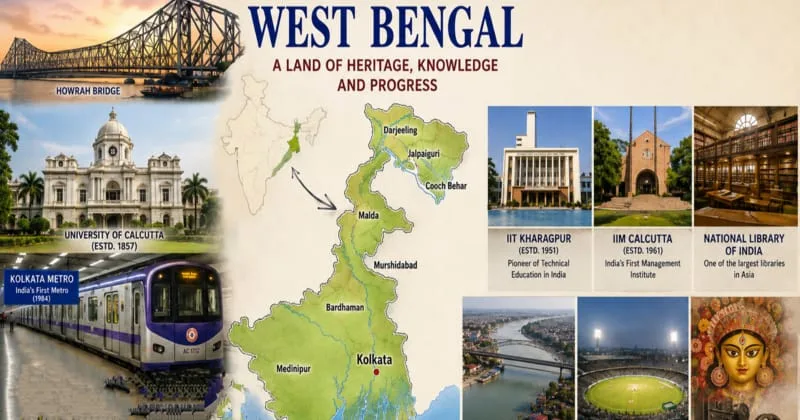
One of the most significant institutions established during this period is the University of Calcutta, founded in 1857, which became one of the earliest modern universities in India. Similarly, Presidency University Kolkata, established in 1817, played a crucial role in introducing Western-style higher education and producing some of India’s most influential intellectuals.
Education and Scientific Development
Bengal has made notable contributions to India’s higher education and scientific advancement. The establishment of the Indian Institute of Technology Kharagpur in 1951 marked the beginning of India’s IIT system, which later became the backbone of the country’s technical education network. This institution remains one of India’s most prestigious engineering institutes.
Similarly, the Indian Institute of Management Calcutta, established in 1961, was the first management institute in India and played a foundational role in developing business education in the country. The National Library of India in Kolkata further strengthens Bengal’s academic legacy, housing one of the largest collections of books and manuscripts in India. These institutions highlight Bengal’s early leadership in structured education and intellectual development.
Journalism, Print Culture and Literary Growth
Bengal was the birthplace of modern journalism in India. The first newspaper in the country, Hicky’s Bengal Gazette, was published in 1780 in Kolkata. This marked the beginning of print journalism in India and played a major role in shaping public discourse during the colonial period.
The region also became a major centre for publishing, literary production, and intellectual debate. Bengali literature flourished during the 19th and 20th centuries, producing writers, poets, and thinkers who shaped not only regional identity but also contributed to the broader evolution of Indian literary traditions.
Social Reform and Political Awakening
Bengal played a central role in India’s social reform and independence movements. Reformers such as Raja Rammohan Roy and Ishwar Chandra Vidyasagar led campaigns against regressive practices such as sati and worked to promote women’s education and widow remarriage. Their efforts laid the foundation for progressive social change in India.
In the political sphere, Bengal produced several key figures in the freedom struggle. Subhas Chandra Bose emerged as one of the most prominent revolutionary leaders, forming the Indian National Army to challenge British rule. Similarly, Swami Vivekananda became an influential global spiritual leader who introduced Indian philosophy to the Western world, strengthening India’s cultural identity internationally.
Cultural Excellence and Global Recognition
Bengal’s cultural contributions have received global recognition across literature, cinema, and art. Rabindranath Tagore became the first Asian to win the Nobel Prize in Literature in 1913, elevating Indian literature to global prominence. His works continue to shape Indian cultural and literary identity.
In cinema, Satyajit Ray brought Indian filmmaking to global acclaim and received an Honorary Academy Award for lifetime achievement. The Bengal School of Art also played a significant role in reshaping modern Indian visual aesthetics by moving away from colonial artistic influences.
Contributions to Sports and Exploration
Bengal and the broader eastern Himalayan region have also contributed significantly to sports and exploration. Tenzing Norgay, associated with the Darjeeling region, was among the first two climbers to successfully summit Mount Everest in 1953, marking a historic moment in global exploration. In sports, Mihir Sen became the first Indian to swim across the English Channel in 1958, followed by Arati Saha, who became the first Asian woman to achieve the same feat in 1959. These achievements demonstrate Bengal’s early presence in international sporting milestones.
Infrastructure and Modern Urban Development
Modern Kolkata continues to be a significant urban and infrastructural centre in India. The Kolkata Metro, inaugurated in 1984, was the first metro rail system in India and remains a vital part of the city’s public transport network.
Landmarks such as Eden Gardens and Salt Lake Stadium have contributed to India’s sporting identity by hosting major cricket and football events. The Indian Museum in Kolkata, one of the oldest museums in Asia, preserves a vast collection of historical artefacts that document India’s ancient and colonial heritage. Together, these institutions reflect Kolkata’s continued importance as a cultural and infrastructural hub.
Bengal’s historical importance lies not in exaggerated claims, but in its authentic and foundational contributions to modern India. From pioneering education systems and print journalism to producing global cultural icons like Rabindranath Tagore and Satyajit Ray, Bengal has played a central role in shaping India’s intellectual and cultural identity.
Its institutions, reform movements, and artistic traditions continue to influence India’s development trajectory. Rather than being defined by overstated “firsts,” Bengal’s true legacy is its enduring impact as a centre of learning, reform, creativity, and modern thought in India.