Ancient dice that rekindled a historical debate
June 6, 2026
  • Read Ecopy
  • Circulation
  • Advertise
  • Careers
  • About Us
  • Contact Us
Android AppiPhone AppArattai
Organiser
  • ‌
  • Bharat
    • Assam
    • Bihar
    • Chhattisgarh
    • Jharkhand
    • Maharashtra
    • View All States
  • World
    • Asia
    • Europe
    • North America
    • South America
    • Africa
    • Australia
  • Editorial
  • International
  • Opinion
  • RSS @ 100
  • More
    • Op Sindoor
    • Analysis
    • Sports
    • Defence
    • Politics
    • Business
    • Economy
    • Culture
    • Special Report
    • Sci & Tech
    • Entertainment
    • G20
    • Azadi Ka Amrit Mahotsav
    • Vocal4Local
    • Web Stories
    • Education
    • Employment
    • Books
    • Interviews
    • Travel
    • Law
    • Health
    • Obituary
  • Subscribe
    • Subscribe Print Edition
    • Subscribe Ecopy
    • Read Ecopy
  • ‌
  • Bharat
    • Assam
    • Bihar
    • Chhattisgarh
    • Jharkhand
    • Maharashtra
    • View All States
  • World
    • Asia
    • Europe
    • North America
    • South America
    • Africa
    • Australia
  • Editorial
  • International
  • Opinion
  • RSS @ 100
  • More
    • Op Sindoor
    • Analysis
    • Sports
    • Defence
    • Politics
    • Business
    • Economy
    • Culture
    • Special Report
    • Sci & Tech
    • Entertainment
    • G20
    • Azadi Ka Amrit Mahotsav
    • Vocal4Local
    • Web Stories
    • Education
    • Employment
    • Books
    • Interviews
    • Travel
    • Law
    • Health
    • Obituary
  • Subscribe
    • Subscribe Print Edition
    • Subscribe Ecopy
    • Read Ecopy
Organiser
  • Home
  • Bharat
  • World
  • Operation Sindoor
  • Editorial
  • Analysis
  • Opinion
  • Culture
  • Defence
  • International Edition
  • RSS @ 100
  • Magazine
  • Read Ecopy
Home Bharat

How a 4,500-year-old terracotta dice is reviving the debate on India’s civilisational continuity & Vedic heritage

A 4,500-year-old terracotta dice from the Indus-Saraswati Civilisation has reignited discussions on India's ancient cultural continuity and the links between the Harappan and Vedic worlds

WEBDESKWEBDESK
Jun 6, 2026, 03:00 pm IST
in Bharat, Culture
Follow on Google News
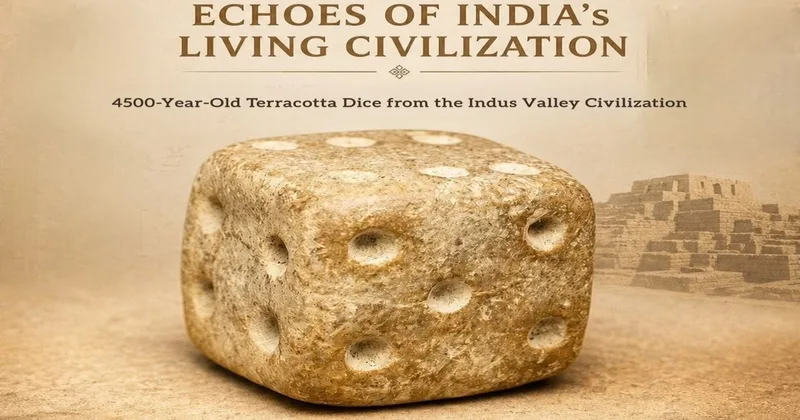
The terracotta dice that challenges historical assumptions and highlights India's millennia-old civilisational heritage

The terracotta dice that challenges historical assumptions and highlights India's millennia-old civilisational heritage

FacebookTwitterWhatsAppTelegramEmail

A 4,500-year-old terracotta dice from the ancient Indus-Saraswati Civilisation has once again brought attention to one of the most significant debates in Indian history, the relationship between the Indus Civilisation and the Vedic tradition. Highlighted recently by India’s Ministry of Culture, the artefact serves as a reminder that many cultural practices described in ancient Indian texts may have deeper roots than previously assumed.

Culture Ministry is playing on front foot now, this post will also fire the ass of leftist and Pakistani puppets😂

1. Simple Explanation: Why This Discovery Matters

For decades, colonial historians and leftist academics pushed the Aryan Invasion Theory (AIT), the idea that:
-… https://t.co/WzN7rdaqI4

— STAR Boy TARUN (@Starboy2079) May 31, 2026

The terracotta dice, dating back roughly 4,500 years, are among numerous gaming objects recovered from archaeological sites associated with the Indus Civilisation. Dice and gaming boards have been found at major urban centres such as Harappa, Mohenjo-daro, Lothal, Dholavira, and several other settlements spread across northwestern India and present-day Pakistan. What makes the artefact particularly intriguing is that dicing and gambling are also mentioned in ancient Vedic literature, including the Rigveda and Atharvaveda.

The Aryan Invasion Theory: A Historical Background

For much of the nineteenth and twentieth centuries, many Western scholars promoted what became known as the Aryan Invasion Theory (AIT). According to this interpretation, Indo-Aryan-speaking groups entered the Indian subcontinent around 1500 BCE, bringing Vedic culture with them after the decline of the Indus Civilisation.

Over time, this theory influenced colonial understandings of Indian history and was often presented as a sharp divide between the urban Indus Civilisation and later Vedic society.

However, modern scholarship has significantly revised these earlier models. Most contemporary historians and archaeologists no longer support the notion of a large-scale violent invasion. Instead, many researchers discuss more complex scenarios involving migrations, cultural interactions, and gradual transformations over long periods. Importantly, archaeological evidence has not revealed signs of widespread destruction or warfare across Indus cities that would indicate a sudden civilizational overthrow.

Evidence for Cultural Continuity

Over the past several decades, numerous discoveries have encouraged scholars to explore the possibility of continuity between the Indus Civilisation and later Indian traditions.

These include:

Ritual Practices
Archaeologists have identified fire altars at several sites, including Kalibangan and Lothal, which some researchers believe resemble later Vedic ritual traditions.

Symbolism
Certain motifs found on seals and artefacts continue to attract attention. Some scholars have pointed to similarities between ancient symbols and those that remain significant in Indian religious and cultural life.

Water-Centred Sacred Spaces
The importance of ritual bathing, water reservoirs, and sacred water structures appears repeatedly in both archaeological remains and later Indian traditions.

Yoga-Like Imagery
A famous seal depicting a seated figure in a meditative posture has often been cited as evidence of early yogic practices, although interpretations remain debated.

Traditional Games
The discovery of dice, gaming boards, and other recreational objects reflects practices that continued to exist in later Indian society and are mentioned in ancient Sanskrit texts.

Together, these findings suggest that many cultural elements may have evolved over time rather than emerging suddenly from external influences.

Also Read: TCS Corporate Jihad Case: Imtiaz Jaleel met Nida Khan’s family while she was absconding, says 1,500-page chargesheet

The term “Indus Valley Civilisation” was coined because the earliest major excavations took place near the Indus River. However, archaeological surveys conducted over the past several decades have identified hundreds of sites along the Ghaggar-Hakra river system, which some scholars associate with the Saraswati River mentioned in the Rigveda.

India as a Living Civilisation

Unlike many ancient civilisations that survive primarily through ruins and historical records, India’s cultural heritage remains visible in living traditions, rituals, festivals, languages, symbols, and social practices. The significance of artefacts such as the terracotta dice lies not merely in their age but in the questions they raise about how civilisations endure. They encourage a deeper examination of the links between archaeological discoveries and cultural practices that continue to shape everyday life.

While historical debates about the origins of Vedic culture, migration patterns, and linguistic development remain subjects of ongoing research, discoveries from the Indus-Saraswati Civilisation increasingly point toward a complex story of continuity, adaptation, and resilience.

The 4,500-year-old terracotta dice serve as more than an archaeological curiosity. It symbolises a broader conversation about India’s past, the interpretation of ancient history, and the enduring nature of one of the world’s oldest civilizational traditions.

As new discoveries continue to emerge, the picture that unfolds is increasingly nuanced—one that moves beyond simplistic invasion narratives and highlights the possibility of deep cultural continuity across millennia. Whether viewed through archaeology, literature, ritual practice, or collective memory, the story of the Indus-Saraswati Civilisation remains central to understanding the origins and evolution of Indian civilisation.

 

Topics: Harappan civilisationIndian historyIndus Valley Civilisationarchaeologyancient indiaSaraswati RiverVedic HeritageIndus-Saraswati Civilisation
ShareTweetSendShareSend
✮ Subscribe Organiser YouTube Channel. ✮
✮ Join Organiser's WhatsApp channel for Nationalist views beyond the news. ✮
Previous News

India’s 655-Year-Old Water Policy: The Porumamilla inscription that turned stone into a manual of hydrology

Next News

From Constable to DGP: Understanding India’s police hierarchy, powers & recruitment system

Related News

The Porumamilla inscription and the ancient science behind a reservoir that survived 650 years

India’s 655-Year-Old Water Policy: The Porumamilla inscription that turned stone into a manual of hydrology

The Pashupati Seal of the indus valley civilisation and the continuity of India’s shaivite spiritual traditions

Pashupati Seal of Mohenjo-daro: The 4,300-year-old symbol of India’s unbroken spiritual & civilisational continuity

Renaming of streets in Lahore

Restoring Lahore’s old names won’t hide Pakistan’s minority persecution

West Bengal has played a foundational role in shaping modern India’s intellectual, cultural, and political identity, with Kolkata emerging as one of the earliest centres of education and reform

Bengal’s Enduring Legacy: How Kolkata became the birthplace of modern India’s education, reform & cultural renaissance

Union Home Minister Amit Shah and other leaders paid tributes to revolutionary Sukhdev Thapar on his birth anniversary

Sukhdev Thapar Birth Anniversary: Amit Shah and other leaders pay tribute to fearless revolutionary hero

Dr Ambedkar: The architect who prevented India from becoming a communist state

Load More

Latest News

Police in AAP-Ruled state of Punjab lathi charge sit-in protesters

Punjab: ITI candidates seeking jobs lathi-charged outside PSPCL HQ; opposition slams AAP Govt over police action

From constables to DGP, India's police system follows a structured chain of command that governs law enforcement across the country

From Constable to DGP: Understanding India’s police hierarchy, powers & recruitment system

The terracotta dice that challenges historical assumptions and highlights India's millennia-old civilisational heritage

How a 4,500-year-old terracotta dice is reviving the debate on India’s civilisational continuity & Vedic heritage

The Porumamilla inscription and the ancient science behind a reservoir that survived 650 years

India’s 655-Year-Old Water Policy: The Porumamilla inscription that turned stone into a manual of hydrology

India’s Permanent Representative to the United Nations Ambassador Harish Parvathaneni

India slams Pakistan at UNSC for peddling false narratives on Jammu & Kashmir

Keralam: Pathanamthitta temple property occupied beyond lease period reclaimed by devotees

A series of high-level engagements signals New Delhi's growing focus on building interoperable security networks across the Indo-Pacific

India strengthens Indo-Pacific security architecture with new defence and maritime partnerships

Prime Minister Narendra Modi

“Makes every Indian proud”: PM Modi hails India’s 7.7 per cent GDP growth in FY 2025-26

Once known for maoist violence, Minpa now leads healthcare revolution with telemedicine services in Sukma

From Maoist Stronghold to Healthcare Hub: How Chhattisgarh’s Minpa is transforming through telemedicine & development

Dr Surendra Jain, Joint General secretary, VHP

VHP Demands Audit of Waqf Properties Amid Encroachment Claims: “Land should go to rightful owner,” says Surendra Jain

Load More
  • Privacy
  • Terms
  • Cookie Policy
  • Refund and Cancellation
  • Delivery and Shipping

© Bharat Prakashan (Delhi) Limited.
Tech-enabled by Ananthapuri Technologies

  • Home
  • Search Organiser
  • Bharat
    • Assam
    • Bihar
    • Chhattisgarh
    • Jharkhand
    • Maharashtra
    • View All States
  • World
    • Asia
    • Africa
    • North America
    • South America
    • Europe
    • Australia
  • Editorial
  • Operation Sindoor
  • Opinion
  • Analysis
  • Defence
  • Culture
  • Sports
  • Business
  • RSS @ 100
  • Entertainment
  • More ..
    • Sci & Tech
    • Vocal4Local
    • Special Report
    • Education
    • Employment
    • Books
    • Interviews
    • Travel
    • Health
    • Politics
    • Law
    • Economy
    • Obituary
  • Subscribe Magazine
  • Read Ecopy
  • Advertise
  • Circulation
  • Careers
  • About Us
  • Contact Us
  • Policies & Terms
    • Privacy Policy
    • Cookie Policy
    • Refund and Cancellation
    • Terms of Use

© Bharat Prakashan (Delhi) Limited.
Tech-enabled by Ananthapuri Technologies