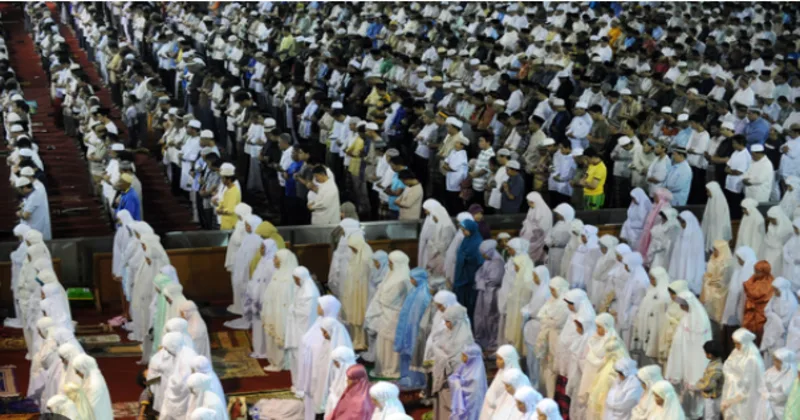
A key moment in the ongoing hearings linked to the Sabarimala case came when Justice Ahsanuddin Amanullah observed that there has historically been no dispute over Muslim women entering mosques, tracing the practice back to the time of the Prophet.
The observation came during submissions by senior advocate MR Shamshad, appearing for the All-India Muslim Personal Law Board (AIPLMB) before a nine-judge bench of the Supreme Court of India.
Agreeing with the court’s remark, Shamshad stated that Islamic sources clearly record that women should not be stopped from entering mosques. He reiterated that there is consensus across Islamic denominations permitting women to enter mosques and offer namaz.
At the same time, he argued that certain disciplinary norms apply, including that women cannot insist on entering through a particular door or seek removal of physical barriers separating men and women inside mosques.
The bench, led by Chief Justice Surya Kant, sought clarifications on multiple aspects, including participation in congregational prayers. Shamshad responded that while women do take part in congregational namaz when they attend mosques, such participation is not mandatory for them, unlike for men. He added that praying at home is considered equally rewarding.
During the exchange, Justice Amanullah also noted that historical practices reflected social considerations, including the need for someone to remain at home to care for children.
Shamshad further submitted that a mosque does not have a “sanctum sanctorum”, and therefore no individual can claim a right to a specific position or role, including leading prayers.
A significant portion of the arguments focused on the Essential Religious Practices (ERP) test, which the AIMPLB argued has been wrongly applied to Islam. Shamshad said Islamic practices are clearly categorised as mandatory, recommended, or forbidden, but courts have often relied on incomplete or inaccurate interpretations.
Referring to past rulings, he argued that courts have held that a mosque is not essential to Islam because namaz can be offered anywhere. “Masjid is the core of the belief of Muslims. All practices are ultimately relatable to mosque. But then we face a judgment saying masjid is not essential. Then what will we do with Article 25?” he submitted.
Justice BV Nagarathna responded that such a view would be akin to questioning the essentiality of a temple. Shamshad agreed, stating that this was precisely his concern.
The bench also briefly touched upon religious expression in other contexts. When Shamshad referred to a case involving a Muslim man dismissed from the Army for keeping a beard, the Chief Justice said the Court would not enter that debate, noting that a beard is expressly mandated in Sikhism as one of its core principles.
Shamshad also highlighted how facially neutral regulations may have differential impacts, citing rules of the Archaeological Survey of India that restrict access to protected monuments from sunrise to sunset. He argued that such rules, when applied to mosques under ASI control, could effectively prevent certain daily prayers.
Before concluding, he pointed to a contradiction before the court: “Here is a petition which says for a Muslim woman, mosque is essential. And I have a judgment which says mosque is not essential.”
The matter is being heard by a Constitution Bench comprising Chief Justice Surya Kant and Justices BV Nagarathna, MM Sundresh, Ahsanuddin Amanullah, Aravind Kumar, Augustine George Masih, Prasanna B Varale and Joymalya Bagchi.
A defining constitutional debate has been taking shape. The courtroom battle seemed to be moving past legal arguments into a deeper clash of faith and constitutional authority.
During the Sabarimala hearings, J Sai Deepak strongly challenged the scope of judicial review, asserting that courts should not evaluate essential religious practices merely because the State is involved.
Opposing this stance, the Bench led by Surya Kant replied that judicial review remains a fundamental feature of the Constitution.
Before concluding his arguments, Shamshad submitted, "Here is a petition, which says for a Muslim women, mosque is essential. And I have a judgment, which says mosque is not essential."https://t.co/Iuif8lWhP0 https://t.co/A35PABkPNq
— Asaduddin Owaisi (@asadowaisi) April 24, 2026
Separately, Asaduddin Owaisi, the AIMIM party chief and Lok Sabha MP, reacted to the proceedings on social media, echoing concerns around the interpretation of essential religious practices and the status of mosques within constitutional protections.