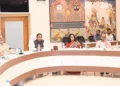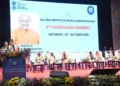

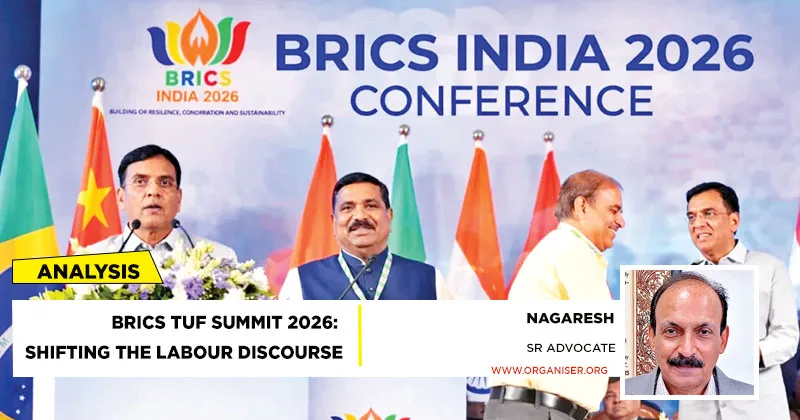
When Bharatiya Mazdoor Sangh (BMS) celebrates its 72nd Foundation Day on July 23, 2026, it has every reason to be proud. It is entitled to a sense of contentment for inculcating national pride among the working class of Bharat and for propagating Bharatiya values in the global industrial sector. From its inception, BMS distanced itself from the Left slogan “workers of the world unite” and propagated the motto “workers to unite the world.” This slogan recognised the local, national and cultural aspirations of workers in both small and large countries, while reminding workers worldwide of their duty to strive for peace and prosperity across the world. The acceptance of the BMS motto, originally coined by Dattopant Thengadi Ji, among workers outside Bharat was evident at the BRICS Trade Union Forum (TUF) Summit 2026. The BRICS TUF Summit 2026, held under the Indian Presidency in Hyderabad from July 14 to 16, 2026, proved to be a remarkable and historic event, influencing the course of the global trade union movement. For delegates from Bharat, it was a moment of pride as BMS ably chaired the Summit and successfully formulated unanimous Task Force Reports and Declarations on subjects with far-reaching implications for the global labour sector. Delegates from Brazil, Russia, China, South Africa and eight other partnering countries encountered a new labour-oriented approach that moved away from the usual confrontational line. Instead, the Summit gave a clarion call to employers, employees and governments worldwide to adopt a united approach to address the challenges arising from rapid technological advancements, including Artificial Intelligence. The contrast with the traditional Left-oriented approach of collective bargaining, and the replacement of confrontation with co-operation, was conspicuous and striking.
The Thrust Areas
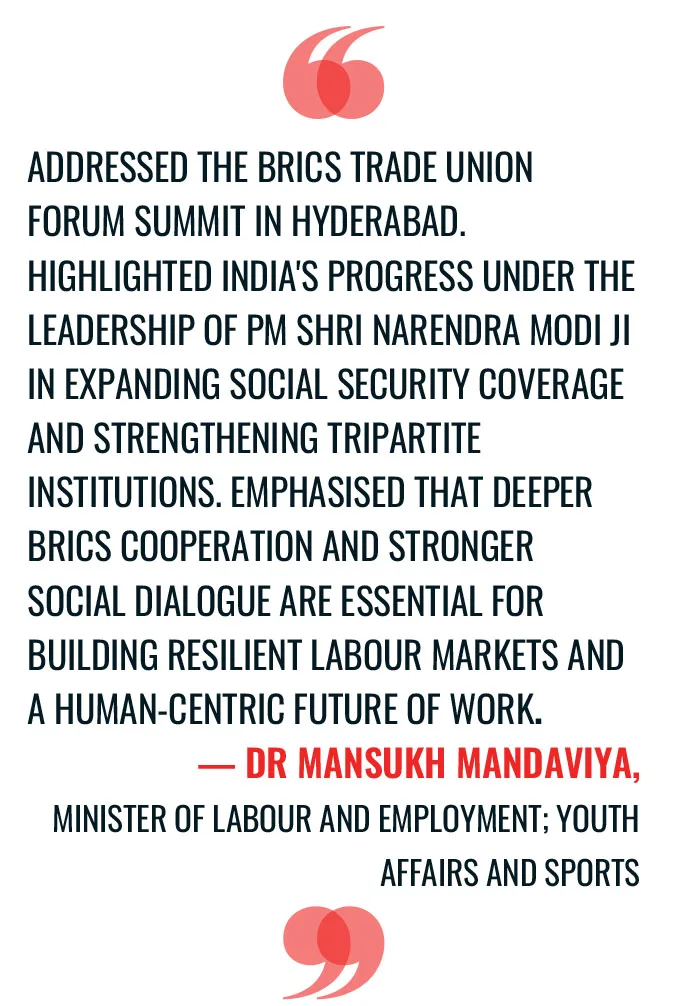
The main thrust areas of discussion at the Summit were social security for workers in the emerging global scenario, upskilling workers for the future world of work, women and the future of work, and human-centric technology and artificial intelligence. Union Minister for Labour and Employment Dr Mansukh Mandaviya addressed the delegates from BRICS and partnering States and called for a united approach to tackle challenges in the labour sector arising from AI and other technological advancements. He emphasised a human-centric approach and outlined the steps taken by India under the leadership of Prime Minister Narendra Modi to reform labour laws and ensure timely assistance and justice for workers. The Minister pointed out that the Employees’ Provident Fund Organisation (EPFO) manages accounts for nearly eight crore active subscribers and provides provident fund, pension and insurance benefits. He also noted that the Employees’ State Insurance Corporation (ESIC) provides health insurance, comprehensive medical care and cash benefits to more than 13.3 crore beneficiaries nationwide. “EPFO and ESIC are real models for the world,” he said.
Demographic & Technological Challenges
The BRICS TUF Summit 2026 observed that demographic and technological changes are two major trends shaping the 21st-century labour force. Population growth has declined globally, which may lead to a reduction in the labour force. At the same time, rapid technological advancement is increasing skill shortages. To keep pace with these economic and social changes, countries will need to undertake large-scale skill development initiatives supported by agile policy frameworks, timely data collection and regular evaluation. Such efforts can succeed only through close partnership and co-operation among governments, employers, social partners and training providers.
The Role Of Women Work Force
The Summit noted that women across BRICS economies sustain production and social reproduction in overlapping ways. They work as wage earners, farmers, entrepreneurs, carers, community leaders, wealth creators, and transmitters of knowledge and social values. However, their labour market outcomes continue to lag behind those of men. The unequal distribution of unpaid domestic and care work restricts women’s access to paid employment. Evidence compiled by the United Nations shows that women perform around three-quarters of all unpaid care work and spend substantially more time than men on unpaid domestic and care responsibilities. Informality remains a defining feature of women’s work across BRICS countries. Women are disproportionately concentrated in segments of the informal economy characterised by low earnings, weak legal protection and poor access to social security. They are overrepresented as self-employed workers and contributing family workers in agriculture, street vending, home-based production and subcontracted work in labour-intensive and hazardous industries. These workers often receive minimal coverage under labour legislation and social protection schemes.
The Summit urged BRICS member States to adopt an intersectional, rights-based approach to women’s work and livelihoods, recognising overlapping discrimination based on gender, caste, race, ethnicity, class, disability, age, migration status and rurality. It also called on governments to institutionalise social dialogue by ensuring the participation of trade unions, women’s organisations, informal worker collectives, community-based organisations and youth groups in the design, monitoring and evaluation of labour, social protection, digital, care and climate policies. The Summit further called for the establishment of a BRICS Women’s Employment Observatory as a permanent tripartite mechanism involving governments, employers and workers. This body would consolidate sex and gender disaggregated data across sectors, including care, digital, green and community-based work, using agreed definitions and quality protocols. It also recommended that BRICS development co-operation, public investment and financing instruments adopt gender-responsive budgeting and set measurable targets for women’s economic empowerment, decent work, safe workplaces and leadership across sectors.
The BRICS Trade Union Summit 2026 advanced the concept of “Samanvaya” over “Sangharsh,” and the ideals of “Vasudhaiva Kutumbakam” and “Loka Samasta Sukhino Bhavantu” over the concept of the “Dictatorship of the Proletariat.” In its 72nd year, BMS can proudly claim that it has contributed to restoring Bharat’s glory among the world’s workers.