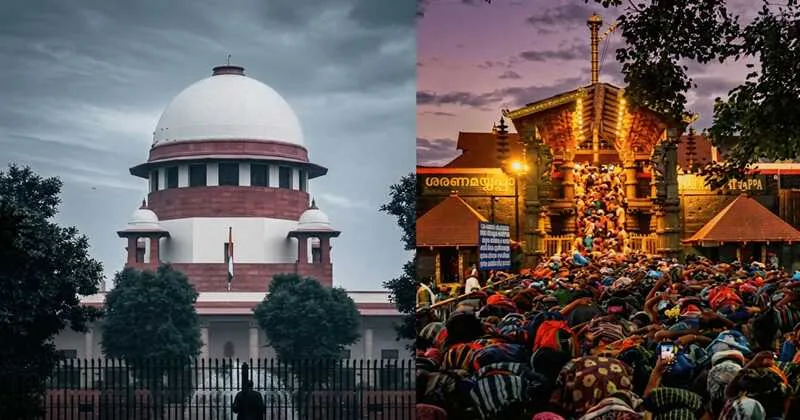
New Delhi: No religion can be “hollowed out” in the name of social welfare and reform, the Supreme Court observed on Wednesday while hearing petitions seeking a review of its earlier order permitting the entry of women of child-bearing age into Keralam’s renowned Sabarimala mandir. A nine-judge Bench emphasised that essential religious practices cannot be stripped away under the pretext of reform, noting that one of the most complex challenges before the judiciary is to declare the deeply held beliefs of millions as incorrect.
The Bench, led by Chief Justice of India Surya Kant, is currently examining a set of crucial constitutional questions arising from the Sabarimala case, particularly those concerning the balance between the right to freedom of religion and the scope of social reform. In its landmark 2018 judgment, the Supreme Court had ruled that women of all age groups should be allowed entry into the Sabarimala mandir. At the time, a five-judge Bench had held that restrictions based on age could not be regarded as essential religious practices, and had likened the exclusion of women between the ages of 10 and 50 to a form of untouchability.
Court questions limits of judicial intervention
During the hearing on Wednesday, the Bench engaged in a detailed discussion on whether Public Interest Litigations (PILs) should be entertained in matters concerning religion. Chief Justice Surya Kant remarked that one of the most difficult tasks faced by the Court is determining how to declare beliefs held by large sections of society as erroneous. Justice MM Sundresh raised a pertinent concern, questioning whether the Court could adjudicate such sensitive issues without first hearing the voices and representations of the millions of individuals directly affected. Justice BV Nagarathna echoed similar reservations, observing that PILs should not be entertained when petitioners act merely as interlopers without a genuine stake in the matter. She cautioned that judicial intervention must not result in hollowing out a religion under the guise of reform.
Debate over constitutional balance
Appearing on behalf of the Travancore Devaswom Board, which administers the Sabarimala mandir, senior advocate Abhishek Manu Singhvi elaborated on the constitutional interplay between Articles 25 and 26. He argued that both provisions must be harmoniously interpreted to preserve the delicate balance between individual rights and institutional autonomy. Article 25 guarantees every individual the freedom of conscience and the right to freely profess, practise, and propagate religion. At the same time, Article 26 grants religious denominations the authority to manage their own religious affairs. However, Article 25(2)(b) empowers the State to enact laws aimed at social reform and to ensure access to religious institutions for all sections of society.
Singhvi contended that while members of all Hindu communities may claim a right to enter mandirs, religious institutions must retain the autonomy to regulate their internal practices and rituals. He stressed that any legislative or judicial intervention must ensure that the core identity and character of a religion remain intact.
Justice Joymalya Bagchi posed a crucial question during the proceedings, asking whether this interpretation would imply that essential religious practices are beyond the scope of legislative change. In response, Singhvi argued that it is not the role of the judiciary to determine what constitutes an essential religious practice. He strongly criticised the “essential religious practices” test, asserting that it effectively grants judges the authority to define the core elements of a religion. According to him, once courts begin using terms such as “essential” or “integral,” they inevitably enter the domain of religious interpretation, thereby allowing external adjudicators to decide what forms the essence of a faith. Singhvi maintained that religious practices must be evaluated from the perspective of the community that adheres to them, rather than through external or judicial standards. He further argued that any practice that is conscientiously held as part of a religion should be afforded constitutional protection, subject only to the limitations imposed by public order, morality, health, and other fundamental rights under Article 25.
Social Reform Versus Religious Autonomy
Justice MM Sundresh also questioned the rationale behind the inclusion of the term “social reform” in Article 25(2)(b). Addressing this, Singhvi explained that such provisions were introduced to enable the eradication of entrenched social evils. Laws enacted under this clause, he said, are intended to promote reform while maintaining constitutional safeguards. The case continues to centre around the long-standing practice at the Sabarimala mandir, where women of menstruating age have traditionally been barred from entry. Devotees regard the presiding deity, Bhagwan Ayyappa, as a celibate, and the restriction has historically been justified on that basis.
In the 2018 judgment, then Chief Justice of India Dipak Misra had held that devotion cannot be subjected to discrimination, and that patriarchal notions must not override the principle of equality in matters of faith.
However, the Travancore Devaswom Board has consistently maintained that the restriction is not discriminatory towards women. It has urged the Court to refrain from adjudicating on matters of religious belief and practice, arguing that such issues fall within the domain of faith rather than judicial scrutiny.
As the hearings continue, the Supreme Court is tasked with resolving a complex constitutional dilemma, how to reconcile the principles of equality and social reform with the autonomy and integrity of religious traditions, without undermining either.