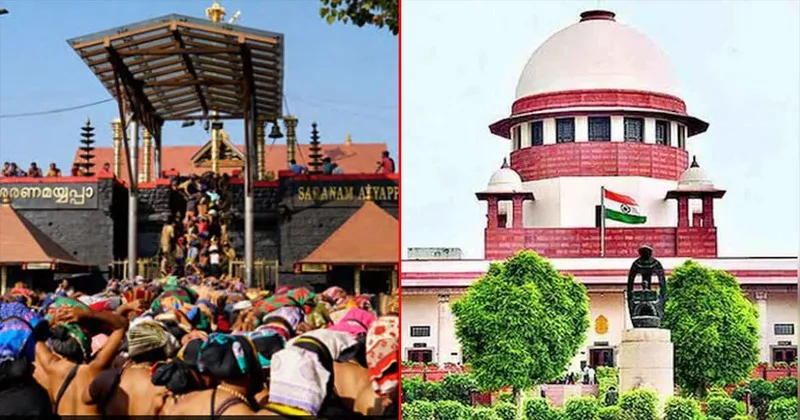
New Delhi: The central government told the Supreme Court that it does not support government control over mandirs, asserting that religious institutions should not be directly managed by the state. The submission was made by Solicitor General Tushar Mehta before a nine-judge Constitution Bench led by Chief Justice Surya Kant. The bench is examining the scope of state authority under Article 25 of the Constitution of India and Article 26 of the Constitution of India, a reference arising from the Sabarimala review petitions.
The Centre’s position stresses a strict distinction between secular management and religious autonomy. It explicitly stated that it does not advocate direct management of religious bodies by the government. While Article 25(2) of the Constitution of India permits state intervention in secular aspects such as financial and political activities, the government argued this should not translate into permanent state takeover of shrines. The Solicitor General further emphasised that constitutional interpretation must remain uniform across all faiths and cannot be shaped by the practices of any single religion. The Centre also highlighted that many Hindu traditions are inherently pluralistic, including practices where certain mandirs restrict entry based on custom, and cautioned against imposing a uniform framework that disregards such diversity.
Court flags concerns over exclusion and access
While advocating autonomy, the nine-judge Bench raised concerns about the implications of granting complete independence to denominations. The court observed that absolute powers to exclude could fragment society and undermine the inclusive character of Hindu traditions. Justice B. V. Nagarathna remarked that “everybody must have access to every temple and matha,” underlining that the state can intervene under Article 25(2)(b) to ensure social reform and prevent discrimination. In related rulings, the court has consistently maintained that mandir funds “belong to the deity” and must be utilised solely for the interests of the shrine, rather than diverted for unrelated state expenditure or commercial use.
The issue remains contentious, with many arguing that Hindu mandirs are uniquely subject to state control, unlike mosques, churches and gurdwaras, which are largely self-managed. Devotees frequently object to mandir revenues being channelled into non-religious state projects or general welfare programmes instead of maintenance and religious activities. Concerns have also been raised that government-appointed administrators may lack the requisite religious understanding or devotion to manage sacred institutions. Additionally, critics argue that such control risks turning mandir boards into “political parking lots,” where appointments are influenced by electoral considerations rather than merit.
The debate unfolds against a backdrop of extensive state involvement in mandir administration across India. In Keralam, multiple state-supervised bodies, including the Travancore, Cochin, Malabar, Guruvayur and Koodalmanikyam Devaswom Boards, oversee around 3,000 mandirs. In Tamil Nadu, the Hindu Religious and Charitable Endowments Department administers over 30,000 mandirs. In Andhra Pradesh, the Tirumala Tirupati Devasthanam Trust Board manages the Tirupati Balaji shrine. Similar frameworks exist in Karnataka under the Hindu Religious Institutions and Charitable Endowments Department, while the Chardham Devasthanam Board administers the Badrinath and Kedarnath shrines in Uttarakhand.