The alleged leak of the National Eligibility-cum-Entrance Test (NEET) question paper has rightly outraged the nation. For millions of students, years of relentless hard work, aspirations and the hope of becoming doctors depend on this single examination. Any allegation of malpractice in such a crucial national examination is not merely an administrative failure; it strikes at the credibility of India’s education system itself. Since the controversy surfaced, students have been anxious, parents have expressed deep anger and public confidence has been shaken.
In such a situation, the government’s foremost responsibility is to ensure a fair and impartial investigation, punish those responsible with the utmost severity and introduce effective safeguards to prevent such incidents from recurring. It is equally true that question paper leaks have occurred under different governments and in various competitive examinations in the past.
However, citing past failures cannot become an excuse for evading present accountability. Nor should the widespread public outrage over the NEET controversy be dismissed merely as political opposition. The genuine concerns of students and the future of an entire generation deserve the highest priority.
Yet, this is precisely where a serious question arises. Is a movement that began as a demand for educational reform remaining focused on that objective or is its character gradually changing? The right to protest is one of the cornerstones of democracy. But when the central demands of a protest are overshadowed by unrelated political or ideological slogans, it is only natural for questions to arise about the movement’s true direction and purpose.
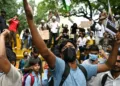
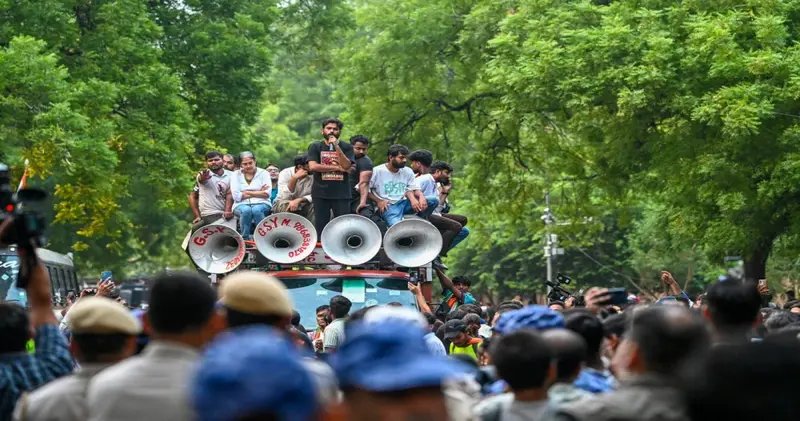
Following the NEET controversy, protests demanding the resignation of Union Education Minister Dharmendra Pradhan began at Jantar Mantar in New Delhi on June 20. A few days later, Sonam Wangchuk also began a hunger strike demanding reforms in the education system. There is nothing objectionable about a democratic movement seeking transparency, accountability and an end to corruption in education. Such demands are entirely legitimate.
However, when slogans unrelated to the NEET examination begin to dominate the protest platform, ordinary citizens are bound to wonder whether the movement’s objectives are shifting. A video clip that has recently gone viral on social media has further intensified these concerns. In the clip, a young man identifying himself as a NEET aspirant says that he, along with many other students, had joined the protest to oppose alleged irregularities in the examination.
But upon reaching the venue, they found participants raising slogans such as “Azadi” and “RSS Hatao”—slogans that have no direct connection with the alleged NEET paper leak. The young man expresses disappointment, saying that their primary demand was transparency and justice in the examination process, yet the protest stage had become increasingly occupied by political slogans unrelated to students’ concerns. According to him, this shift has pushed the genuine demands of aspirants into the background.
If students participating in the movement themselves express such apprehensions, it is only natural for questions to arise regarding the movement’s direction. Peaceful protest is a fundamental right guaranteed by the Indian Constitution. But one must also ask: what happens if anti-national forces receive support under the guise of showing solidarity with students? The Constitution not only guarantees citizens the right to protest but also, under Article 51A, places upon every citizen the fundamental duty to uphold the unity, integrity, and sovereignty of the nation.
Adding to the controversy is the presence, at various stages of the movement, of certain public figures whose past statements have long been the subject of public criticism. Questions have been raised regarding the participation of Arundhati Roy, who has previously raised the slogan of “Azadi” in independent India—a nation whose freedom was secured through the sacrifices of countless brave sons and daughters.
Roy has also been criticised by many for her positions on issues such as the exodus and killings of Kashmiri Hindus and for expressing views perceived by her critics as sympathetic towards figures like Yasin Malik, a convicted separatist leader. It is therefore reasonable for some to ask whether an individual associated with such positions genuinely represents the interests of India and its youth. The greatest strength of any mass movement lies in its moral legitimacy. The moment slogans or personalities become associated with a movement in ways that overshadow its core issue, sections of public support inevitably begin to erode.
If the objective is to secure justice for NEET aspirants, then that objective alone should remain at the centre of the movement. Introducing unrelated political or ideological agendas ultimately harms the very students in whose name the protests were launched. In a democracy like India, criticising the government is unquestionably a constitutional right. Indeed, a strong and responsible opposition is essential for the healthy functioning of any democracy. Citizens have every right to protest against government policies or administrative failures.
However, there is a fundamental distinction between opposing a government and opposing the nation. Criticising the policies or decisions of an elected government is one thing; promoting slogans or narratives that target the country’s constitutional framework or national unity is something entirely different. Once this distinction becomes blurred, legitimate questions naturally emerge about the true purpose of the movement.
In today’s digital age, social media plays a decisive role in shaping public opinion. A video lasting only a few seconds can reach millions of people within hours. That is precisely why everyone associated with a public movement carries the responsibility of ensuring that its core message remains clear and unambiguous. If slogans unrelated to the legitimate demands of students—and perceived as being contrary to India’s unity and integrity—begin to dominate the protest platform, the consequences can be deeply damaging.
Every citizen of India wants the truth behind the NEET paper leak to come out. Those responsible must be punished. Students deserve justice. Public faith in the education system must be restored. But if these entirely legitimate demands become intertwined with broader political or ideological conflicts, there is a real danger that the original issue will be eclipsed. Ultimately, it is the students—the very people for whom this movement began—who stand to lose the most.
That is why it is imperative to keep the movement’s objectives focused and unambiguous. Let there be protests against corruption in the NEET examination. Let there be demands for comprehensive reforms in the education system. Let there be accountability from the government. But the platform created to secure justice for students must not become a vehicle for any agenda that is perceived as being hostile to India’s unity and national interest.