SC flags PIL misuse, backs strict locus standi in faith cases
June 25, 2026
  • Read Ecopy
  • Circulation
  • Advertise
  • Careers
  • About Us
  • Contact Us
Android AppiPhone AppArattai
Organiser
  • ‌
  • Bharat
    • Assam
    • Bihar
    • Chhattisgarh
    • Jharkhand
    • Maharashtra
    • View All States
  • World
    • Asia
    • Europe
    • North America
    • South America
    • Africa
    • Australia
  • Editorial
  • International
  • Opinion
  • RSS @ 100
  • More
    • Op Sindoor
    • Analysis
    • Sports
    • Defence
    • Politics
    • Business
    • Economy
    • Culture
    • Special Report
    • Sci & Tech
    • Entertainment
    • G20
    • Azadi Ka Amrit Mahotsav
    • Vocal4Local
    • Web Stories
    • Education
    • Employment
    • Books
    • Interviews
    • Travel
    • Law
    • Health
    • Obituary
  • Subscribe
    • Subscribe Print Edition
    • Subscribe Ecopy
    • Read Ecopy
  • ‌
  • Bharat
    • Assam
    • Bihar
    • Chhattisgarh
    • Jharkhand
    • Maharashtra
    • View All States
  • World
    • Asia
    • Europe
    • North America
    • South America
    • Africa
    • Australia
  • Editorial
  • International
  • Opinion
  • RSS @ 100
  • More
    • Op Sindoor
    • Analysis
    • Sports
    • Defence
    • Politics
    • Business
    • Economy
    • Culture
    • Special Report
    • Sci & Tech
    • Entertainment
    • G20
    • Azadi Ka Amrit Mahotsav
    • Vocal4Local
    • Web Stories
    • Education
    • Employment
    • Books
    • Interviews
    • Travel
    • Law
    • Health
    • Obituary
  • Subscribe
    • Subscribe Print Edition
    • Subscribe Ecopy
    • Read Ecopy
Organiser
  • Home
  • Bharat
  • World
  • Operation Sindoor
  • Editorial
  • Analysis
  • Opinion
  • Culture
  • Defence
  • International Edition
  • RSS @ 100
  • Magazine
  • Read Ecopy
Home Bharat

SC flags PIL misuse, says Sabarimala plea would have been dismissed, backs stricter locus standi in faith cases

The Supreme Court has flagged the growing misuse of PILs, cautioning against challenges driven by agendas rather than genuine grievances. Hearing the Sabarimala matter, the court signalled a shift towards stricter locus standi, especially in cases involving faith and religious practices

Dr Vishnu AravindDr Vishnu Aravind
Apr 9, 2026, 09:30 am IST
in Bharat, Kerala
Follow on Google News
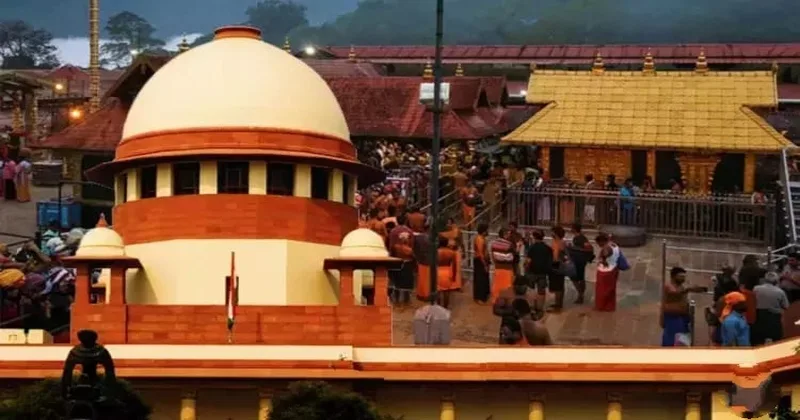
SC bench led by CJI Surya Kant hears Sabarimala case, flags PIL misuse and stresses stricter locus standi norms

SC bench led by CJI Surya Kant hears Sabarimala case, flags PIL misuse and stresses stricter locus standi norms

FacebookTwitterWhatsAppTelegramEmail

New Delhi: Acknowledging the rampant misuse of public interest litigation (PIL) for ulterior motives and the pursuit of personal agendas, the Supreme Court on Wednesday observed that it would have dismissed a PIL petition had it been filed by a lawyers’ body currently challenging the Sabarimala practice that bars the entry of women of menstruating age.

The remark was made by a nine-judge bench comprising Chief Justice of India Surya Kant and Justices B V Nagarathna, M M Sundresh, Ahsanuddin Amanullah, Aravind Kumar, A G Masih, P B Varale, R Mahadevan and Joymalya Bagchi. The observation came during submissions by Solicitor General Tushar Mehta, who argued that the Sabarimala custom was not challenged by a devotee of Lord Ayyappa and contended that the Supreme Court had earlier struck it down as unconstitutional due to a misreading and misapplication of the “constitutional morality” doctrine to matters of faith, belief and religious custom.

Mehta submitted that the attributes of deity Ayyappa at Sabarimala, who is regarded by devotees as a “Naistik Brahmachari,” cannot be examined through what he described as a “Western-imported” concept of constitutional morality. He argued that this doctrine is meant to test the validity of actions of the state or constitutional authorities, and not to scrutinise deeply held religious beliefs and practices that are inherently beyond judicial determination.

Debate on constitutional morality and religious practices

Justice B V Nagarathna concurred with the submission to an extent, observing that even if the lawyers’ body had approached the court by way of a civil suit, the case would likely have been dismissed for lack of cause of action. Chief Justice Surya Kant agreed with this reasoning but added an important caveat, noting that the PIL in question had been entertained nearly two decades ago, in 2006, and that a judgment had already been delivered. He emphasised that the present bench is tasked with determining the scope and limits of judicial intervention in matters concerning religion.

Also Read: Manipur: Kuki militants suspected to be involved in Moirang attack arrested; Huge cache of arms, ammunitions recovered

During the hearing, Mehta also raised concerns about what he termed the “corrupting influence” of a Western mindset in judicial reasoning, particularly referencing the judgment in the Joseph Shine case, which decriminalised adultery. He pointed out that the law was struck down on the grounds that it violated women’s dignity, liberty and equality by restricting sexual autonomy. While clarifying that he had no objection to the outcome of the case, Mehta argued that fidelity is an obligation applicable equally to both men and women in a marriage. Therefore, he said, a legal provision discouraging extramarital relationships cannot be characterised as curbing sexual freedom.

He further contended that societal norms had been incorrectly labelled as “mob morality,” and criticised the use of constitutional morality to invalidate such norms. According to him, this approach reflects a problematic expansion of judicial reasoning into areas traditionally governed by social and cultural values.

Justice Nagarathna responded by noting that concepts of morality are not static. “What was considered immoral and obscene in the 1950s is no longer viewed in the same way today,” she said, adding that many earlier standards are now regarded as narrow-minded or outdated. However, she also emphasised that public morality continues to evolve, and its dynamic nature must be acknowledged.

Concerns over misuse of PIL and locus standi

A significant part of the hearing focused on the issue of locus standi,  the legal standing required to file a petition,  particularly in the context of PILs. Addressing the question of whether an individual not belonging to a religious denomination can challenge its practices through a PIL, Mehta argued that such interventions should be restricted.

He traced the origins of PIL jurisprudence to the Supreme Court’s 1984 judgment in the Bandhua Mukti Morcha case, where the concept was developed as a tool to enable marginalised and disadvantaged groups, who lacked access to courts, to seek enforcement of their fundamental rights. At that time, the court adopted a liberal approach to locus standi, allowing public-spirited individuals to file petitions on behalf of those unable to approach the judiciary.

However, Mehta argued that this liberal approach has since been widely misused, with individuals and organisations unconnected to the issues filing PILs for personal, political or ideological reasons. Given the significant improvement in access to justice over the years, he urged the court to enforce stricter standards of locus standi, particularly in cases involving religion, customs, faith and belief systems.

The Centre supported this position, arguing that the definition of locus standi should not be applied liberally in such sensitive matters. The bench appeared inclined towards this view. Chief Justice Kant noted that in recent years, constitutional courts have become increasingly cautious in entertaining PILs, recognising that many petitions are filed with hidden motives or to advance specific agendas. “In the last few years, courts have started enforcing stricter locus standi rules in PILs,” the CJI observed, adding that constitutional courts are now far more circumspect in admitting such petitions. The hearing in the matter will continue on Thursday.

 

Topics: PIL misuselocus standireligious practices IndiaSupreme CourtSabarimala caseTushar MehtaConstitutional MoralityAyyappa temple
ShareTweetSendShareSend
✮ Subscribe Organiser YouTube Channel. ✮
✮ Join Organiser's WhatsApp channel for Nationalist views beyond the news. ✮
Previous News

Telangana: Sri Keshav Spoorti Mandir to be inaugurated in RSS founder Hedgewar’s ancestral village Kandakurthi

Next News

Sabarimala: The Indian discourse on the constitution and women’s power- A reference to Justice BV Nagarathna

Related News

Supreme Court of India

‘RTI activism has become business’: SC denies anticipatory bail, questions activist’s authority to monitor road project

The AMU Judgment: Why the Supreme Court must revisit Article 30

Tamil Nadu Assembly (File Photo)

Tamil Nadu speaker drops action against 21 rebel AIADMK MLAs after EPS withdrawal, targets 4 who joined TVK

Supreme Court remarks have revived the UAPA bail debate, with supporters citing national security concerns

UAPA Bail Debate: Striking a delicate balance between individual liberty and national security

Supreme Court invokes Article 142, issues strict timelines to curb delay in High Court judgments

Supreme Court invokes Article 142, orders strict timelines for High Court judgments to end delays in justice delivery

SIR and Article 324: Supreme Court strengthens the constitutional spine of Indian Democracy; Reaffirms ECI’s authority

Load More

Latest News

For the first time, NCERT adds Emergency to class 9 curriculum, highlights suspension of rights and democratic struggles

NCERT includes Emergency chapter in class 9 textbook, describes 1975-77 period as a major challenge to Indian democracy

Delhi HC adjourns Jawad Siddiqui’s plea seeking 6-week interim bail

Al-Falah Trust Case: ED opposes interim bail for chairman Jawad Ahmad, cites risk of concealing Rs 493 cr proceeds

Twin earthquakes devastate Venezuela

Venezuela Earthquake 2026: Powerful 7.5 & 7.2 magnitude tremors leave the country in ruins; State of emergency declared

Pakistan’s Defence Minister, Khawaja Muhammad Asif

Pakistan Defence Minister Khwaja Asif sparks fury in POJK, labels Mirpuris &  Rawalakot residents ‘Non-Kashmiris’

Sunil Ambekar (Akhil Bharatiya Prachar Pramukh Rashtriya Swayamsevak Sangh addressing the gathering in Patna

The Emergency taught us that a vigilant society is essential to protect democracy: Sunil Ambekar ji

Punjab Moga Massacre 1989: When Khalistani terrorists turned an RSS shakha into a killing field

From sovereign satellite networks to human spaceflight, India is building the foundations of a globally competitive space power

India eyes a $45 billion space economy by 2033: AnanthSat-1’s 2029 launch heralds the private satellite age

Emergency and RSS- The resistance years: Sangh, society and restoration of democracy

Andhra Pradesh Chief Minister N. Chandrababu Naidu inaugurates the Jonnagiri Gold Mining Project in Kurnool district

Andhra Pradesh: CM Chandrababu Naidu lunches first major gold mining project in Kurnool district

AI-generated image for representation

Tamil Nadu: School teacher faces action over alleged humiliation of menstruating student

Load More
  • Privacy
  • Terms
  • Cookie Policy
  • Refund and Cancellation
  • Delivery and Shipping

© Bharat Prakashan (Delhi) Limited.
Tech-enabled by Ananthapuri Technologies

  • Home
  • Search Organiser
  • Bharat
    • Assam
    • Bihar
    • Chhattisgarh
    • Jharkhand
    • Maharashtra
    • View All States
  • World
    • Asia
    • Africa
    • North America
    • South America
    • Europe
    • Australia
  • Editorial
  • Operation Sindoor
  • Opinion
  • Analysis
  • Defence
  • Culture
  • Sports
  • Business
  • RSS @ 100
  • Entertainment
  • More ..
    • Sci & Tech
    • Vocal4Local
    • Special Report
    • Education
    • Employment
    • Books
    • Interviews
    • Travel
    • Health
    • Politics
    • Law
    • Economy
    • Obituary
  • Subscribe Magazine
  • Read Ecopy
  • Advertise
  • Circulation
  • Careers
  • About Us
  • Contact Us
  • Policies & Terms
    • Privacy Policy
    • Cookie Policy
    • Refund and Cancellation
    • Terms of Use

© Bharat Prakashan (Delhi) Limited.
Tech-enabled by Ananthapuri Technologies