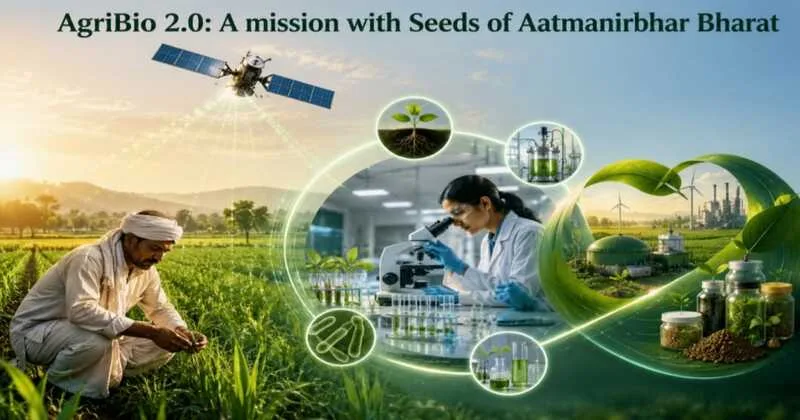
India has joined a race for the biological century, the place where the century will be won or lost based on how a country approaches the bioeconomy. If a five-acre holding in Bundelkhand where the rain arrives a fortnight late, a saline patch in coastal Odisha where the paddy yellows before it fills or a Vidarbha cotton field where the cost of a fertiliser sack has quietly outrun the price of the crop. If the bioeconomy is to mean anything to the 600-million-strong rural India that still lives off the land, it must first answer the questions those fields are asking. NITI Aayog’s flagship agricultural mission, AgriBio 2.0, is the clearest signal that the government intends the biological revolution to reach the kisan before it reaches anyone else.
A mission written for the monsoon
AgriBio 2.0 is framed as India’s response to a climate that has stopped keeping its old appointments. The mission’s core promise by 2035 is a generation of climate-resilient crops with varieties bred to hold their yield through drought, heat and salinity, the three stresses that punish the Indian farmer most and most often. Alongside them, it envisions the mainstreaming of biofertilizers and biopesticides across major cropping systems, so that soil health is restored rather than mined and the farmer’s dependence on costly chemical inputs is steadily loosened.
The modern tools such as CRISPR-based gene editing, genomic selection, and molecular breeding but the ambition is old-fashioned, in the best sense, for farm profitability and ecological stewardship pursued together, not traded off against each other. This speaks of farmer-owned crop varieties and equitable access. This is not a scheme to make the Indian cultivator a regular customer of foreign seed and chemistry. It is a bid to hand a better tool and let the farmers keep the gains.
The key feature of AgriBio 2.0 is what it refuses to do. It does not propose to bulldoze the existing agricultural architecture and erect a parallel bureaucracy in its place. The roadmap is explicit that the mission’s job is to integrate and amplify what India has already built to carry the last-mile of scientific breakthrough into the field at scale.
The National Mission on Sustainable Agriculture, Paramparagat Krishi Vikas Yojana for organic farming, the Mission for Integrated Development of Horticulture, the National Food Security Mission and the Soil Health Card Scheme already push efficient nutrient use, water-wise practices and reduced chemical dependence. Layered over them is the Department of Biotechnology’s own farmer-facing machinery: the Biotech-KISAN programme, Farmer Resource Groups and the Biofertilizer and Biopesticide Quality Control Labs that have quietly built a translational bridge between the bench and the khet.
AgriBio 2.0 proposes to route its innovations through exactly this trusted plumbing, the Biotech-KISAN hubs, the Krishi Vigyan Kendras and the state agricultural universities that farmers already know and visit. Field-testing, validation and farmer-scale demonstration will happen where the farmer is not in a distant capital. Agricultural technology in India has failed most often not at the point of invention but at the point of adoption. By anchoring the mission in institutions that already command rural trust, the government is betting on delivery over spectacle.
The quiet revolution in bio-inputs and the self-reliance
If one thread runs through this mission and elevates it from farm policy to national strategy, it is the push for high-quality bio-inputs such as biofertilizers, biopesticides, microbial consortia, biostimulants and microbial seed coatings. The roadmap wants these produced indigenously, at scale, through a network of BioInput Production and Innovation Clusters co-located with existing rural biotechnology hubs.
Consider what that means beyond the field. India spends heavily every year importing fertilisers and their raw materials, a persistent drain on the exchequer and a standing vulnerability to global price shocks and supply disruptions. Every tonne of soil-friendly biofertilizer brewed in an Indian rural cluster is a tonne of imported urea the country does not have to buy. The roadmap ties AgriBio 2.0 directly to the PM PRANAM scheme, which rewards states for cutting chemical fertiliser use and to the Atmanirbhar Clean Plant Initiative. In doing so, it reframes the humble biofertilizer as an instrument of strategic autonomy. Reducing dependence on imported fertilisers and industrial enzymes, as the roadmap’s own framers note, is not a green nicety; it is a pillar of Atmanirbhar agriculture.
There is a jobs story buried here too, and it belongs to the villages. These bio-input clusters are meant to sit in rural India, not on the fringe of a Bengaluru or a Hyderabad. Manufacturing microbial products, running quality-control labs, servicing seed-coating lines this is skilled, dignified rural employment of a kind that keeps the young from having to migrate to survive. Indian coastal belt offers a preview of the model, with the roadmap holds up Odisha’s women-led seaweed farming as a template for scalable livelihood and social inclusion, with seaweed-derived biostimulants already cleared under the Fertiliser (Control) Order to enter the agri-input market. What women have begun on the coast, the bio-input clusters can extend across the heartland.
The numbers represent the Project development
The roadmap projects India’s Bio Agriculture segment growing from roughly $51 billion in 2030 to $90 billion by 2035 and $338 billion by 2047, driven precisely by gene-edited crops, biopesticides, biofertilizers, biochar, precision farming and bio stimulants. This sits within a national bioeconomy climbing from $195.3 billion today to a projected $691 billion by 2035, an engine expected to generate more than 30 million high-value jobs across its segments. Agriculture is not a sideshow in that arithmetic; it is one of its four load-bearing pillars.
For the farmer, the translation of those macro-figures is concrete crops that survive a failed monsoon, inputs that cost less and heal the soil, and a value chain in which more of the margin stays in the village rather than leaking out to importers and middlemen.
Guardrails the farmer can trust
None of these schemes works without trust, and the roadmap is careful on the point. AgriBio 2.0 is to advance behind a science-based, transparent regulatory framework that ensures biosafety and meets both national and international standards. The document explicitly calls for a “quality-first” approach to bio-inputs; spurious or ineffective biofertilizers have burned farmers before, and the mission’s insistence on validation through recognised labs and KVKs is a direct answer to that hard-earned suspicion. On gene editing, the emphasis is on clarity and public confidence rather than a rush to market. The roadmap even flags the need to resolve regulatory ambiguities from the Biodiversity Act’s chilling effect on start-ups to Section 3 patent questions on microbes that have slowed honest innovation. For a farmer who has been sold snake oil before, a mission that leads with safety and quality is a mission worth believing in.
The field as the foundation
There is a temptation, whenever India dreams of a technological frontier, to picture it as urban, English-speaking and elite. AgriBio 2.0 is a useful corrective. It insists that the biological century, if it is to be India’s, must be built from the soil up; that the first beneficiary of CRISPR and precision fermentation should be the small and marginal farmer and that the first proof of a bioeconomy’s worth should be a fuller granary and a fatter harvest cheque in a village that the growth story usually forgets.
That is a distinctly Indian way to enter the future and a distinctly swadeshi one. The nation that fed itself through the Green Revolution now has the chance to feed itself again, this time with crops it engineered, inputs it brewed at home and a countryside that shares in the value rather than merely supplying the raw material. The roadmap is right that the coming decade will decide whether India shapes the biological age or is shaped by it. For rural India, the answer will be written not in a policy paper but in the field. AgriBio 2.0 gives the farmer the tools to write it well and, for once, to keep the pen.