For decades, Indian school curricula leaned heavily on Eurocentric timelines that focussed on the works and theorems of scientists from mostly European countries. When that framing is now challenged, ideological hostility enmeshed with institutional inertia makes a potent mix and stands up to oppose any scrutiny, retrospection, and – or correction.
A stray remark about a school textbook, “even Maths will now be finished”, was meant to dismiss a curriculum change. Instead, it triggered something far more substantive: a precise, text-backed lesson in the history of mathematics.
At the centre of the debate is NCERT’s new Class 9 textbook Ganita Manjari, which attempts to place mathematical concepts within their historical evolution, including contributions from ancient India.
What critics saw as ideological colouring, one respondent countered not with rhetoric, but with geometry. He cited the Śulba Sūtras to demonstrate that principles now taught globally had been articulated in the subcontinent millennia ago.
In that moment, the argument shifted. It was no longer about politics versus pedagogy, but about something far harder to dismiss: whether acknowledging documented mathematical knowledge from India’s past is correction, or provocation.
The Trigger That Started The Debate
As reported by PTI, the newly introduced NCERT Class 9 mathematics textbook ‘Ganita Manjari’ features references to ancient Indian mathematical systems and embeds historical context within core concepts, marking a shift from earlier editions.
The 196-page Part 1 textbook, comprising eight chapters and to be implemented from the 2026-27 academic session, aligned with the National Education Policy 2020, makes a deliberate shift from purely procedural mathematics to contextual learning, embedding historical narratives within mathematical concepts.
It places greater emphasis on indigenous contributions, unlike the previous book which contained limited references to ancient Indian mathematics and largely focused on procedural learning.
While the earlier textbook presented topics such as number systems, integers and irrational numbers in a largely definition-based format, the new book integrates these concepts with historical narratives, linking them to ancient texts and scholars.
One of its key features is the inclusion of ancient Indian mathematicians and texts, not as ornamental references but as integral to conceptual development. Among those highlighted are Baudhāyana, Āryabhaṭa, and Brahmagupta.
The textbook reportedly:
- Introduces coordinate geometry through early grid systems seen in the Indus Valley civilisation
- Explains geometric constructions using the Śulba Sūtras
- Mentions early formulations of zero and place value
- Contextualises mathematical ideas as evolving across civilisations, including India
This is not a replacement of modern mathematics, but a reframing of how its origins are taught.
The Flashpoint: “Even Maths Will Now Be Finished”
Reacting to this shift, Sushant Singh took to X with a sharply worded remark suggesting that even mathematics was now being ideologically altered.
Nothing will be spared. Even Maths will now be finished. pic.twitter.com/BDo0ESRM4O
— Sushant Singh (@SushantSin) April 23, 2026
The criticism echoed a broader concern often raised in such debates, that academic subjects are being reshaped to fit cultural or political narratives, potentially at the cost of scientific rigour.
But what followed was not a political counterattack. It was a mathematical one.
The Rebuttal: Returning to First Principles
A user identified as Dr Juggernaught responded with a structured breakdown rooted in primary sources.
Sushant, listen up and pay attention, I’ll try to do it slowly so you can keep up.
Below is the Baudhāyana Śulba Sūtra 1.9, (sometimes numbered 1.12):
dīrghasyākṣaṇayā rajjuḥ pārśvamānī tiryaṅmānī ca yat pṛthagbhūte kurutastadubhayāṅ karoti.
Literally: “The rope… https://t.co/9744L3rnWP
— Dr Juggernaught 🔱 (@vajravyuha) April 24, 2026
At the centre of his argument was a verse from the Baudhāyana Śulba Sūtra, which describes a geometric relationship equivalent to what is globally known today as the Pythagorean Theorem.
He wrote:
“Below is the Baudhāyana Śulba Sūtra 1.9, (sometimes numbered 1.12):
dīrghasyākṣaṇayā rajjuḥ pārśvamānī tiryaṅmānī ca yat pṛthagbhūte kurutastadubhayāṅ karoti.
Literally: “The rope [stretched] along the diagonal of an oblong produces [an area] which the lateral side and the horizontal side make together.”
In even more plain terms: the square on the diagonal equals the sum of the squares on the two sides.
That’s called the Pythagorean theorem today. A generalized declaration, not empirical observation of triplets in the wild. Before Christ. A late addendum to the Vedas.”
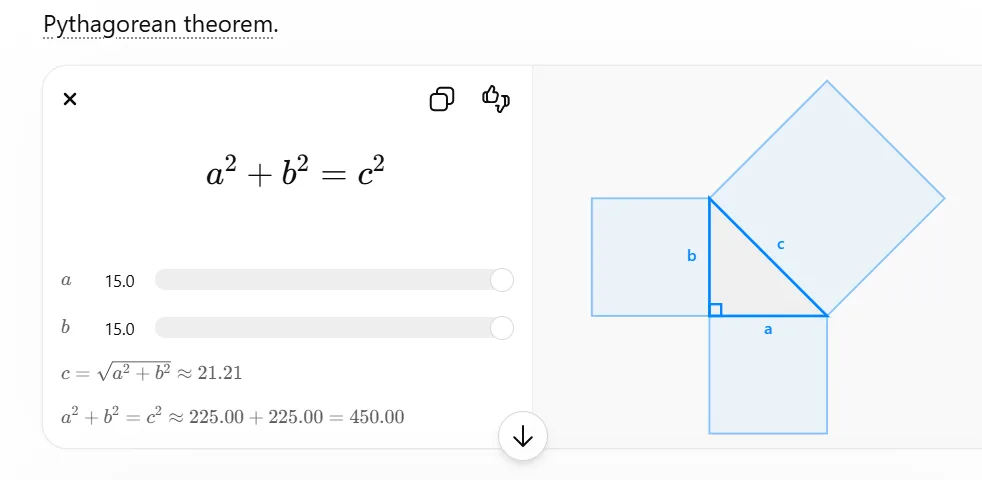
His point was precise: the text does not merely list numerical examples, it articulates a general rule. That distinction matters. A generalised geometric statement reflects abstraction, not just observation.
Beyond the Theorem: What the Śulba Sūtras Actually Contain
The rebuttal did not stop at one theorem. It expanded into a broader survey of mathematical sophistication present in the Śulba Sūtras:
- Documented use of Pythagorean triples like (3,4,5) and (5,12,13)
- An approximation of √2 accurate to several decimal places
- Recognition of irrational quantities (marked as saviśeṣa, or “with remainder”)
- Methods for transforming geometric shapes while preserving area
- Practical geometry used in altar construction, suggesting applied mathematical thinking
This was not presented as a claim of supremacy, but as a correction of omission: that such contributions exist, are documented, and are relevant when discussing the history of mathematics.
What NCERT Is Actually Doing, And Not Doing
A key misunderstanding in the backlash is the assumption that NCERT is replacing established mathematics with civilisational narratives.
That is not the case.
The revised approach
- Retains standard mathematical curriculum and problem-solving methods
- Adds historical context to show how concepts evolved
- Encourages conceptual understanding over rote learning
- Places Indian contributions alongside global developments
In effect, it aligns with a global pedagogical trend, teaching mathematics as a human endeavour shaped across cultures, rather than a linear Western progression.
The Real Debate: Knowledge vs Narrative
The episode reveals a deeper fault line.
One side views the inclusion of ancient Indian knowledge as ideological insertion. The other sees resistance to it as a form of intellectual gatekeeping, where only certain civilisational contributions are considered “neutral” or “scientific.”
What made this exchange stand out was the nature of the rebuttal. It did not rely on sentiment or identity. It relied on text, translation, and mathematical reasoning.
Conclusion: When Facts Do the Talking
In the end, the controversy was less about a textbook and more about how knowledge is framed.
The NCERT revision attempts to widen the lens. The criticism questioned that intent. But the most effective response came not from rhetoric, but from demonstrating that the mathematics itself holds up.
Because in a debate about mathematics, the most decisive argument is still the equation. Top of Form