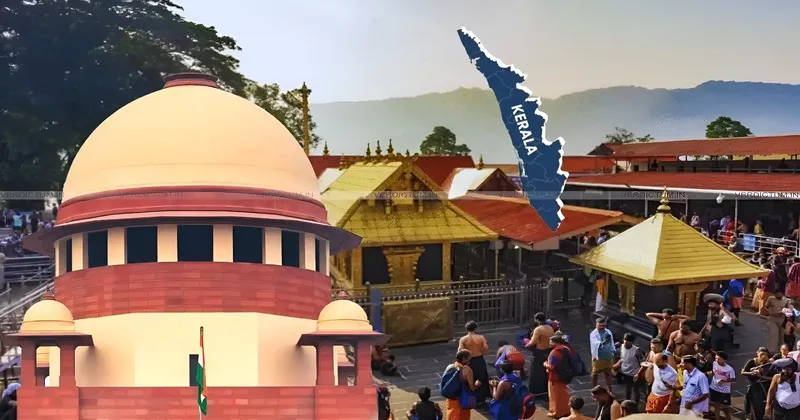
New Delhi: The Supreme Court of India has made a significant observation that believers do not question rituals, while non-believers have no right to question them. The remarks were made by Justice B. V. Nagarathna during the hearing of review petitions against the Sabarimala verdict on women’s entry.
“Can any devotees of Lord Ayyappa file a writ petition challenging this? No. If a non-devotee, a person who is not concerned with the temple, challenges it, can this court entertain that writ petition?” Justice Nagarathna asked.
She questioned why the court should entertain petitions from non-believers, especially when those who initially challenged the restriction on women’s entry were not devotees of Bhagwan Ayyappa. Justice Nagarathna observed that such public interest litigations should not be encouraged, adding that many individuals approach the court with specific agendas. “The original writ petitioners are not devotees. No devotee has approached this court challenging this… Then who is assailing this?” Justice Nagarathna queried.
The hearing is currently underway before a nine-judge Constitution Bench headed by Chief Justice Justice Surya Kant. Justice Nagarathna’s observations came during arguments presented by senior advocate V. Giri, appearing for Thantri Kantar Rajeevar. The Thantri’s counsel argued that each mandir in Hinduism follows its own distinct rituals and traditions, and that courts cannot determine whether the restriction on the entry of women of a particular age group at Sabarimala constitutes an essential religious practice. Giri further stated that individuals who do not subscribe to the beliefs and practices of a mandir cannot claim a right to enter it and question its rituals.
Judiciary’s role vs centre’s stand on defining religious practices
During the proceedings, the court raised the question of whether any devotee of Bhagwan Ayyappa had filed a petition seeking the entry of young women into Sabarimala. The Chief Justice observed that the judiciary does possess the authority to determine whether certain practices amount to superstition. At the same time, the bench clarified that the legislature cannot be considered the final authority in matters of religion.
Presenting its position, the Central Government argued that courts cannot arbitrarily declare a religious practice to be superstition, emphasising that the judiciary does not possess the specialised scholarly knowledge required for such determinations. The Centre also informed the bench that the appointment of priests in mandirs is based on qualifications and knowledge, and that the government does not interfere in such matters.
The Chief Justice further remarked that in extreme cases, such as the practice of human sacrifice, the court has the authority to intervene without the need for extensive inquiry. Justice Nagarathna added that judicial intervention becomes necessary when religious practices have an impact on public order, peace, or morality. The court is expected to hear arguments from those supporting the entry of women into Sabarimala later this week, as the proceedings in this crucial case continue.