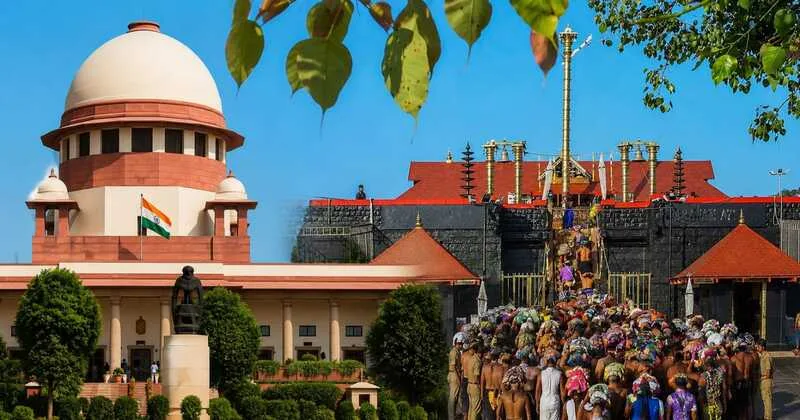
New Delhi: The Supreme Court sharply questioned the role of the Indian Young Lawyers Association (IYLA) in the long-running Sabarimala Mandir entry litigation, with judges of a nine-judge Constitution Bench asking why the organisation had involved itself in matters concerning Hindu religious traditions and whether it had any locus to challenge the customs associated with the Sabarimala Ayyappa Mandir in Keralam.
Hearing petitions linked to discrimination against women at religious sites and the broader interpretation of religious freedom across faiths, the Bench made a series of pointed observations directed at the association that had originally filed the 2006 public interest litigation (PIL) challenging the restriction on women between the ages of 10 and 50 entering the Sabarimala shrine.
The nine-judge Constitution Bench comprised Chief Justice of India (CJI) Surya Kant and Justices B V Nagarathna, M M Sundresh, Ahsanuddin Amanullah, Aravind Kumar, Augustine George Masih, Prasanna B Varale, R Mahadevan, and Joymalya Bagchi.
Advocate Ravi Prakash Gupta, appearing for the IYLA, informed the court that the PIL had been filed after four newspaper reports published in June 2006. He argued that the association was not attacking the faith of Bhagwan Ayyappa’s devotees but was instead seeking to uphold it. However, the Bench repeatedly questioned the basis and intent of the litigation. Chief Justice Surya Kant asked the counsel, “Why have you filed this PIL? Are you the chief priest of the country?” The CJI also remarked that the Supreme Court should have thrown the association’s PIL into the “dustbin”. Justice M M Sundresh described the petition as a “clear abuse of the process of law”.
Justice B V Nagarathna questioned how a legal association could claim religious belief or conscience in matters concerning a deity and Mandir traditions.
“How does a juristic body like yours have a belief? This is for an individual. You don’t have a conscience,” Justice Nagarathna observed during the hearing.
Justice Aravind Kumar also questioned the internal decision-making process of the organisation, asking whether the association had formally passed a resolution authorising the PIL and whether its president had signed it.
Supreme Court exposes Young Lawyers Association and its head Naushad Khan
During the hearing, the Bench also asked about the leadership of the Indian Young Lawyers Association. Justice Aravind Kumar asked, “Who is the president of your association? Is he a believer?”
Counsel Ravi Prakash Gupta replied that the president of the association was Naushad Khan. The disclosure prompted further observations from the Bench regarding belief, faith, and the standing of an organisation to litigate in matters concerning Mandir traditions and religious practice. Justice B V Nagarathna remarked, “How can an entity that is not a ‘believer’ develop a belief in a deity? How can a juristic personality have a belief, a conscience?”.
The counsel had earlier argued that the Mandir’s ‘tantri’ (Cheif Priest) had stated that young women should not enter the shrine because the deity did not like the presence of young ladies. Gupta questioned whether such statements reflected devotion towards Bhagwan Ayyappa or amounted to placing words in the deity’s mouth. “They say the deity does not like the presence of young ladies… Is that said as an expression of regard towards the deity, or is it meant as an insult to the deity? Are they putting words in the mouth of Bhagwan Ayyappa?” Gupta submitted.
The Bench, however, remained unconvinced about the role played by the association in pursuing the litigation.
Justice Nagarathna strongly criticised what she described as the increasing tendency to file PILs based merely on newspaper articles. “Articles are being published in newspapers merely for the sake of filing PILs,” she observed.
The judge further advised the association to focus on the welfare of young advocates and the legal profession rather than intervening in religious matters. “Young Lawyers Association has no other business? They can’t work for the welfare of the Bar, or assist the bench or for the legal system of the country? Other than doing this kind of work?… Work for the Bar, work for younger members, work for their welfare. Those who are struggling in the country from rural areas…they have difficulty coming to the cities to argue cases. They are brilliant minds. Work for them, rather than doing this kind of work in the Supreme Court” Justice Nagarathna said.
She added that many talented advocates from rural areas struggle to establish themselves in cities and need institutional support. “Those who are struggling in rural areas have difficulty coming to the cities to argue cases. They have brilliant minds. People have come from the villages with different minds. Rather than doing this time, in the Supreme Court,” she remarked.
Background of the Sabarimala Mandir case
The Indian Young Lawyers Association had filed the writ petition challenging the prohibition on women aged between 10 and 50 years entering the Sabarimala Ayyappa Mandir in Keralam.
In September 2018, a five-judge Constitution Bench of the Supreme Court delivered a 4:1 majority verdict striking down the restriction. The ruling held that the centuries-old practice barring women of menstruating age from entering the shrine was unconstitutional and illegal.
The judgment triggered nationwide debate and protests over the balance between constitutional rights and denominational religious practices.
The current proceedings before the nine-judge Constitution Bench concern broader constitutional questions arising from that judgment, including the scope of religious freedom under the Constitution and whether courts can intervene in essential religious practices followed by various faith communities.
During Tuesday’s hearing, the judges repeatedly questioned whether organisations with no direct connection to a particular faith or Mandir tradition should invoke PIL jurisdiction in such matters. The hearing in the matter is continuing.