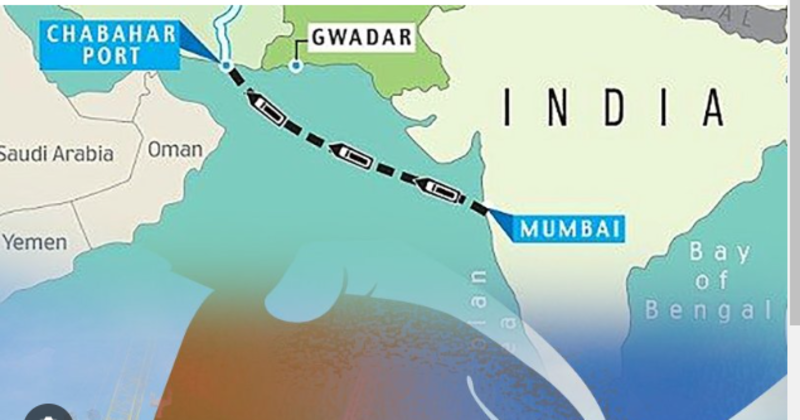
On 13 May, 2023 India’s Minister of State of the Ministry of Ports, Shipping and Waterways, Sarbananda Sonowal, signed a 10-year deal with Iran to operate and develop the strategically important port of Chabahar in Sistan, Baluchistan province.
Indian Ports Global Limited (IPGL) will invest around US$120 million in the port and around US$ 250 million in credit to reinforce India’s connectivity to Central Asia, Afghanistan, the South Caucasus, and the greater Eurasian region.
Amidst global geopolitical contestations and the increasing disquiet in the Red Sea, the agreement will provide India with much-needed access and the right to transit across Eurasia for economic growth and resilient connectivity. Additionally, the deal will give India significant leverage and strategic heft over the China-Pakistan alliance and China’s much-hyped Belt and Road Initiative (BRI). The project also helps India circumvent Pakistan to gain connectivity to Eurasia, who, influenced by Beijing’s hegemonic and belligerent influence, has traditionally blocked New Delhi’s past connectivity initiatives in Eurasia.
India’s gateway to Eurasia
Though India announced its plan to invest in the strategic Chabahar Port in 2003, a formal agreement was signed between New Delhi and Tehran only in 2015. The construction of the Chabahar Port received momentum in 2016 when Prime Minister Narendra Modi pledged an investment of US$ 500 million to develop the Chabahar Port during a visit to Tehran.
In 2018, the Shahid Beheshti terminal of the port became operational following an investment of US$ 25 million by IPGL. Since 2019, the port has efficiently handled 90,000 TEUs and over 8.4 million tonnes of general cargo after IPGL set up six mobile cranes with capacities ranging from 100 to 140 tonnes.
The Chabahar Port is a vital link connecting Mumbai to Eurasia via different corridors of the International North-South Transport Corridor (INSTC). INSTC, spanning over 7,200 km, includes sea routes, and rail and road links to connect Mumbai with Eurasia and Central Asia. It was proposed in the September 2000 agreement between India, Russia and Iran.
Since then, the INSTC agreement has been ratified by 13 countries, including Russia, India, Iran, Türkiye, Azerbaijan, Belarus, Bulgaria, Armenia, Central Asian Republics, Ukraine, and Oman. According to estimates, The INSTC will reduce transit time to 25-30 days from 45-60 days and decrease the freight cost by 30 percent compared to the Suez Canal route, which has lately faced disruptions due to regional conflict.
In 2016, New Delhi and Tehran unequivocally signed a Memorandum of Understanding (MOU) to connect the Chabahar port with INSTC by constructing a 628 km-long Chabahar-Zahedan rail link. However, the United States (US) unilaterally withdrew from the Joint Comprehensive Plan of Action (JCPOA) in 2018 and imposed even harsher sanctions on Iran. These sanctions significantly crippled the Iranian economy, leading to a significant setback in the construction of this crucial railway line connecting Chabahar with the Iranian railway system.
Using diplomatic tactfulness, New Delhi was able to obtain exemptions from the US for the development of Chabahar Port and other infrastructure projects in 2018. Subsequently, India reinforced its commitment to the Chabahar Port by doubling the port development budget from US$ 5.5 million in 2020-21 to US$ 12.3 million in 2022-23.
Despite its proactive stance, repeated funding delays amidst sanctions, inter-regional disputes, and bureaucratic hurdles slowed the construction of the crucial Chabahar-Zahedan railway line, and only 65 percent of the project was completed in 2023. Once the rail link is established, India will have access to the sizeable Eurasian market, mainly Central Asia, via the Eastern and Western corridors of the INTSC.
Geoeconomic and geostrategic rationale
India currently stands as the world’s fastest-developing economy and is set to become a US$ 5-trillion economy over the next two years. To maintain its growth momentum and make India the central global manufacturing hub by 2030, New Delhi needs to develop resilient, reliable and diversified supply chains and connectivity to transit across Eurasia to maintain its growth momentum.
By 2030, India will have the potential to export more than US$ 1 trillion, which will require new robust linkages of connectivity with Greater Eurasia for sustained economic growth and prosperity. The Chabahar Port and its development will boost trade between India and Central Asia with a bilateral trade potential of more than US$ 200 billion.
New Delhi has taken a bold and proactive approach by utilising the Chabahar Port and the INSTC to establish direct connectivity with the hydrocarbon-rich and strategically vital Eurasian region. This approach upholds sovereignty and territorial integrity, which sets it apart from the BRI and China-Pakistan Economic Corridor (CPEC) projects. Central Asian countries recognise India-led connectivity projects as game-changers for the region.
They are determined to amplify their trade through INSTC and Chabahar to lessen their reliance on China and mitigate the related geopolitical threats. New Delhi’s regional connectivity with Eurasia and Central Asia received a strategic boost in 2020 following a trilateral working group initiated by Uzbekistan with Iran and India for greater convergence on the Chabahar, INSTC and Ashgabat Agreement of 2016.
Similarly, during the first India-Central Asia Summit in 2022, presidents of five Central Asian countries stressed on adding the strategic Chabahar Port in the INSTC to facilitate more trade and commerce between the two geographies.
Taking it forward in April 2023, India, Iran and Central Asia formed a joint working group (JWP) on the working of Chabahar Port to boost private sector participation. Given the apprehensions of the hegemonic nature of the BRI, the Central Asian countries and India have always stressed upholding the sovereignty and territorial integrity of participating nations.
Way forward
Indian investors and shippers were reluctant to invest in the Chabahar Port as India mainly used short-term agreements for port operations. However, signing the 10-year deal with Iran on 13 May will boost investors’ confidence. It also highlights India’s assertive and proactive foreign policy in the face of disruptions in the global supply chains following the pandemic, the conflict in Ukraine, and the Middle East crisis.
Furthermore, New Delhi can use the Trans-Caspian International Transport Route (TITR), sometimes called the Middle Corridor via the Western Route of INSTC, to gain access to the Eastern European markets, the Caspian region and beyond.
Indian policymakers should view the investments in Chabahar Port and INSTC as a strategic counter to China’s growing regional influence amidst geopolitical contestations. For this commitment, private investors who see the 10-year agreement on Chabahar as an opportunity should be given tax rebates.