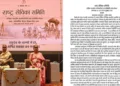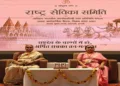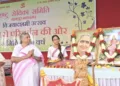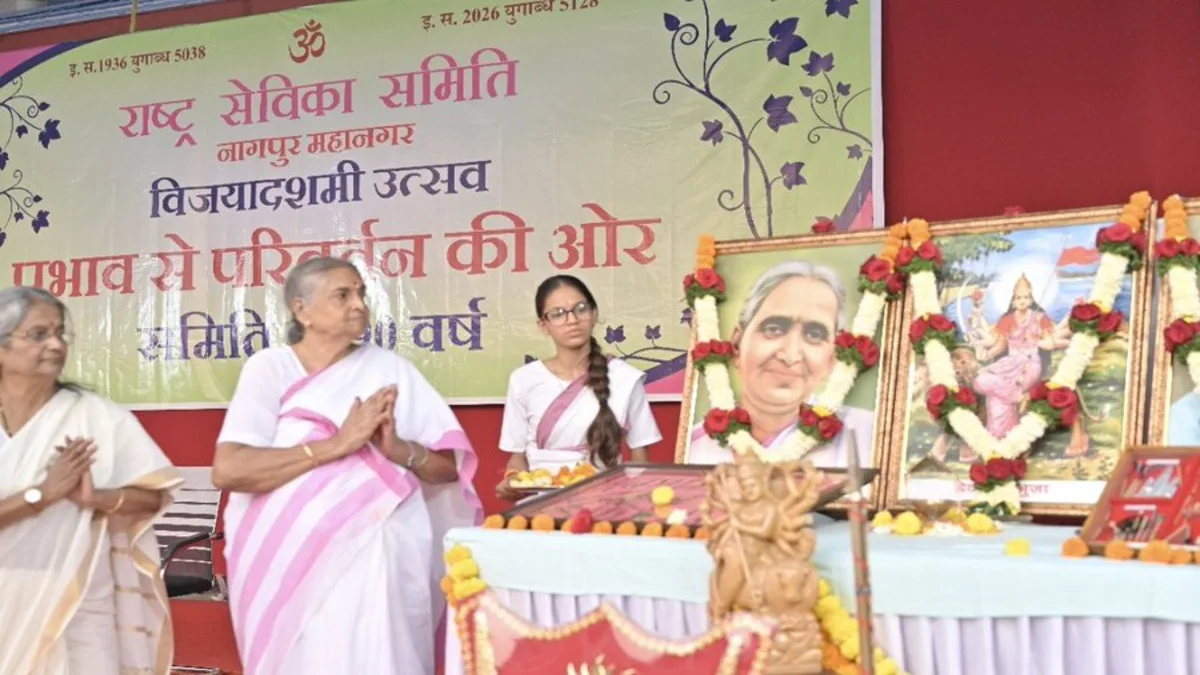
Nagpur, October 16, 2026: The Rashtra Sevika Samiti Nagpur Mahanagar organised its annual Vijayadashami Utsav and Shastra Pujan on October 16 at Sindhu Education Society’s Mahatma Gandhi Centennial, Sindhu High School, Jaripatka, Nagpur, marking the organisation’s 90 years of continuous dedication and service.
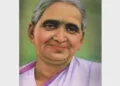
The programme was attended by Anuradha Prabhudesai, Founder of Lakshya Foundation, as the chief guest.
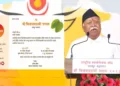
The keynote address was delivered by Vandaniya Shantakka ji, Pramukh Sanchalika of the Rashtra Sevika Samiti. Karuna Sathe, Nagpur Mahanagar Karyavahika, was also present at the event.
Addressing the gathering, Vandaniya Shantakka ji highlighted the importance of food in Bharatiya culture, describing it as sacred and essential to human nourishment and character formation. Referring to the Bhagavad Gita, she explained how food associated with the three gunas—Sattva, Rajas and Tamas—influences an individual’s nature and qualities. She emphasised that just as sattvic food nourishes the body and mind, the Rashtra Sevika Samiti seeks to provide the mind and intellect with sattvic values.
Shantakka ji said that the Samiti’s work through its regular shakhas aims to instil a soldier-like mentality among its sevikas, including courage, patience, dedication, commitment and discipline. She explained that these qualities enable trained and dedicated Samiti sevikas to serve society effectively and earn its trust.
Citing examples from the COVID-19 pandemic, she said that Samiti sevikas across the country promptly undertook relief work, including arranging medicines, preparing and distributing food, caring for elderly people and providing other essential assistance. She noted that people voluntarily entrusted money to the sevikas because of their confidence that it would be used responsibly.
She also recalled the Samiti’s contribution to vaccination efforts in Assam, where sevikas ensured that not even a single drop of vaccine was wasted. Their work earned the confidence of state government officials, who subsequently entrusted them with the responsibility of taking mobile vaccination vehicles to villages.
Recalling another example from Saurashtra in Gujarat, Shantakka ji described how young women sevikas, aged between 17 and 23, stepped forward during the COVID-19 pandemic to help manage the cremation ground amid an overwhelming number of deaths. Responding to the concerns of local residents, the sevikas worked from early morning until night, helped ensure the proper cremation of the deceased, maintained cleanliness and arranged space for additional cremations. They also preserved the ashes in labelled plastic covers so that family members could collect them later.
She said the selfless service of these young sevikas strengthened public confidence in the Samiti and demonstrated how its work over the years had created a positive impact on society. She added that, as the organisation completed 90 years of its journey, it continued to work towards bringing positive change across society.
Giving another example from Jashpur in Chhattisgarh, Shantakka ji spoke about young women sevikas who took the initiative to clean a mud-filled pond after noticing the difficulties faced by local women in accessing water. Rather than depending entirely on the authorities, the sevikas decided to take responsibility and work towards resolving the problem themselves.
She said the initiative brought a change in the mindset of villagers, who began believing that they should take responsibility for their village’s development instead of depending entirely on the government or others. She described this as an example of the transformation brought about by the Samiti through its shakha activities.
Giving another example from Yavatmal, Maharashtra, Shantakka referred to the difficulties faced by farming families in the region, where farmer suicides have been a concern. She said Samiti sevikas reached out to women in the villages, spoke to them and explored ways to help them become self-reliant. Some women were provided sewing training and sewing machines, along with financial assistance of Rs 3,000.
She explained that the sevikas continued visiting the women, engaging with them through satsang, bhajans, conversations and the sharing of positive thoughts. After eight months, one woman returned the Rs 3,000 she had received as assistance. When the sevikas expressed surprise and clarified that the money had been given to support her, the woman explained that the Samiti’s approach had inspired her to think about helping others in the same way.
The woman said she was now earning enough to support other women and had begun providing Rs 3,000 in assistance to women in her own locality. She had also helped other women from the surrounding rural areas receive sewing training and become self-reliant.
Shantakka ji said that when the sevikas first approached the women, some were hesitant and lacked confidence. However, sustained engagement and encouragement helped them develop the confidence to speak up and eventually become capable of extending assistance to others. She described this change, from receiving help to becoming capable of helping society as an important example of the Samiti’s work towards social transformation.
However, she said that despite such achievements, the Samiti could not remain satisfied with its work because of the challenges facing society. Referring to what she described as disruptive ideological influences and attempts to create instability in the country, she expressed concern over activities that, in her view, sought to undermine Bharat’s cultural foundations and influence young people.
She referred to protests and movements, including those at Jantar Mantar, and invoked Dr BR Ambedkar’s views on unconstitutional methods of protest. She said that, in her assessment, certain activities are aimed at creating instability in Bharat.
Shantakka ji also spoke about the status of women in Bharatiya tradition. Referring to the works of the ancient scholar Varahamihira, she mentioned a chapter titled Stree Prashansa, which contains verses praising women. She said such references demonstrated the respect accorded to women in Bharatiya civilisation and reflected their recognised place in society.
She expressed concern that contemporary narratives sometimes encouraged women to view their lives primarily through competition and continuous conflict over rights, rather than focusing on constructive social relationships. She said that while exploitation and atrocities against women remained genuine concerns, efforts to address these issues should also focus on bringing positive change to society and strengthening families.
Emphasising the importance of the family as the foundation of society in Bharat, Shantakka ji said that the disintegration of families was a matter of concern. She called for sustained social efforts to strengthen families and promote a balanced understanding of women’s dignity, rights and responsibilities.
She reiterated that the Rashtra Sevika Samiti continues to work towards social transformation through its dedicated sevikas, community service and sustained engagement with society.
Earlier, addressing the gathering, Anuradha Prabhudesai, Founder of Lakshya Foundation, spoke about the lives of soldiers deployed at the borders and the resilience of their families. Describing the courage of soldiers and their mothers, she said, “A soldier is a poem, but a soldier’s mother is an epic.”
She also highlighted the courage of soldiers’ wives, stating that they are as brave as the soldiers themselves. “Dreams have been shattered, but courage remains alive,” she said, describing the hardships faced by soldiers stationed at the borders and the strong mental resolve of their families.
The annual Vijayadashami Utsav and Shastra Pujan were organised in the backdrop of the Rashtra Sevika Samiti completing 90 years of its journey.