NEW DELHI: Political protests in India are a legitimate public expression of dissent or opposition against a law, policy or action of the government. Though protest is not specifically mentioned in the Constitution of India, it is assured through Article 19, Article 21 and Article 32 of the Constitution. But such a fundamental right is not absolute, and the government under Article 19(2) and 19(3) can impose reasonable restrictions to protect the sovereignty and integrity of India, maintain public order and to prevent defamation/incitement to an offence. In short, our Constitution protects peaceful protests as a democratic right but not at the cost of other people’s right to move, work or live.
Political protests are not new to India, but these protests have increasingly acquired an agitational mode in the last seven years. It started with anti-CAA protests in December 2019, where communal polarisation was attempted, which ultimately resulted in the Northeast Delhi riots in February 2020. It was no coincidence that the riots took place just prior to President Trump’s visit to Delhi on 24-25 February 2020. Farmers’ protests from November 2020 to December 2021 again took a violent turn. Manipur has witnessed violent unrest from May 2023 onwards. Sixth Schedule agitation in Ladakh from the year 2024 onwards is still fresh in our memory. It may be noted that all these protests took place after the NDA coalition under PM Modi returned to power with an even bigger majority in May 2019.
But the protests by Cockroach Janata Party (CJP) against examination paper leaks in June-July this year have added another dimension to the agitational culture in India. The ability of the CJP to mobilise thousands of supporters has surprised the local administration. These organisations have also displayed scant regard for the constitutional bodies. They have exploited social media in a clever manner and have also shown political ambitions. That is why they have started questioning the S.I.R. process and have cast aspersions on the Chief Election Commissioner (CEC). The guerrilla tactics of the CJP have now been adopted by the political opposition in India. That is why the political opposition did the unthinkable act of marching towards the Supreme Court of India in a typical agitational procession.
It is therefore important to understand as to how such prolonged protests and agitations affect the internal security of India. It starts with erosion of trust in the constitutional authorities and important bodies, such as the Supreme/High Courts, ECI, ED, CBI, CAG, RBI, SEBI, etc. Some of the organisations and political parties even question the armed forces. Their aim is to weaken the public confidence in the impartiality of these important functionaries, without any substantive proof. The prolonged agitation over the S.I.R. is simply to disrespect the popular mandate and create confusion in the minds of the people. The S.I.R. process is tedious but critical to cleanse the electoral rolls. Even with the best intentions, some voters may be left out. That is why the ECI has now commenced a special drive to include the left-out voters. But it has to be understood that in a country with approximately 100 crore voters, some anomalies in the electoral rolls are possible.
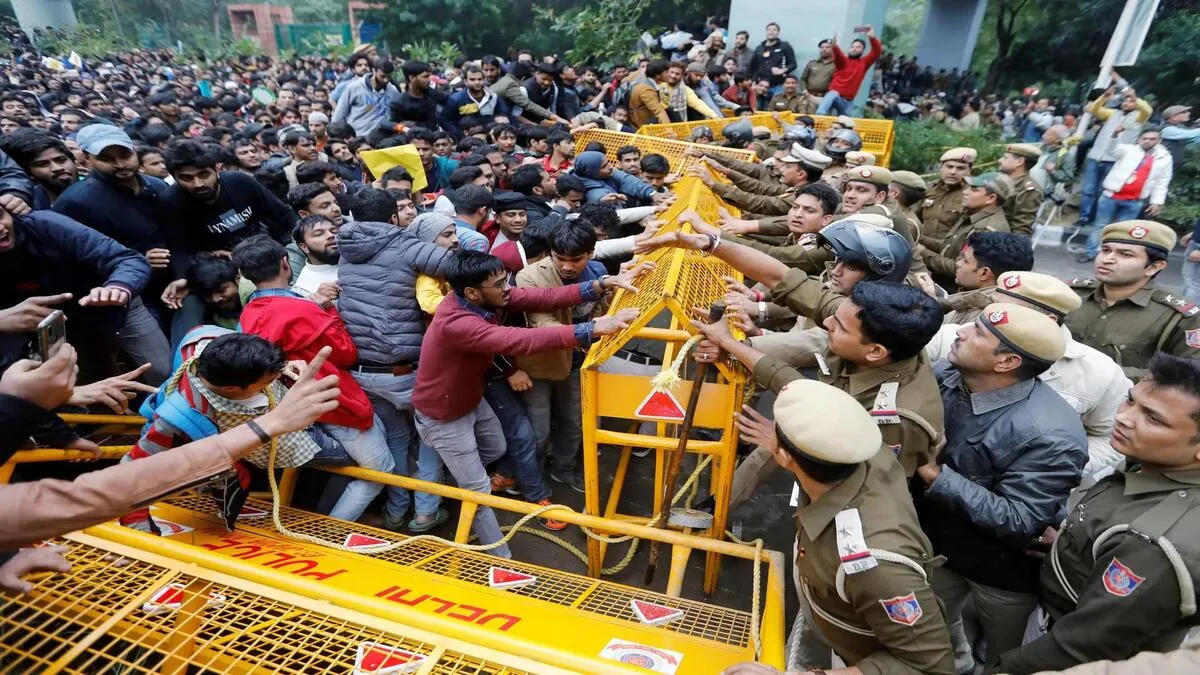
It is not difficult to see that the prolonged agitations require preventive deployment of the police and paramilitary forces in large numbers. Since these protests happen under the media glare, the law enforcement agencies have to deploy more manpower for crowd control, traffic management and protection of the sensitive installations like the Parliament or the Supreme Court of India. Such regular protests on the streets divert police from crime prevention, counter-terrorism, border policing and community policing. The police are also constrained to restrict the movement of people to prevent untoward incidents. The police are made to look oppressive in the eyes of the people by the leaders leading the protests. In the long term, it creates a sense of mistrust in the law enforcement agencies, as it happened in the case of Manipur.
Two consequences of prolonged protests and agitations weaken internal security, either directly or indirectly. The first one is radicalisation and polarisation. When such protests get amplified through social media, the radical elements take over and polarise the thought process of the innocent public. In the October protests in Delhi, there are credible inputs of Pakistan-sponsored social media handles trying to foment internal unrest in India. The second consequence of prolonged unrest is disruption of essential services, commerce, education, healthcare and ease of movement. There are frequent calls for bandhs, and the common man suffers the most. These disruptions ultimately adversely impact the economy, particularly in the medium and small sectors. A good example of this is the state of West Bengal under the previous Communist and TMC rule. West Bengal witnessed maximum illegal immigration from Bangladesh over the last two decades, because the state became a fertile ground for continuous agitations.
There is another danger. India has just finished Naxalism, and the security forces are now carrying out operations to neutralise the last remnant of the cadre and their hidden cache of arms, ammunition and explosives. My fear is that continued unrest may embolden the urban Naxals to revive Naxalism in India. The government is trying its best to revive the economy in the interiors of Naxal-affected areas. But a false narrative and foreign interference can undo decades of hard work put in by the security forces. I suspect that there would be attempts to cause unrest in the states impacted by Naxalism. The aim of the forces inimical to India’s interests would be to tie down the police and paramilitary forces in unnecessary crowd management, thus weakening the anti-Naxal operations.
Another worrying pattern is giving open threats to the constitutional bodies, law enforcement officials and other government officials that we will sort you out once we come to power. Such an attitude creates a defensive approach from the civil servants and other government officials, including the police. With the threat of a future vendetta, the officials hesitate in taking firm and uncomfortable decisions to maintain public order. Such threats can also lead to politicisation of the government officials, particularly when they are told that more than 200 officials are in touch with the opposition. Therefore, a threat of punitive action against the government officials who are doing their lawful duty has long-term implications for eroding governance. In the Indian context, weak governance invariably impacts internal security.
The legal framework also has to recognise the new realities of the simmering tension and unrest. As the ongoing student movement in France has shown, such protests end up in violence. Thus, the courts have to put reasonable restrictions on protests to ensure public order. The police have a tough job at hand, and they need good SOPs to deal with the unruly mobs. The police also need high-quality training and competent leadership to direct action when necessary. The courts have to consider institutional fatigue, and one odd police aberration should not defame the police. At the same time, the government should not shy away from any administrative correction. A good example was the repeal of the Farm Laws by the Modi government in November 2021.
For a country of 140 crore people and an aspirational society, internal security is the foundation of growth, development and prosperity of the nation. India is aspiring to be a developed nation by the year 2047 @ Viksit Bharat 2047. As we have seen in the past, India’s fragile internal order was exploited by external forces. Modi government has dealt with the internal security threats in a firm manner, be it J&K, the North East and Left-Wing Extremism. India has also articulated a new normal to deal with terrorism sponsored from across the borders. Now the inimical forces have found a new weapon in prolonged protests to weaken the government, both at the centre and in the states, particularly the border states. Repeated attempts by Pakistan to smuggle drugs and war-like stores through drones in Punjab and Rajasthan are another example of how internal security is disturbed. During such a state of perceived unrest in the country, even Elon Musk seeks entry of Starlink into India, disregarding the security concerns and quickly finds support from the LoP.
It is also a fact that external agencies fund, directly or indirectly, many of the agitations in India. Even internal funding is not a problem now. We also find that many such organisations and their leaders are represented by the celebrity lawyers. Many of these lawyers are able to exert pressure on the courts to seek favourable decisions. These brazen acts embolden the fence-sitters, and the agitations tend to persist and broaden. The regime change in India’s neighbourhood (Sri Lanka, Nepal and Bangladesh) has also inspired the fringe elements, and we also hear of regime change in India in the ongoing agitation. Such a narrative has extremely dangerous connotations for defending the constitutional order through constitutional means. For the sake of the country, all the stakeholders have to exert themselves to preserve the idea of India. The constitutional bodies have to exhibit transparency and fairness, the courts have to protect the law, and policing has to be firm but impartial. A timely political dialogue and community engagement should find solutions to the genuine grievances of the people. India can not afford to slip away from the growth trajectory through the stage-managed internal frictions.