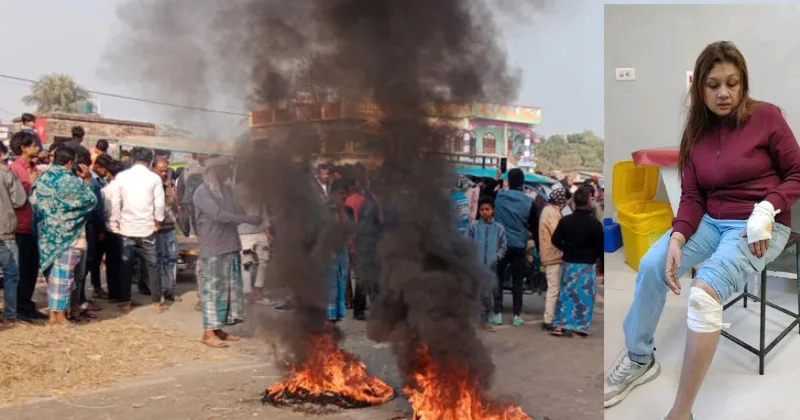
A woman journalist from a television news channel was allegedly attacked by a mob while covering violent protests in Beldanga, West Bengal’s Murshidabad district, on January 16. Zee 24 Ghanta journalist Soma Maity was reportedly dragged onto the road and brutally assaulted while reporting from the protest site.
According to accounts, she sustained serious injuries to her hands and legs during the attack.
Recalling the incident later, Soma said she had never faced such a terrifying experience in her career.
She alleged that two men lifted her, while others pulled her hair, held her legs, tugged at her clothes, and touched her inappropriately.
Her mobile phone was also reportedly snatched during the assault, leaving her deeply shaken and traumatised.
The attack on a journalist, often regarded as part of the fourth pillar of democracy, has raised serious concerns over the safety of media personnel operating in volatile situations.
Questions have also been raised over the absence of adequate police protection for journalists reporting from the ground.
The violence unfolded amid widespread unrest in Beldanga following the death of a migrant labourer. The turmoil began after the body of 30-year-old Alauddin Sheikh was brought to his native village, Sujapur Kumarpur, which falls under the Beldanga police station limits.
Sheikh, who had been working in neighbouring Jharkhand, was found hanging from the ceiling of his room on the morning of January 16. The circumstances surrounding his death triggered suspicion, grief, and anger among local residents.
As the body arrived in the village, emotions escalated rapidly. Protests soon broke out, with demonstrators blocking major roads and railway tracks, disrupting normal life across the area.
Protesters demanded strict and exemplary punishment for those they believed were responsible for the young labourer’s death. What began as a protest over a suspicious death quickly spiralled into widespread disorder, exposing the fragile law-and-order situation in the region.
Amid the violence, criticism mounted over the perceived inaction of the West Bengal Police. Observers noted that while police personnel appeared passive during incidents of mob violence and attacks on journalists, they had previously acted with force, including lathi-charges, against peaceful protests by teachers and other civil groups. This contrast has led to allegations of selective enforcement and questions over neutrality and accountability.
In the midst of the Beldanga unrest that followed the tragic death of a migrant labourer, West Bengal Chief Minister Mamata Banerjee made a remark that has ignited controversy and drawn fierce criticism. Attempting to explain why protests erupted with such intensity on Friday, Banerjee referred to “Jumma day”; the Muslim congregational prayer day — suggesting that protesters had emotional “sentiments” attached to it and that it partly explained the timing and scale of mobilisation.
She stressed that many were gathered for Friday prayers, pointing to religious practice as a contextual factor in the unrest, and implicitly linked the crowd’s motivation to communal identity rather than purely to the profound grief and justice demands of local residents.
This remark is deeply troubling for several reasons. First, in a secular republic, assigning behavioural explanations to a community on the basis of religious observance — especially in the context of violence — risks fuelling division rather than calming tempers.
Second, by framing the crowd’s reaction through a religious lens, the Chief Minister appears to divert attention from the very real grievances that ignited the protests; a young man’s suspicious death and widespread anger over justice and safety.
Third, her comments conveniently echo a political narrative that shifts blame onto communities instead of holding accountable those whose failure to prevent lawlessness allowed journalists to be assaulted and public order to break down.
Rather than fostering empathy and unity, such statements can compound mistrust at a time when authoritative leadership and clear, impartial investigation are most needed. Balanced governance requires stepping above sectarian framing; yet Banerjee’s remark risks entrenching precisely the perception of bias that undermines democratic trust and public safety.