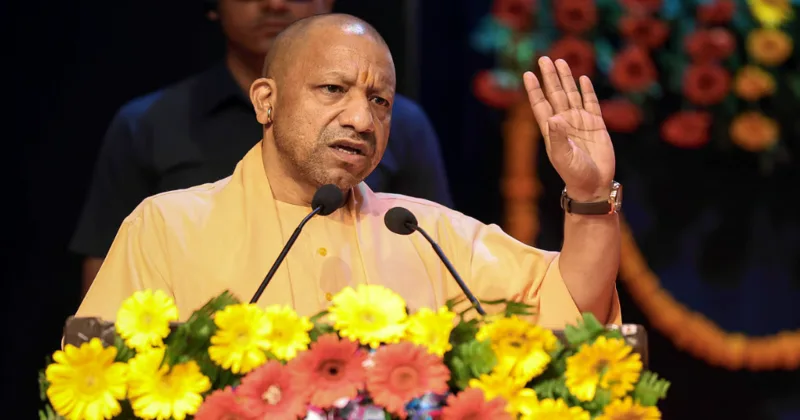
In Lucknow, the Chief Minister Yogi Adityanath launched Project Ganga (Government Assisted Network for Growth and Advancement) to give fresh momentum to the campaign for Digital Entrepreneurship across the state. This innovative initiative carries forward the resolve of Hon’ble Prime Minister Shri Narendra Modi ji’s ‘Digital India’, a vision that forms the strong foundation for building a ‘Viksit Bharat’ and an ‘Aatmanirbhar Bharat’. He shared heartfelt thanks to the UP-Transformation Commission, the IT and Electronics Department, the Hinduja Group and congratulated the people of the state.
डिजिटल सशक्तीकरण का विस्तार,
आत्मनिर्भरता का नया आधार!मुख्यमंत्री @myogiadityanath जी आज लखनऊ में 'प्रोजेक्ट गंगा' (Government Assisted Network for Growth and Advancement) के शुभारंभ कार्यक्रम में सम्मिलित हुए।
इस अवसर पर मुख्यमंत्री जी ने कहा कि प्रोजेक्ट गंगा प्रदेश में… pic.twitter.com/mn9N7vZNNC
— CM Office, GoUP (@CMOfficeUP) June 9, 2026
The UP government formally inaugurated Project GANGA (Government Assisted Network for Growth and Advancement) on 9th March 2026. Its most ambitious push is to carry high-speed broadband into the deepest corners of rural Bharat. The launch was marked by the signing of a Memorandum of Understanding between the State Transformation Commission and OneOTT Intertainment Ltd, the broadband vertical of the Hinduja Group’s Hinduja Global Solutions.
It pledges to connect more than 20 lakh rural and semi-urban households within two to three years. The MoU was signed by STC CEO Manoj Kumar Singh and Vynsley Fernandes of HGS/OIL, in the presence of Finance and Parliamentary Affairs Minister Suresh Kumar Khanna. At that time, Chief Minister Yogi Adityanath made clear that the ceremony was only a formal beginning, the real work of selecting and training the entrepreneurs who will run the network and reaching the last village on the map decides its success.
The connectivity ladder: Why Nyaya Panchayats come first
The scheme’s design reveals a plan to enable 8,000 to 10,000 local entrepreneurs with Digital Service Providers or DSP to operate as independent internet providers at the Nyaya Panchayat level by delivering broadband directly inside their own communities.
The choice of the Nyaya Panchayat as the launch tier is strategically development-oriented. Uttar Pradesh has roughly 8,135 nyaya panchayats, with 58,000-plus gram panchayats organised across 75 districts and 823 development blocks. Chief Minister Yogi Adityanath at the launch said that saturating the nyaya panchayat layer first makes the final descent to individual gram panchayats far easier, because the units are interlinked in what he described as a scientific and hierarchical model. Crack the middle tier, and the last mile follows almost on its own.
This is where the rural-digital story genuinely begins. The Chief Minister was candid in identifying last-mile digital connectivity as the single biggest challenge before the state. With around 7,000 gram panchayats already connected through BharatNet and a handful of private operators in the mix, the government’s own estimate is that existing coverage reaches perhaps 10,000 units at most. Bridging the gap to all the nyaya panchayats and every gram panchayat has the obstacle that Project GANGA is built to clear.
Standing on infrastructure: Digital India
What distinguishes Project GANGA from a standalone broadband contract is that it stacks onto a rural digital foundation the state has spent years building. Consider the Gram Sachivalaya model. Uttar Pradesh has established secretariats across its gram panchayats, not single-room outposts but four-to-six-room facilities, several equipped with their own digital libraries, giving elected gram pradhans and lekhpals dedicated offices for the first time.
The practical payoff is immediate, where a villager can now obtain income, residence, caste and birth-and-death certificates within the village itself, without trekking to the block or district headquarters. That is the human face of digital governance and the kind of service Project GANGA’s bandwidth is meant to deepen and speed up.
Layered onto this is the BC (Business Correspondent) Sakhi network banking correspondents, many women, seeded during the COVID period and now operating self-reliantly. Combined with the migration of welfare payments to Direct Benefit Transfer and digital channels, the Chief Minister argued, this has squeezed out the middlemen who once extracted bribes on pensions and entitlements. Project GANGA DSP are explicitly modelled with equipped, identifiable and weaned toward independence after initial support.
The entrepreneur engine and the financial-inclusion
CM also shared about the CM -YUVA yojna. The most prominent CM-YUVA, the Mukhyamantri Yuva Udyami Vikas Abhiyan portal, went live on 24 January 2025. It offers eligible youth a collateral-free, interest-free loan of up to Rs 5 lakh (a project cost cap of Rs 5 lakh, with the loan component around Rs 4.5 lakh), a 10 per cent margin-money subsidy, and structured training. The scheme drew over three lakh registrations within weeks of launch, underscoring rural appetite for self-employment capital. The DSP is not conceived as a salaried government functionary but as a small entrepreneur, and the state intends to plug each one into financing schemes already running.
The government has signalled that women are to form a significant share of the DSP cohort by continuing the gender pattern set by the BC Sakhi rollout. If realised, that turns Project GANGA from a connectivity contract into a rural women’s enterprise programme riding on fibre.
The sustainability question
The Chief Minister drew a sharp philosophical line at the launch of a model built on aatmanirbharta self-reliance. The DSP design is meant to make the citizen self-sufficient and government dependence minimal, producing a sustainable rather than subsidy-dependent system. The honest counter-question worth posing is whether dependence on a single private partner for last-mile infrastructure simply relocates that reliance rather than removing it, a tension any rigorous account of the scheme should hold open.
Set for the national canvas, the ambition is unmistakably sovereign in framing. Project GANGA is pitched as a state-level engine for the Centre’s Digital India, Viksit Bharat and Aatmanirbhar Bharat goals, an attempt by India’s most populous state, home to over 240 million people. To demonstrate that rural digital inclusion at a continental scale is an Indian capability, not an imported one. This yojna describes the smart village as a gram panchayat where broadband enables local online commerce, and remote services and governance are delivered at the doorstep.
The launch by the Chief Minister talks about the first wave of targets, where a set of districts is selected before scaling toward all 75. The metrics that will matter are how many nyaya panchayats are lit up on schedule, how many women actually become DSPs and whether the certificate at the doorstep promise holds when bandwidth is finally the binding constraint.
If Uttar Pradesh can wire its gram panchayats the way it describes, it will have built not just a broadband network but a supportive structure for digital Bharat. This kind of model can be implemented in other states to ensure the vision of Viksit Bharat and Aatmanirbhar Bharat.