On January 8, 2026, the Enforcement Directorate (ED) conducted coordinated raids at multiple locations in Kolkata and Bidhannagar, placing Pratik Jain, co-founder and director of the influential political consultancy Indian Political Action Committee (I-PAC), squarely under the scanner. The searches were carried out at I-PAC’s Salt Lake office, Jain’s residence on Loudon Street, and the premises of a trader in Burrabazar’s Posta area.
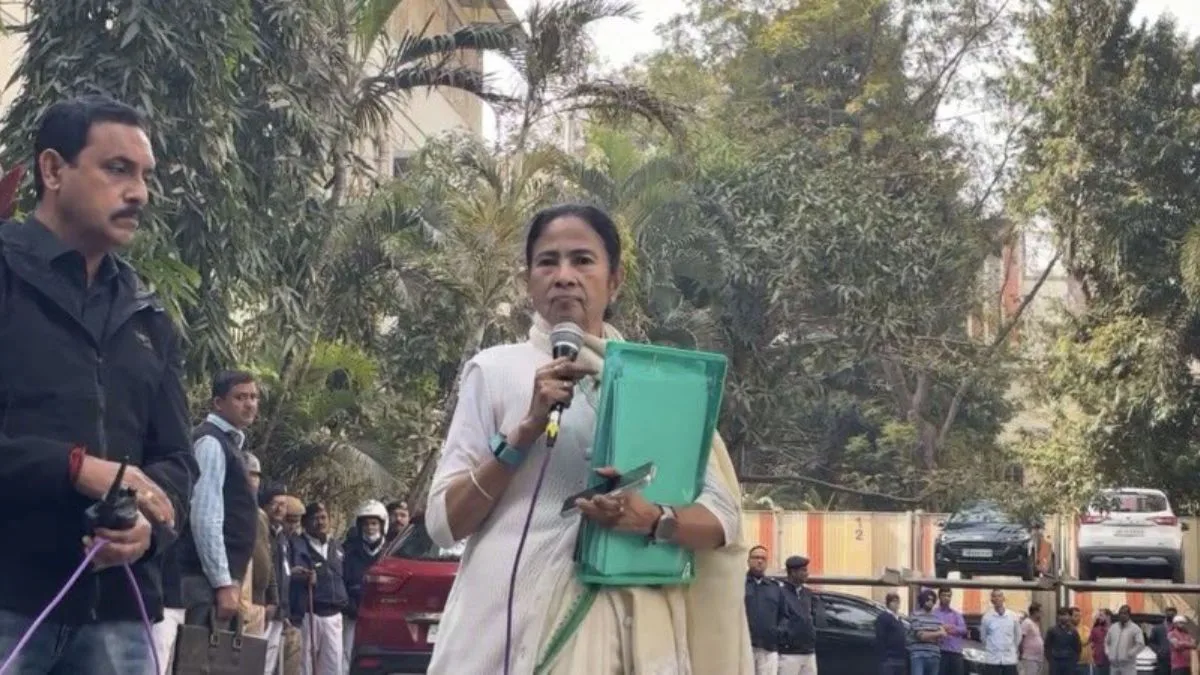
While ED raids are not uncommon in West Bengal’s increasingly crowded landscape of corruption investigations, what set this operation apart was the extraordinary political reaction it triggered. West Bengal Chief Minister Mamata Banerjee made a sudden appearance at Jain’s residence during the searches, publicly condemning the agency and alleging political vendetta.
Calling Jain “in charge of party work,” Banerjee accused the ED of attempting to seize sensitive data related to Trinamool Congress’s (TMC) organisational and digital operations. Her dramatic intervention, coupled with allegations that she removed files and a hard disk from the premises, has since become a focal point of political and legal debate.
Why Pratik Jain matters to TMC
Pratik Jain is not merely a private consultant. He heads the IT and digital strategy wing of the ruling Trinamool Congress and has been deeply embedded in the party’s electoral machinery since 2019. I-PAC’s role in crafting TMC’s winning narrative in the 2021 West Bengal Assembly elections cemented Jain’s position as one of Mamata Banerjee’s most trusted strategists.
This proximity explains why a probe into a “private consultancy firm” has provoked such an aggressive political response. Critics argue that the Chief Minister’s conduct suggests panic rather than principle, raising uncomfortable questions about what exactly is at stake.
Coal Scam: The original crime trail
The roots of the current investigation lie in the massive illegal coal mining and smuggling racket that surfaced in West Bengal in 2020. An FIR registered that year revealed rampant theft of coal from Eastern Coalfields Limited (ECL) lease areas, particularly in Paschim Bardhaman district.
The scam was allegedly enabled through collusion between coal mafia operatives, railway officials, CISF personnel, and local administrative machinery. Investigators later discovered that the stolen coal was sold across Bardhaman, Bankura, Purulia, and adjoining districts, with a significant portion allegedly supplied to the Shakambhari group of companies.
According to ED findings, between December 2017 and October 2020, illegal mining resulted in losses exceeding Rs 2,742 crore in royalties, taxes, and coal value. Approximately 25.51 lakh metric tonnes of coal, valued at over Rs 1,114 crore, was illegally extracted during this period.
The kingpin and the hawala web
At the centre of the coal syndicate is Anup Maji, also known as “Lala,” who investigators describe as the mastermind of the operation. Maji’s criminal history dates back decades, with at least 16 FIRs registered against him between 2000 and 2015.
As investigations widened, the Central Bureau of Investigation (CBI) registered a fresh case in late 2020, while the ED began tracing the proceeds of crime. This is where hawala operators entered the picture, facilitating the laundering of massive cash flows generated by coal theft.
ED records show that Gurapada Maji transferred around Rs 89 crore, while another accused, Jayadev Mandal, routed approximately Rs 58 crore as proceeds of crime through illegal channels between 2017 and 2020.
How I-PAC E=entered the frame
According to the ED, one of the hawala operators involved in laundering coal scam money facilitated the transfer of “tens of crores of rupees” to Indian PAC Consulting Private Limited. This discovery prompted the agency to conduct searches linked to Pratik Jain.
The agency alleges that these funds were eventually used for political operations, specifically for the Trinamool Congress’s election campaign in Goa between 2021 and 2022.
In a writ petition filed before the Calcutta High Court on January 9, the ED claimed that approximately ₹20 crore of illicit funds were deployed in Goa as part of TMC’s political strategy.
Investigators have pieced together a detailed money trail. The proceeds of crime, originating from Anup Maji’s coal syndicate, were allegedly routed through hawala firms in Kolkata, including a company named R. Kanti Lal, before being transferred to Goa.
WhatsApp chats recovered from Anup Maji’s accountant Niraj Singh, involving former Bankura police officer Ashok Kumar Mishra, reportedly indicate that R. Kanti Lal was instrumental in moving illegal cash across states. Mishra was arrested by the ED in 2021 and is currently out on bail.
ED intelligence suggests that cash consignments were handled in Goa by hawala operator Sagar Kumar Patel, who, during interrogation, named Akshay Kumar as the recipient of the funds.
Event companies and campaign operations
Akshay Kumar, according to ED statements, is linked to event management firms ASM Event Technology and Hertz and Pixelz. These companies, investigators say, worked extensively for I-PAC during the Goa campaign period.
Under questioning in October 2023 and January 2024, Akshay Kumar admitted that both firms were engaged by I-PAC to manage political events in Goa. Another accused, Alpesh Patel of R. Kanti Lal firm, confessed to arranging ₹20 crore in cash and handing it over to Akshay Kumar.
The trail further led to Mukesh Patel of Rajesh Maganlal firm, Mukesh Thakkar alias Munna, and Kolkata-based NBFC operator Jitendra Mehta, all allegedly involved in facilitating the hawala transfers.
In its court filing, the ED states that Pratik Jain personally handled I-PAC’s Goa operations and that the laundered funds were used for election-related activities. The agency claims the cash was ultimately received by I-PAC-linked personnel through event management intermediaries.
If proven, the allegations establish a direct link between proceeds of crime from a coal scam and political financing, an explosive charge with far-reaching legal and political consequences.
Who is Pratik Jain?
An IIT Bombay graduate, Pratik Jain began his career in finance and consulting before co-founding Citizens for Accountable Governance (CAG), which later evolved into I-PAC. Jain worked briefly at Deloitte and interned at Axis Mutual Fund before transitioning into political strategy.
As I-PAC’s co-founder and director, Jain became a key architect of data-driven political campaigns. His influence grew significantly after Prashant Kishor’s exit in 2021, when Jain and Rishi Raj Singh assumed greater control of the firm.
While I-PAC delivered a landmark victory for TMC in 2021, its subsequent campaigns have been less successful. The consultancy failed to turn the tide for YSRCP in Andhra Pradesh in 2024 and later for AAP in Delhi in 2025, where the BJP emerged victorious.
Simultaneously, allegations of opaque funding and political favouritism have increasingly dogged the firm.
Past Allegations: Andhra Pradesh episode
In 2023, the Telugu Desam Party accused the YSRCP government of diverting Rs 274 crore of public funds to I-PAC through shell companies under the guise of volunteer supervision contracts.
TDP leaders alleged that government orders were issued without tenders and that employees of contracted firms were, in reality, I-PAC staff, effectively routing public money to a political consultancy.
While those allegations remain politically contested, they now add historical weight to the ED’s current investigation.
On January 9, TMC leaders, including Mamata Banerjee and Mahua Moitra, staged protests accusing the Centre of misusing federal agencies. Banerjee even filed a police complaint against the ED.
Yet, many note that such aggressive mobilisation over a probe into a private consultancy firm is unusual and potentially revealing.
As the investigation deepens, the Pratik Jain-I-PAC case has become emblematic of a larger issue: the unchecked power of political consultancies operating in grey zones between strategy, governance, and finance.
And for Mamata Banerjee’s TMC, the political cost of this probe may be only beginning.