
This is a familiar pattern: Islamists and the political parties that back them repeatedly target popular Hindu temples that draw massive crowds and generate high revenue. The goal is to manufacture a “secular” narrative linking Muslims to the temple — either for financial control or radical motives.
This time, their focus is on the ancient Kottiyoor Mahadeva Temple in Kannur, Kerala. This sacred Shiva shrine has followed purely Hindu traditions for over 2,000 years. Year after year, the number of devotees keeps rising — with more and more pilgrims coming from other states for the Vaisakha Mahotsavam, which falls in the Malayalam month of Edavam, usually in June.
How exactly are they planning to force their radical narrative onto this ancient shrine? Who is backing them? And why is the Kerala government silently shielding Karnataka Congress leader and Cabinet-rank minister Shahid Thekkil while he pushes a brand-new “Muslim ritual” at the sacred Bavali River — the very site of Lord Shiva and Daksha Yaga?
Keralam’s Kottiyoor Mahadeva Temple
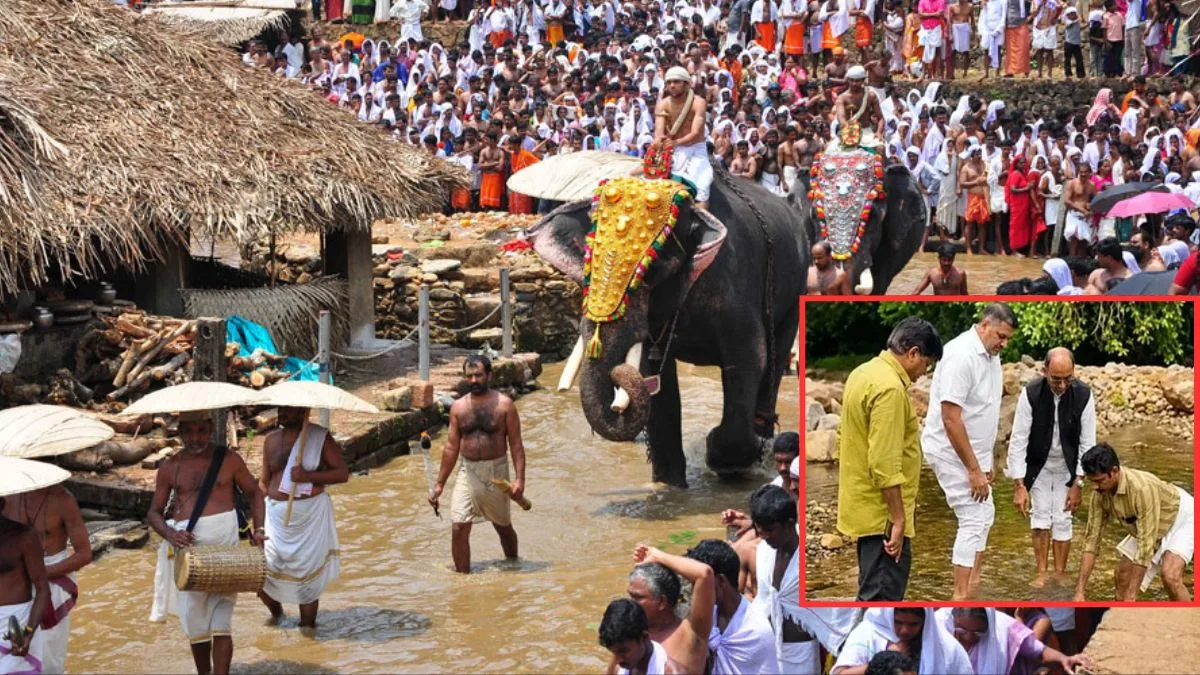
Deep in a forest in Keralam there is a special shrine that opens only once a year. For most of the year the Akkare Kottiyoor temple is a quiet forest with no walls or roof. During the Vysakha Mahotsavam festival it becomes a busy sacred place. People wade through the monsoon waters of the Bavali River to reach a Shiva Lingam on a bed of river stones. With a history spanning more than 2,000 years, the Kottiyoor Temple complex stands among Hinduism’s most sacred pilgrimage centres.
According to the Puranas, the eastern bank of the Bavali River, known as Akkare Kottiyoor, is where the Daksha Yaga took place— the great cosmic sacrifice where Sati Devi, Lord Shiva’s beloved wife, was publicly shamed by her father, Daksha, who had deliberately excluded Shiva from his royal ritual. Sati set herself on fire. Shiva’s sorrow reverberated across the three worlds. In Shaivite tradition, Kottiyoor is the site of both the universe’s fracture and its healing.
The rituals practised today were formalised by Adi Shankaracharya, who visited the site and felt Shiva’s divine presence so strongly that he refused to step onto the eastern bank for fear of polluting it. Instead, he prayed from the western shore. That act of respect in the 8th century created a ceremonial framework that has remained largely unchanged for over twelve centuries.
What makes Kottiyoor unique is how its ritual calendar integrates social roles. The Kottayam (Pazhassi) royal family assigned specific hereditary duties to 64 communities, from Brahmin priests to Kurichya tribal families. Each group carries raw materials for the festival, sometimes traveling over a hundred kilometers on foot. Every task is linked to a specific family, and everyone knows who holds each role.
The Kurumathur family pours the first ghee onto the Shivalinga. The Thammangadan Namboothiri family performs the Alingana Pushpanjali — a ritual embrace of Shiva by a devotee representing Vishnu, symbolically calming the grieving god. These roles are not mere assignments; they are identities passed down through generations. This is the world that the Bavalikkettu family claims to have entered.
Muslim Family’s Claim, Muslim League led Congress Govt Support and Cabinet-rank minister Shahid Thekkil’s Drama at Bavali River
The Claim That Shook the Festival In the weeks leading up to the 2025 Vysakha Mahotsavam, a petition reportedly reached the Malabar Devaswom Board, the government body that oversees Kottiyoor. This petition, from a Muslim family, a Kottayam Malabar Ponnambilathu Parapravan Tharavadu, claimed that their ancestors historically held a role at the festival called Bavalikkettu.
This new claim sounds completely bizarre to the local people who have lived around the temple for generations. For over 2,000 years, they and their forefathers have known and witnessed Kottiyoor only as a sacred Mahadeva temple with its exclusive Hindu rituals. They are shocked and firm — they have never heard of any Muslim family or any Muslim connection to the Vaisakha Mahotsavam with the Mahadeva Temple and the Bavali river where the ancient temple resides.
This role was linked to a preparatory task at the ceremonial site, which they argued had been wrongly abandoned. Bavalikkettu roughly translates to “the tying of the Bavali,” and according to the family’s account, it refers to a specific preparatory function at the festival’s start. The noteworthy aspect was not the claim itself—hereditary service disputes are common in Kerala temples—but the religion of the claiming family. Once the news hit social media and Hindu activist groups, reactions were swift and intense.
What Happened? The Drama
Shahid Thekkil, a senior Congress leader from Karnataka and Chairman of the Karnataka Minimum Wage Advisory Board, arrived at the Bavali River with a group posing as historians. They performed a strange ritual known only to themselves, filmed it with a media crew, and aggressively promoted it on social media.
The Kottiyoor Temple Devaswom Board has clearly stated that it has no knowledge of any such ritual and that the temple’s traditional rights belong exclusively to recognised Hindu titleholders. This cannot be dismissed as an isolated incident. It fits a familiar pattern of challenging ancient customs, publicising the violation, and trying to manufacture a “new tradition.”
With both Kerala and Karnataka under Congress rule, it is hard to believe Shahid Thekkil would carry out such a provocative act — one that has deeply hurt Hindu sentiments — without backing or silent approval from higher authorities.
The Political Shadow in Kerala, temple issues seldom stay purely theological for long, and the Bavalikkettu dispute was no exception.Within days, the political aspects became clear…
The Congress-led United Democratic Front, along with its key ally, the Indian Union Muslim League, faced accusations of creating a political environment conducive to such a claim. V.D. Satheesan, who was then the Leader of the Opposition and later became Kerala’s Chief Minister after the UDF’s 2026 assembly victory, became implicated in this story.
According to members of the Devaswom, Shahid Thekkil’s visit was driven by a radical agenda, and they allege that both the Kerala and Karnataka governments lent support to the newly propagated ‘Bavalikkettu’ narrative. They further claim that the group led by Shahid arrived under the escort and protection of the Kerala Police.
Vysakha Mahotsavam 2026 and the Rituals
The Vysakha Mahotsavam takes place from May 23 to June 24. Devotees once again crossed the Bavali. The Rohini Aradhana was performed. The Kurumathur family poured their ghee. The Thammangadan Namboothiris carried out the sacred embrace. The Palmyra-leaf hermitage was constructed at the festival’s beginning and taken down at its end, restoring the forest’s ancient quiet.
A retired schoolteacher who had attended the festival for 47 consecutive years shared a thought: “I don’t know all the legal details. What I know is that when I wade into this river, I am part of something that existed long before my grandmother’s grandmother was born. Anything threatening that continuity—whatever the source—should be opposed. Not because of politics, but because this is not politics. This is the ground we stand on.”