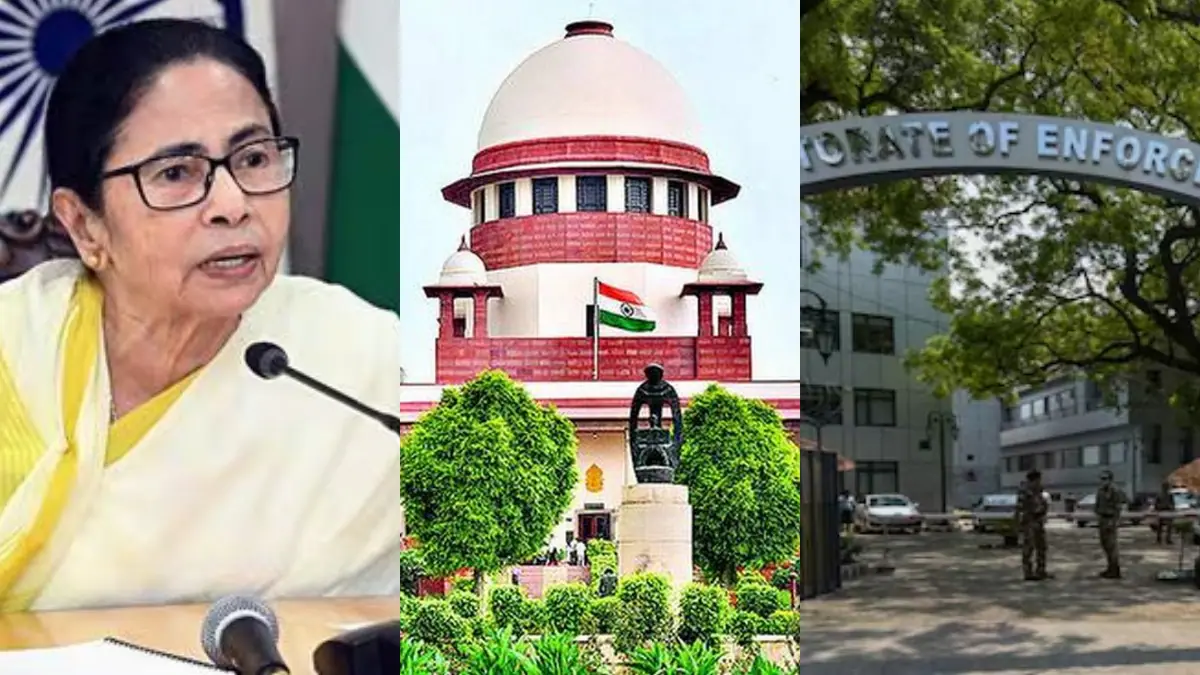
The Supreme Court on January 15, heard the Enforcement Directorate’s petition accusing West Bengal Chief Minister Mamata Banerjee and the state police of interfering with search operations conducted at the headquarters of political consultancy firm I-PAC and the residence of its director, Pratik Jain, in Kolkata on January 8.
Taking note of the submissions, the apex court observed that the allegations raised by the central agency were “serious” and warranted careful examination, as they touched upon the functioning of investigative agencies and the broader issue of law and order.
Appearing for the ED, Solicitor General Tushar Mehta described the events during the raids as a “shocking state of affairs,” alleging that the Chief Minister, accompanied by top police officials, entered the premises while search operations were underway and forcibly removed incriminating material linked to an alleged coal smuggling scam.
Mehta claimed that senior police officers not only failed to protect the lawful search but actively aided its obstruction. He told the court that several police personnel sat on dharna along with political leaders in protest against the raids, creating an atmosphere of intimidation for ED officers.
In a significant escalation, the ED filed a fresh application seeking the suspension of senior West Bengal police officers, including Director General of Police Rajiv Kumar. The agency alleged that the police leadership facilitated Mamata Banerjee’s actions and enabled the removal of crucial evidence from the raid sites.
The ED further claimed that the DGP himself accompanied the Chief Minister to the locations where the searches were being conducted, despite the operation being authorised under Section 17 of the Prevention of Money Laundering Act (PMLA).
Making strong submissions, the Solicitor General told the court that ED officers had duly informed the local police before conducting the searches, as mandated by law. Despite this, he alleged, the Chief Minister intervened directly.
“CM Mamata Banerjee took away all the files. This is clearly theft. She even took an ED officer’s phone,” Mehta told the court. Warning of wider implications, he argued that such actions would demoralise central forces and embolden states to obstruct investigations by force and public protest. “Let an example be set,” he urged.
The ED argued that it is not a mere arm of the government but a statutory investigative body discharging duties under law. Referring to chaos that allegedly unfolded at the Calcutta High Court on the day the ED’s plea was listed, Mehta said the court premises turned into “Jantar Mantar,” preventing the agency from effectively presenting its case.
“This is what happens when mobocracy takes over democracy,” the ED submitted, rejecting the Trinamool Congress’s claim that the raids were aimed at accessing data related to the Special Intensive Revision (SIR) of electoral rolls.
The ED clarified that the raids were conducted in connection with an illegal coal smuggling racket involving proceeds of crime amounting to Rs 2,742 crore. The agency told the court that it had also identified hawala channels used to launder the money.
It further pointed out that I-PAC itself had not filed a single complaint regarding the conduct of the raids, undermining the state government’s claims of illegality and harassment.
According to the agency, while police officers were being briefed at the premises, Mamata Banerjee entered despite requests not to interfere. “Violating all norms of law and order, she forcibly took possession of all digital devices and documents from ED officers and left around 12.15 pm,” the ED told the court.
Appearing for Mamata Banerjee, senior advocate Kapil Sibal questioned the necessity of conducting raids at the I-PAC office ahead of Assembly elections. He pointed out that I-PAC has been managing the TMC’s election-related activities in West Bengal since the 2021 polls.
Sibal argued that the ED was aware that sensitive party-related data would be present at the premises. “What was the need to go there in the middle of an election? The last statement in the coal scam case was recorded in 2024. What were they doing since then?” he asked.
Denying the ED’s allegations, Sibal said Mamata Banerjee did not seize all devices. He claimed she only took Pratik Jain’s laptop, which allegedly contained TMC-related data, and a personal iPhone. He accused the ED of acting with “mala fide intent” and using the raids to collect political intelligence rather than pursue a legitimate investigation.
Senior advocate Abhishek Manu Singhvi, representing the State of West Bengal and the DGP, challenged the maintainability of the ED’s petition. He argued that such petitions are permissible only in exceptional circumstances where the agency is rendered completely helpless.
Responding to concerns about repeated disruptions, Singhvi acknowledged that there were issues on January 9 but said emotions can sometimes run high. The Supreme Court, however, cautioned that “emotions cannot go out of hand repeatedly,” signalling its concern over recurring confrontations.
The hearing also saw sharp exchanges between the Solicitor General and Kapil Sibal. Mehta suggested that the Chief Justice of India should frame guidelines restraining lawyers from discussing ongoing cases with the media. Sibal countered that investigative agencies like the CBI and ED should also refrain from selectively leaking information to journalists.