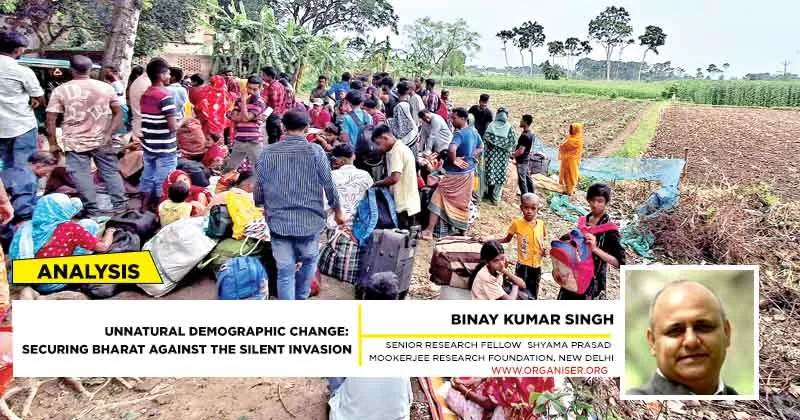
When the Supreme Court of Bharat invoked the precise, chilling legal designation of ‘External Aggression’ to describe the unrestricted, silent, and undocumented demographic transformation of our eastern borderlands, it was not only offering a judicial observation. It was sounding a civilisational alarm.
For more than half a century, Bharat’s frontiers and historical tribal heartlands have been confronting a silent, systemic crisis. It is not an overt war fought with conventional infantries or roaring artillery, but an asymmetrical demographic invasion that strikes at the core of the nation’s cultural fabric, economic stability, and sovereign identity. Recognising the acute transformation of the regional landscape, the Government of India has taken a historic step by operationalising a High-Level Committee on Unnatural Demographic Change. This landmark intervention marks a decisive shift from decades of political apathy under previous regimes toward an active, institutionalised defense of Bharat’s sovereign integrity.
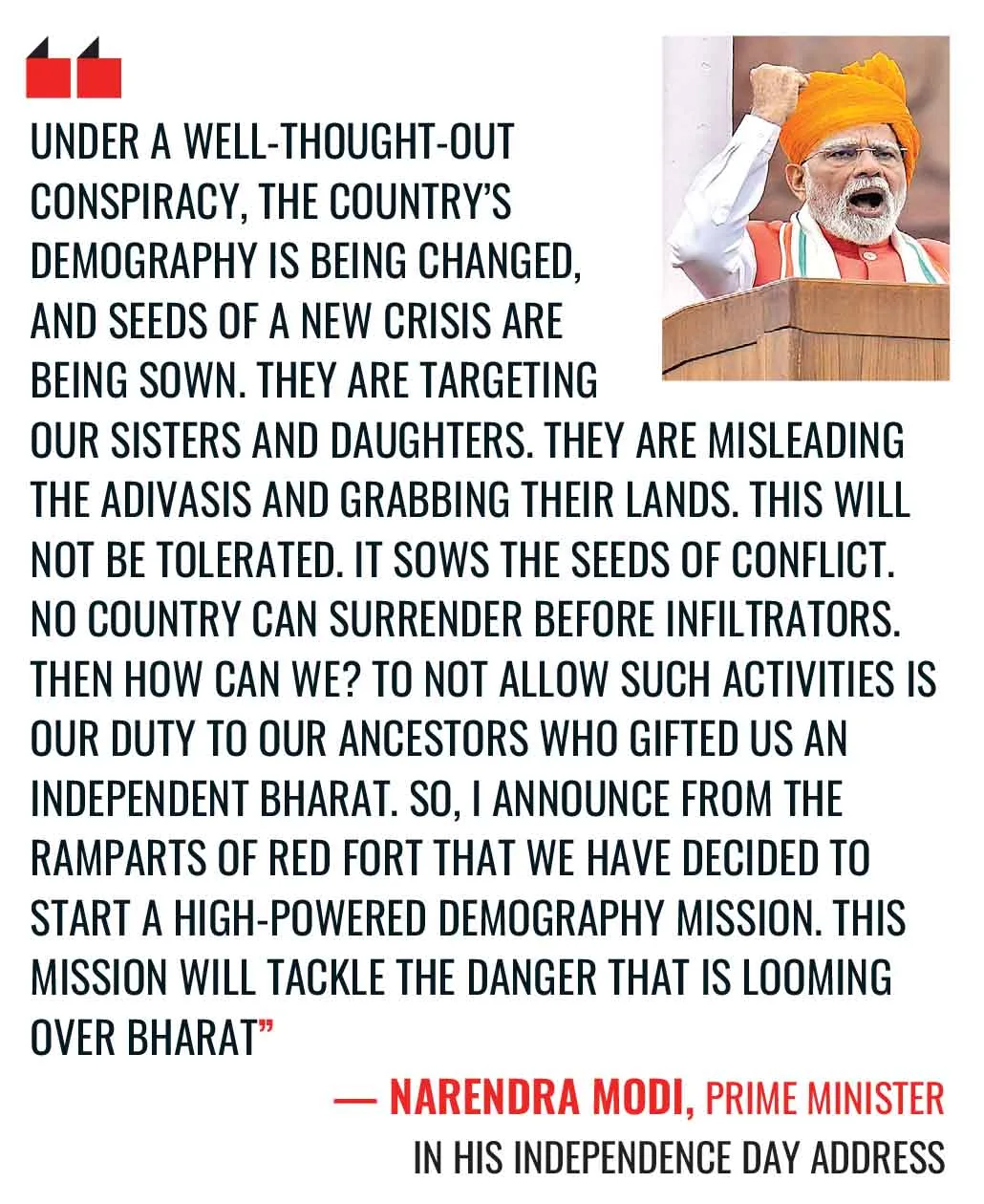
This article presents a comprehensive analysis of demographic reconfiguration, tracking its roots back to the 1970s, detailing the multi-dimensional hazards it inflicts upon national security, and exploring the historical and judicial milestones that have defined this legal and political battle. Using essential field audit of land transfer records, electoral roll anomalies, and demographic surge data this piece provides undeniable proof of how spatial asset shifts, voter roll manipulation, and structural settlement networks are threatening the stability of sensitive States like West Bengal and Jharkhand.
Genesis of Demographic Mutation
The demographic shifts seen across Bharat’s frontier states over the last several decades are neither accidental nor a natural byproduct of normal internal migration or biological fertility trends. Instead, they represent a structured alteration of the regional social matrix. Following the political upheavals of 1971 in the subcontinent, porous borders became open conduits through which millions of illegal infiltrators poured into Assam, West Bengal, and adjoining territories. By the late 1970s, indigenous communities faced severe displacement, prompting the historic Assam Movement (1979-1985) as native populations realised their lands were shrinking, their languages were being sidelined, and their names were being systematically diluted on electoral rolls by an influx that self-serving political groups weaponised to build permanent votebanks.
Official decadal censuses began recording exponential population spikes in border districts that could not be mathematically reconciled with natural biological growth, establishing a deliberate demographic reconfiguration designed to reshape the regional electoral landscape. This historical neglect laid the groundwork for a broader, multi-layered crisis that has since expanded deep into the interior tribal zones of neighboring States.
Multi-Dimensional Perils
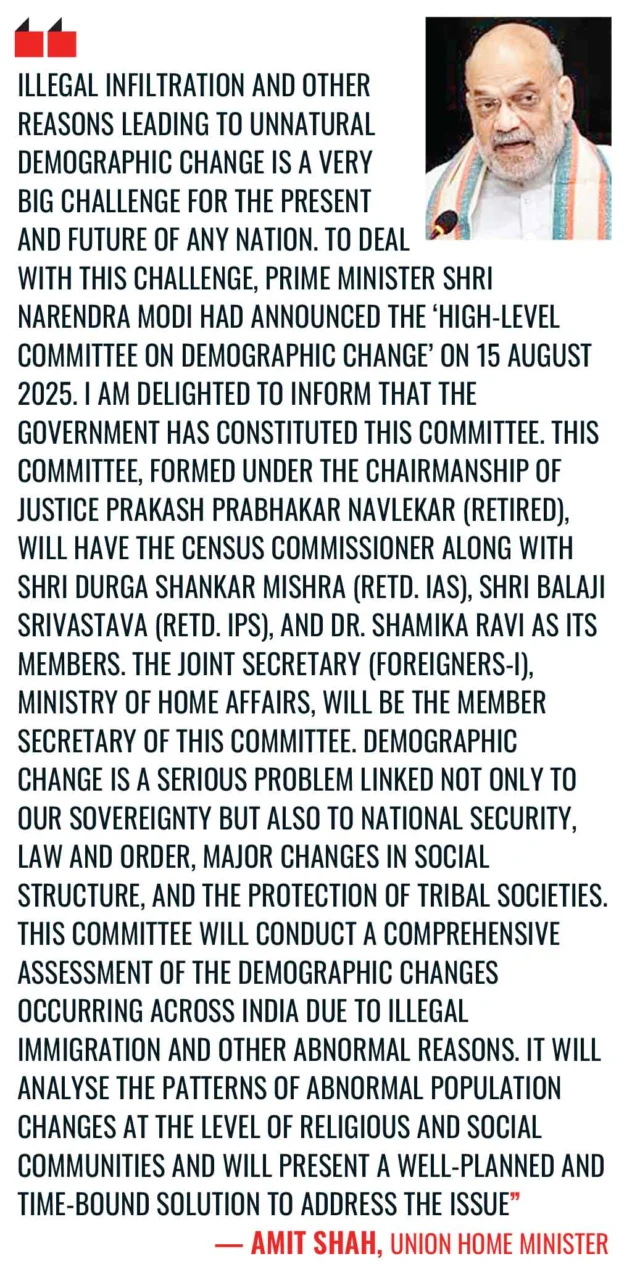
The unchecked demographic expansion resulting from illegal migration has far-reaching implications, presenting deep systemic challenges to the Indian state across multiple dimensions. Economically, illegal infiltration exerts immense pressure on civic infrastructure, depletes local natural resources, and disrupts traditional agrarian markets. For instance, in regions such as the Santhal Pargana division of Jharkhand, this is evident in the accelerated transfer of landed properties away from traditional tribal and Hindu ownership to newly settled communities. This shift undermines the economic leverage of indigenous populations, depresses local wages, and diverts welfare benefits intended for legitimate citizens. Culturally, the influx threatens the core of ancient sub-regional identities, steadily eroding tribal customs, local languages, and spiritual traditions as organised, expanding populations with no historical connection to Bharat settle in these regions. Socially, rapid demographic changes disrupt long-standing communal balances, leading to heightened land disputes, deepening social polarisation, and increased pressure on local law enforcement. Traditional systems of community dispute resolution are weakened, complicating routine administration. From a security standpoint, the risks are significant; unnatural settlement patterns in sensitive border areas create vulnerable corridors, complicate border management, and facilitate logistical support for cross-border networks. The concentration of these populations near strategic zones such as the Siliguri Corridor poses a direct threat to national defense by offering hostile foreign interests’ potential footholds for radicalised groups.
Institutionalised Protection by IMDT Act
Instead of confronting this crisis directly, past administrative regimes chose institutionalised appeasement, enacting the Illegal Migrants (Determination by Tribunals) Act, 1983 (IMDT Act). Introduced under the guise of protecting minorities, the IMDT Act was structurally designed to achieve the exact opposite: it shielded illegal infiltrators from deportation by creating an unworkable legal framework. Under the standard Foreigners Act of 1946, which applies to the rest of Bharat, the burden of proof lies on the accused to prove they are legitimate citizens. The IMDT Act flipped this rule exclusively for Assam, placing the burden of proof entirely on the complainant and the local police to prove a suspect was an illegal alien.
By restricting complainants to a rigid geographic radius and forcing citizens to pay fees to lodge complaints, the Act functioned as a legal shield for illegal migration. During its two-decade existence, it ensured that virtually no infiltrators were formally identified or deported, institutionalising vote-bank politics at the direct expense of national sovereignty.
SK Sinha’s Historic Report
In November 1998, the Governor of Assam, Lieutenant General (Retd.) SK Sinha, submitted a comprehensive, watershed report to the President of Bharat. A veteran military strategist, Gen. Sinha articulated the long-term geopolitical conspiracy behind the influx, explicitly warning about the strategic designs of external elements seeking to execute a systematic demographic expansion across the borders.
“The long-cherished design of Greater Bangladesh, making inroads into the strategic landmass of the North East, is no longer a distant theoretical threat. The silent demographic invasion of Assam poses a direct threat to India’s integrity.” – Lt. Gen. (Retd.) SK Sinha, Governor of Assam, Report to the President of Bharat, November 1998
He warned that if left unchecked, the indigenous population of the region would be reduced to a minority, creating severe internal security instability and potentially severing the Northeast from the rest of Bharat via the Siliguri Corridor. This document lifted the discourse from a localized law-and-order concern to an undeniable national security priority, serving as an official indictment of decades of political apathy.
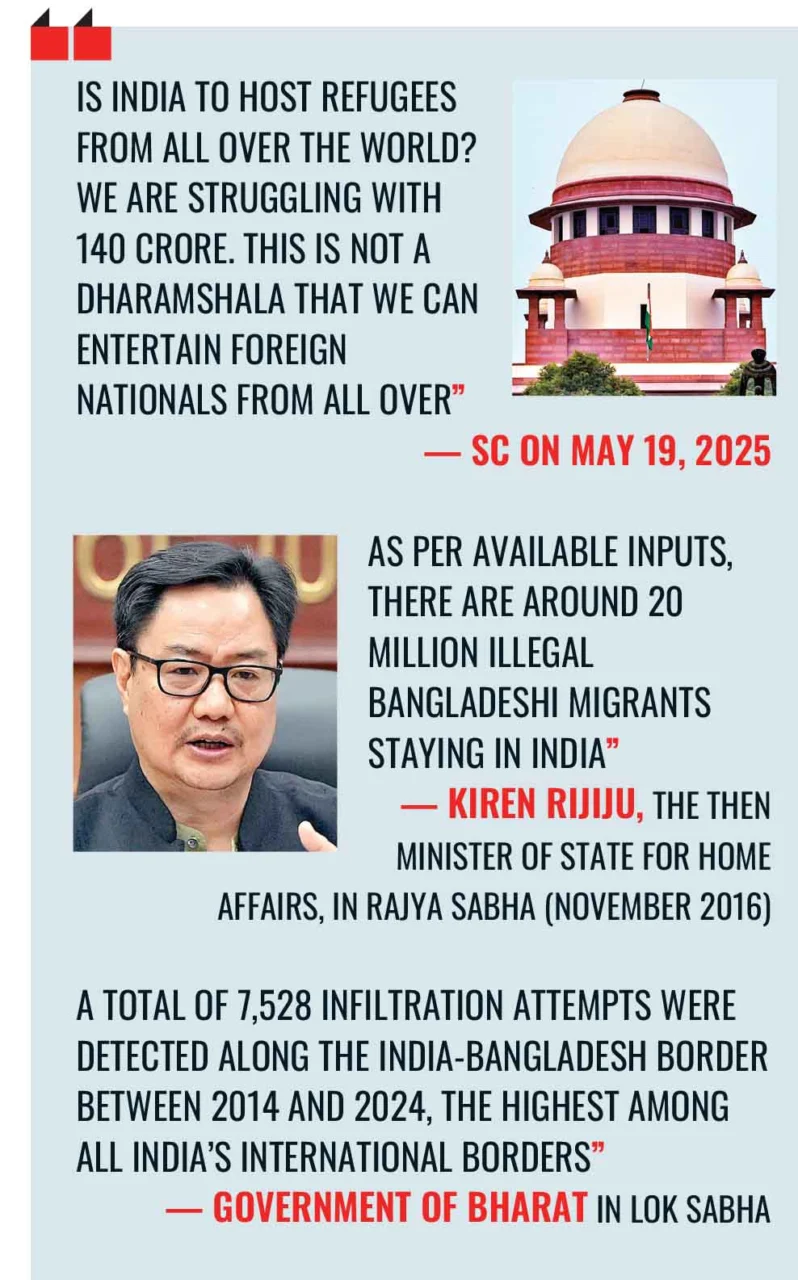
Even during periods of political denial, successive Union Governments were forced to admit the scale of the crisis on the floor of Parliament. In 1997, Home Minister Indrajit Gupta placed the figure at an estimated 10 million illegal migrants residing within Bharat. By July 2004, Minister of State Sriprakash Jaiswal revised this estimate upward to 12 million nationwide with West Bengal hosting 5.7 million and Assam accounting for 5 million.
Judicial Intervention and Key SC Judgements
Where political willpower had failed for decades, the judiciary eventually stepped in, driven by patriotic civil action. The turning point came when nationalist leader Sarbanand Sonowal challenged the constitutional validity of the discriminatory IMDT Act. In July 2005, a three-judge bench delivered the landmark verdict in Sarbanand Sonowal v. Union of India. The Supreme Court struck down the IMDT Act as unconstitutional, ruling that the unmitigated influx of millions of illegal migrants into Assam constituted a state of “External Aggression” and “Internal Disturbance.” The apex court observed that the state had failed in its constitutional duty under Article 355 to protect the region from external erosion, thereby restoring the strict, uniform application of the Foreigners Act, 1946 across the nation.
Official Admissions by Parliament Statements
For years, those defending illegal migration downplayed the scale of the issue, often dismissing concerns as exaggerated or alarmist. However, official data presented in the Parliament of Bharat by multiple administrations has dispelled such denial. In 1997, the Union Home Ministry acknowledged on the floor of Parliament that an estimated 10 million illegal nationals were residing across various states. By 2004, the Minister of State for Home Affairs provided a state-wise breakdown, reporting that as of December 2001, there were about 12 million illegal infiltrators, with 5 million in Assam and 5.7 million in West Bengal alone. The reality of the growing issue was further underscored in 2016, when the Union Home Ministry reaffirmed in Parliament that the estimated number of illegal individuals across Bharat had reached approximately 20 million. This confirmed that illegal migration was no longer confined to border states but had spread into urban and rural areas nationwide.
Problems posed by illegal immigrants
National Security
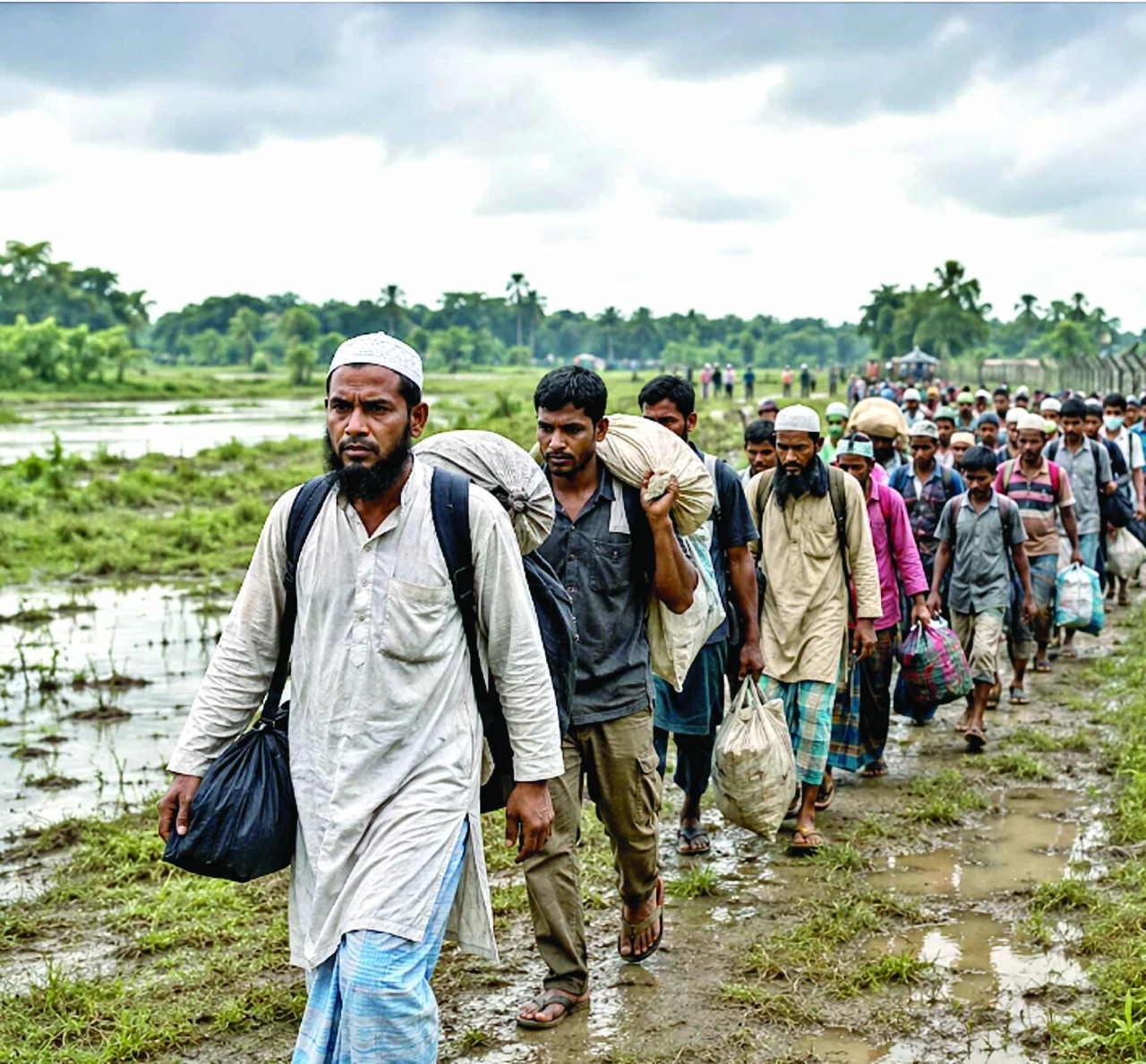
- The continuance of the illegal immigration of Rohingyas and Bangladeshis into Bharat is a serious national security ramifications and poses serious security threats. Also, it impacts the interests of local populations in the areas seeing large-scale influxes of Illegal immigrants
Human trafficking
- l In the recent decades, trafficking of women and human smuggling have become quite rampant across the borders by Illegal immigrants
Drug Smuggling
- Illegal immigrants are largely involved in in the trade of narcotics. While addressing a press Conference, Milind Bharambe, Commissioner of Police, Navi Mumbai, on December 31, 2024, said, “Those who are illegal immigrants, especially Africans, are indulging in the trade of narcotics. They come on student visas, medical visas, and business visas, but over time, they begin engaging in the narcotics trade. Several have been arrested and are in jail. Navi Mumbai Police has taken action against Africans involved in the narcotics trade in the last two years,” he said.
Law and Order
- The rule of law and integrity of the country are undermined by the illegal migrants who are engaged in illegal and anti-national activities
Escalation of Social Challenges
- Rapid changes in the religious and social makeup of local neighborhoods frequently disrupt long-standing communal balances. The resulting friction manifests in increased land disputes, social polarisation, and a rising strain on local law enforcement. This shifting environment complicates regular policing and undermines established frameworks for community
dispute resolution.
Threats to Electoral Integrity and Security
- The rapid expansion of specific voter blocks far exceeding regular growth rates directly affects the integrity of local democratic representation. When concentrated in sensitive border districts, these artificial demographic shifts pose a direct threat to national security. They create vulnerable corridors along international borders, complicating border management and potentially creating logistical support bases for cross-border networks.
Grassroots Surveys
While macro-statistics provided legislative proof, field realities were brought to light by nationalist student organisations. Extensive ground-level surveys conducted by the Akhil Bharatiya Vidyarthi Parishad (ABVP) across the sensitive border districts of Assam and West Bengal documented deep anomalies. These included abnormal spikes in voter enrolment within 10-15 kilometres of the international border, registering localised jumps of 40 per cent to 70 per cent within single five-year electoral cycles increases that are biologically impossible through natural birth rates alone. The surveys also highlighted the steady inward migration of native families due to mounting social polarisation, compromised physical security in border villages, and the rapid, undocumented turnover of agricultural properties that effectively locked out native populations.
West Bengal: ECI Audit and Electoral Forgery
The crisis of electoral integrity is vividly demonstrated by the Election Commission of India (ECI) audit findings in West Bengal. The ECI flagged severe, systemic voter roll data anomalies pointing to deep-seated electoral forgery. The audit revealed massive data entry errors that represent clear demographic and biological impossibilities:
ECI Electorate Audit: Core Findings
● A single voter was officially listed as the parent to 389 electors.
● Another voter was mapped as the parent to 310 electors.
● Seven distinct individuals were mapped to over 100 children each.
● The system detected structural absurdities, including grandparents registered under the age of 40 and parent-child age gaps of less than 15 years.
● Crucially, over 4.59 lakh entries listed more than five children per parent – a massive deviation from the local fertility benchmarks established by the National Family Health Survey (NFHS-5).
This systematic forgery serves as a legal cover, converting undocumented cross-border infiltrators into registered electors to artificially flip localised political representation and create permanent votebanks.
The Decadal Historical Blueprint of West Bengal
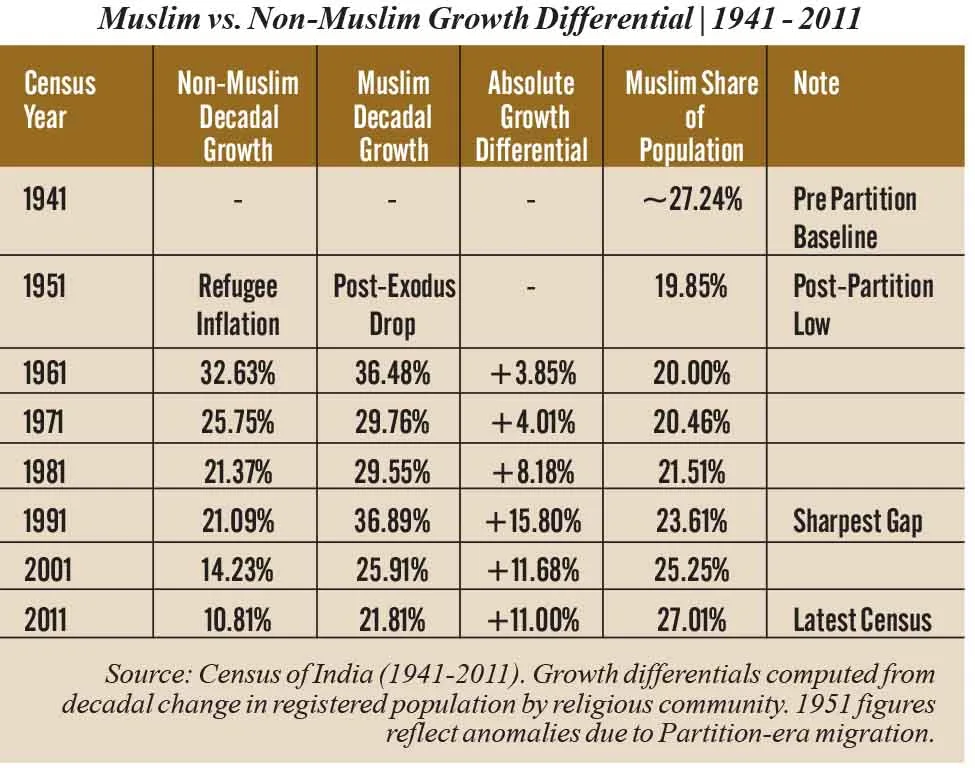
This is what happening today is a replication of a long-term historical trajectory. Unlike the Western Front (Punjab), which saw a total population exchange in 1947, the partition of Bengal left a dense baseline minority intact. Over successive decades, this baseline grew exponentially through unmonitored cross-border migration corridors that became highly active around 1971. The historic spike during the 1981-1991 decade marked the structural consolidation of an informal, cross-border migration system, where the Muslim decadal growth rate spiked to 36.89 per cent while the non-Muslim rate slowed to 21.09 per cent, creating an absolute growth gap of 15.80 per cent. By the 2011 Census, this unmonitored growth had pushed frontier districts past demographic tipping points: Murshidabad scaled to a 66.27 per cent minority share, Malda crossed the majority threshold to 51.30 per cent, and Uttar Dinajpur reached 50.00 per cent. Today, this high-density demographic saturation in Bengal’s frontier zones has naturally overflowed across porous interstate borders into the lower-density tribal heartlands of Jharkhand.
The Santhal Pargana Land and Asset Crisis in Jharkhand
It provides a micro-level asset-transfer analysis of the Thakur Gangti Block, Godda District, Jharkhand for the calendar year 2024, exposing a stark, unidirectional shift in land ownership that bypasses the statutory protections of the Santhal Pargana Tenancy (SPT) Act. Over this period, a total land area of 2,837 katha changed hands across 29 major transactions. Categorizing these transactions by social identity reveals a striking pattern:
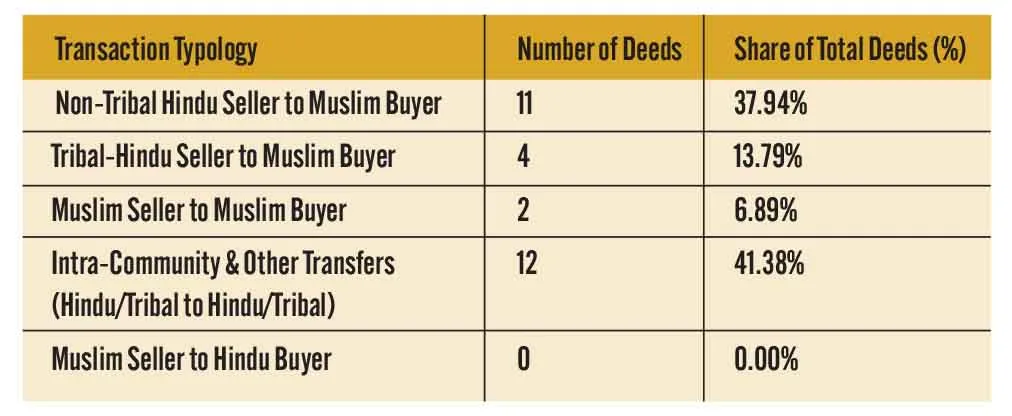
This structural acquisition is heavily concentrated within specific pockets like the Jogichak Mauza, where a single buyer (Shaifa Khatoon) executed a concentrated purchase from three separate Hindu vendors, acquiring approximately 12 bigha 12 katha in a single year which is a clear indicator of systematic rather than opportunistic purchase behavior. Furthermore, this real estate dominance is independently validated by commercial transport metrics on the Ministry of Road Transport’s Vahan Dashboard, showing high capital concentration under minority names: 37.66 per cent in Thakur Gangti, 40.79 per cent in Meharma, and 35.05 per cent in Mahagama, significantly surpassing baseline historical population shares. This rapid asset concentration mirrors historical precursors documented in Kerala’s Malabar belt (such Tas Malappuram and Kozhikode districts between 2003-2008), where concentrated property acquisition from non-Muslim sellers systematically altered traditional land ownership composition.
Macro-Analysis of Electorate Growth Anomalies
This economic transition directly mirrors a rapid expansion of the local electorate. Between 2019 and 2024, total voter registration in Bharat grew by 6.2 per cent. In stark contrast, the total voter registration in Jharkhand surged by 16.7 per cent which is nearly three times the national average. While the total tribal electorate in Jharkhand increased by a modest 13.4 per cent over this five-year period, the Muslim voter base across the analysed segments surged by an astonishing 33.7 per cent, growing from 3,037,329 to 4,061,145 electors. In the Santhal Pargana division, this asymmetric expansion has raised the minority share of the electorate to 24.2 per cent, systematically altering the regional socio-political balance and diluting statutory tribal characters. Granular data across selected Assembly Constituencies highlights the severity of this trend:
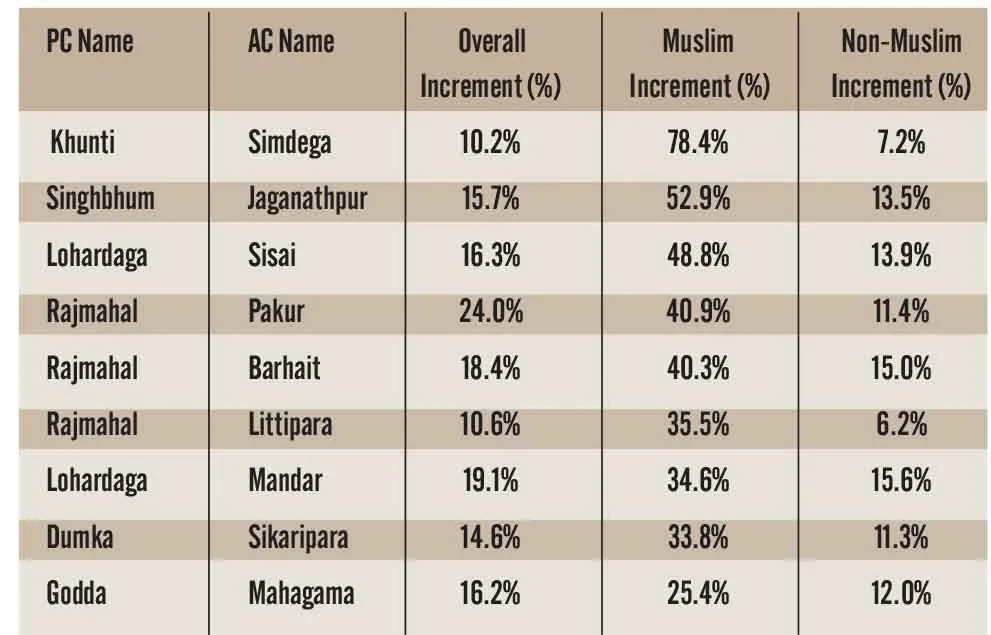
In constituencies like Simdega, the Muslim voter base grew by an extraordinary 78.4 per cent, while the non-Muslim base grew by just 7.2 per cent. In critical tribal-dominated zones like Barhait and Littipara, Muslim voter growth reached 40.3 per cent and 35.5 per cent respectively, heavily outstripping non-Muslim growth and signaling targeted electoral enrollment and migration strategies designed to build localised majorities and dilute statutory tribal characters.
Securing the Civilisational Future of Bharat
The era of passive management has ended. Backed by strong legislative clarity, accelerated completion of advanced technological border fencing, and a resolute national security strategy, the current administration is taking decisive steps to counter this silent invasion. By cleansing electoral registries of fraudulent manipulation, enforcing rigid land preservation laws, and placing national sovereignty above votebank politics, the Indian state ensures that its sacred soil, democratic integrity, and ancient civilisational roots remain permanently secured and protected.