Politics often teaches a simple lesson: power can insulate leaders from public sentiment, but it can never permanently suppress it. The dramatic scenes witnessed in Sonarpur on May 30, where former ruling party leader Abhishek Banerjee faced public protests during his visit to the family of a deceased Trinamool Congress worker, have once again brought the question of political accountability to the centre of West Bengal’s public discourse. Predictably, the incident triggered a sharp political reaction. Former Chief Minister Mamata Banerjee and several Trinamool Congress leaders accused the BJP and its supporters of encouraging a culture of political violence. Calls were made for a violence-free political environment and for restoring democratic norms in public life.
In principle, such appeals deserve support from every democrat. Politics in a constitutional democracy should indeed be free from intimidation, violence, and personal attacks. Yet the irony of the situation has not escaped public attention. For many citizens, the Trinamool Congress’s present appeal for political civility starkly contrasts with the political atmosphere that prevailed during much of its fifteen-year rule. For years, opposition parties in West Bengal repeatedly accused the Trinamool government of fostering a climate where political intimidation became routine. Numerous incidents of political clashes, attacks on opposition workers, and allegations of partisan administration dominated headlines. Whether every allegation was justified or not, political violence undoubtedly became a defining feature of Bengal’s political landscape during the past fifteen years.
This is precisely why the Sonarpur episode carries significance beyond a single protest. It is not merely about a leader being confronted by angry citizens. Rather, it reflects a broader shift in the relationship between political power and public perception. There is a famous saying: “The most beautiful habit of time is that it changes.” Political fortunes, which often appear permanent, can change with remarkable speed. Leaders who once commanded unquestioned authority may suddenly find themselves facing resistance from the very public, they once addressed from positions of strength. The symbolism of Sonarpur becomes even more striking when viewed in this context. Abhishek Banerjee was among the most powerful political figures in West Bengal until recently. As the second-in-command of the Trinamool Congress, he was widely regarded as one of the principal architects of the party’s political strategy. His statements and political rhetoric often dominated public discussions.
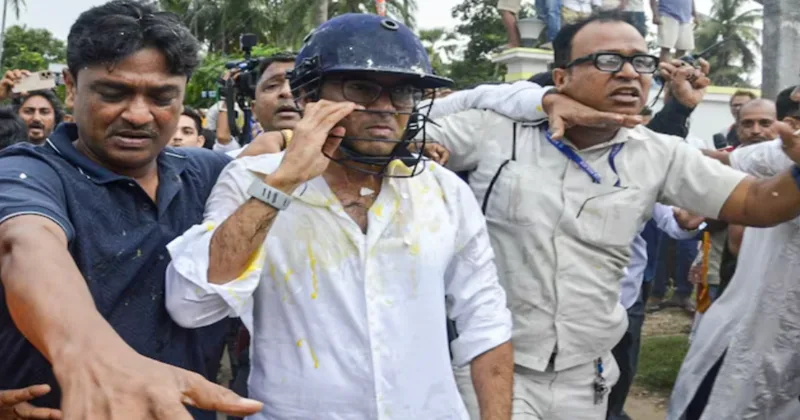
It is therefore noteworthy that barely a few weeks after the party’s electoral defeat, his first major political programme encountered such visible public hostility. The images of protesters throwing eggs, shoes, and other objects at his convoy quickly spread across social media. Equally significant was the reaction online. While some supporters condemned the incident, the volume of mockery, criticism, and political trolling appeared to far outweigh expressions of sympathy. Social media reactions are not always an accurate measure of public opinion. Yet they often provide valuable insights into prevailing political moods. The absence of widespread public sympathy for a senior political leader facing such humiliation suggests that significant sections of society may have developed deep resentment toward the political establishment he represents.
Of course, no democratic society should celebrate physical attacks on political leaders. Public anger should find expression through lawful protest, electoral participation, and democratic mobilisation. Throwing objects at political figures cannot become an acceptable norm, regardless of partisan loyalties. If such behaviour becomes normalised, it ultimately weakens democratic culture itself. At the same time, democratic societies must also recognise that public anger rarely emerges in a vacuum. When citizens feel ignored, intimidated, or unheard for prolonged periods, frustration eventually seeks an outlet. Political leaders often discover that electoral defeat alone does not erase accumulated public grievances.
The circumstances surrounding Banerjee’s visit further complicate the picture. He had travelled to meet the family of a deceased Trinamool Congress worker. However, local residents reportedly expressed strong resentment toward the deceased individual. Various allegations have circulated within the locality regarding his conduct and behaviour. Residents have claimed that public development activities were obstructed, while some women alleged that they faced harassment and verbal abuse. These allegations remain matters of public accusation rather than judicially established facts, but their existence has clearly contributed to local tensions. Several protesters argued that their demonstration was directed not merely at a political party but also at what they viewed as years of local-level political arrogance and impunity. Whether such perceptions are fully justified is ultimately for the public and institutions to determine. Nevertheless, perceptions themselves often carry enormous political consequences.
One of the most striking images from the incident was the sight of party workers placing a helmet on Banerjee’s head amid fears of further attacks. Amid the pushing, shoving, and aggressive behaviour of the protesters, the helmet eventually came off. Despite these adverse circumstances, he proceeded to meet the family of the deceased party worker and spent considerable time speaking with them. Nearly an hour and a half later, he left the area under a tight security cordon provided by the police and central forces. The incident, however, raises several pertinent questions. First, why did Abhishek Banerjee arrive at the venue with a helmet readily available? Was there prior anticipation of a hostile situation? Second, if he was able to hold discussions with the bereaved family for well over an hour after the alleged attack, how did his health suddenly deteriorate thereafter? What transpired that necessitated his hospitalization? These questions remain unanswered and have only added to the political speculation and controversy surrounding the episode.
The Sonarpur episode should therefore serve as a warning not only for the Trinamool Congress but for every political party in India. Electoral victories can create an illusion of invincibility. Long periods in power often encourage political organisations to mistake administrative control for genuine public approval. Yet the two are not always the same. History repeatedly demonstrates that public patience has limits. Citizens may remain silent for years, but silence should never be mistaken for acceptance. When opportunities arise—whether through elections, protests, or public demonstrations—suppressed frustrations often emerge with unexpected intensity.
For the Trinamool Congress, the challenge now extends beyond explaining away the Sonarpur incident as opposition-sponsored agitation. Such explanations may satisfy party loyalists, but they do little to address the deeper political questions raised by the event. Why did the protests attract local participation? Why did images of the confrontation resonate so strongly across social media? Why was public sympathy relatively limited? These questions deserve serious reflection. For Bengal’s broader political culture, the lesson is equally important. Political violence cannot be condemned selectively. It cannot be unacceptable when directed against one party while being tolerated when directed against another. Consistency remains the foundation of democratic credibility.
Ultimately, Sonarpur was not merely about eggs, shoes, or slogans. It was about accountability. It was about the consequences of political memory. And it was about the reality that power, however formidable it may seem, is always temporary. The incident reminds us that democracy is not only decided in legislatures and polling booths. It is also shaped by public sentiment, collective memory, and the willingness of citizens to express their approval or disapproval of those who govern them. In the end, political parties may win or lose elections, but they cannot escape the judgment of society. Sonarpur has offered a powerful reminder of that enduring democratic truth.