
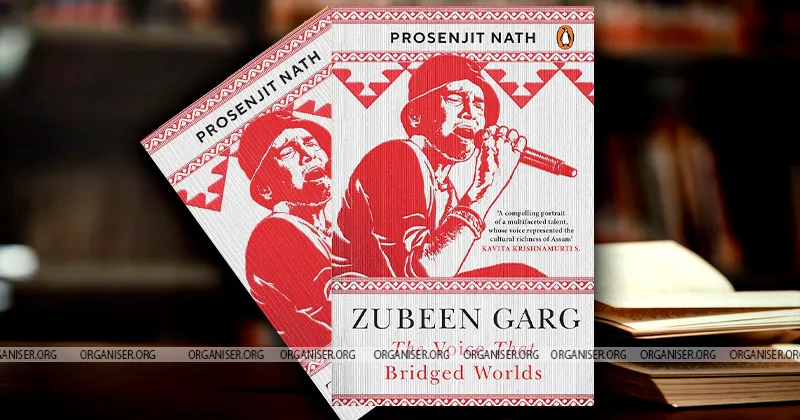
Biographies of cultural icons often face a difficult challenge: balancing factual documentation with emotional resonance. In Zubeen Garg: The Voice That Bridged Worlds, Prosenjit Nath successfully navigates this challenge by producing a work that is at once a detailed biography, a cultural history of contemporary Assam and a heartfelt tribute to one of the Northeast’s most influential artistic figures.
The book chronicles the life and career of Zubeen Garg, tracing his journey from a musically inclined child in Tura, Meghalaya, to a singer, composer, songwriter and cultural icon whose influence extended far beyond Assam. Structured into six thematic sections covering his childhood, artistic emergence, Bollywood success, cultural activism and enduring legacy, the narrative unfolds chronologically while constantly situating the artist within the larger social and political landscape of Assam.
One of the book’s greatest strengths is its treatment of Zubeen’s formative years. Nath presents a vivid portrait of a child raised in a household where literature, music and public service coexisted harmoniously. The descriptions of his father, the poet-magistrate Kapil Thakur, and his mother, whose folk songs nurtured his musical instincts, provide important insights into the roots of his creativity. The narrative skillfully demonstrates how Zubeen’s early exposure to diverse cultures across Northeast India shaped his later artistic versatility.
The author deserves particular credit for highlighting Zubeen’s intellectual development alongside his musical growth. Unlike many celebrity biographies that focus exclusively on fame and achievement, Nath explores the singer’s educational experiences, literary influences and philosophical outlook. The discussion of his multilingual upbringing and his engagement with Assamese, Bengali and English literary traditions helps readers understand why his music resonated across linguistic and cultural boundaries.
Stylistically, the book combines journalistic research with a literary narrative voice. Nath writes with evident admiration for his subject yet largely avoids descending into uncritical hero worship. In the author’s note, he explicitly states his intention to portray Zubeen as an “extraordinarily talented and imperfectly human” figure rather than an idealised saint. This commitment to nuance gives the work credibility and depth.
The chapters dealing with Zubeen’s rise during the 1990s are among the most compelling sections of the book. Nath effectively captures the mood of post-Assam Accord society, showing how a generation searching for cultural self-expression found its voice in Zubeen’s music. The analysis of albums such as Junaki Mon, Maya and Asha demonstrates how the singer became more than an entertainer; he emerged as a symbol of Assamese aspirations and identity.
Another notable achievement is the book’s broader cultural perspective. Rather than presenting Zubeen merely as a successful musician, Nath positions him as a bridge-builder between Assam and the rest of India, between tradition and modernity and between regional and global cultural spaces. This thematic emphasis is reflected throughout the text and reinforced in the title itself. The author’s argument that Zubeen served as a cultural ambassador for Assam is persuasive and supported by numerous examples from his career.
The book also excels in documenting the social impact of Zubeen’s work. Chapters devoted to his humanitarian activities, mentorship of younger artists and contribution to the Assamese film and music industries reveal dimensions of his legacy that are often overlooked in popular discussions. The author convincingly argues that Zubeen’s importance cannot be measured solely through album sales or chart success; his true significance lies in his role as a cultural institution who helped shape the identity of modern Assam.
However, the book is not without limitations. Nath’s deep admiration for his subject occasionally leads to a somewhat celebratory tone. While the biography acknowledges imperfections and controversies, readers seeking a more detached critical assessment may feel that certain episodes receive less scrutiny than they deserve. At times, the prose also becomes highly lyrical, prioritising emotional impact over analytical precision. Yet these tendencies are understandable in a work written shortly after the artist’s death, during what the author describes as a period of collective mourning.
From a literary standpoint, the writing is accessible and engaging. Nath possesses a storyteller’s instinct for detail and atmosphere, making the narrative appealing not only to Zubeen fans but also to general readers interested in music, culture, and regional history. The extensive structure, supported by notes and references, further enhances the book’s value as a resource for future scholars and researchers.
Ultimately, Zubeen Garg: The Voice That Bridged Worlds is more than a biography of a celebrated singer. It is a chronicle of Assam’s cultural evolution over the past several decades, told through the life of one of its most influential artistic voices. Prosenjit Nath succeeds in creating a work that is informative, emotionally resonant and culturally significant. For admirers of Zubeen Garg, it offers a richly detailed account of a beloved icon. For readers unfamiliar with Assamese music and culture, it serves as an illuminating introduction to a remarkable artist and the society that shaped him.