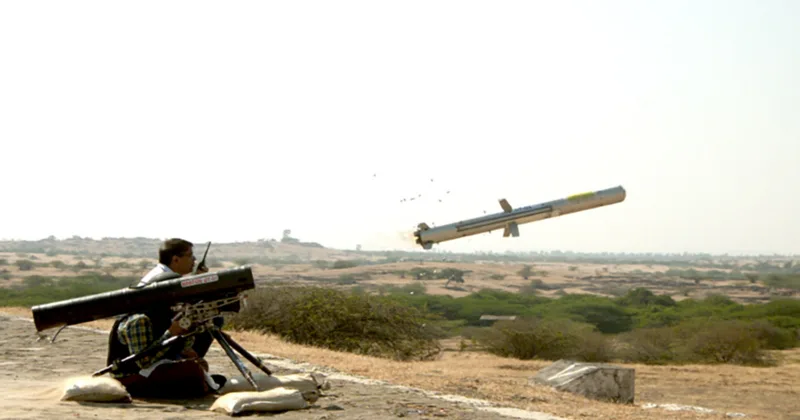
On January 11, 2026, India has created threshold in indigenous defence capability with the successful flight test of the Man Portable Anti-Tank Guided Missile (MPATGM). Conducted at the KK Ranges in Ahilya Nagar, Maharashtra the test validated not just the missile’s accuracy against a moving armoured target, but also years of sustained effort to master one of the most complex categories of battlefield weapons. The MPATGM is not merely another missile in India’s arsenal, it represents India’s firm entry into the third generation of anti-tank warfare systems.
The importance of MPATGM, needs to be put into perspective as part of the broader development of anti-tank guided missiles. First generation ATGMs required continuous manual guidance from the operator, thus keeping soldiers exposed to enemy fire and limiting effectiveness under combat stress.
Second generation systems made operations easier through semi-automatic guidance but still required the operator to stay exposed until impact. Third generation systems is defined by fire and forget capability. Once launched, the missile autonomously acquires, tracks and destroys its target. MPATGM belongs firmly to this third generation, aligning India with the most advanced global standards in infantry anti armour warfare.
The focus point of MPATGM capability is its Imaging Infrared (IIR) homing seeker. Unlike earlier infrared seekers that tracked simple heat sources, an IIR seeker produces a detailed thermal image of the target. Before launch, the operator locks onto this image and once fired, the missile’s onboard computer continuously compares real time thermal data with stored reference patterns. This enables precise tracking even if the target changes speed, direction or attempts evasive manoeuvres. It allows full day and night operation and remains effective in challenging weather conditions, giving infantry units round theclock engagement capability.
Another defining technical feature is the missile is attack profile. Modern main battle tanks are heavily armoured on the front and sides, anticipating direct fire threats. Structural and weight limitations, make them relatively vulnerable on the top surfaces. MPATGM correctly identifies this weakness by flying in a lofted trajectory to strike the target from above with a much enhanced kill probability against tanks with advanced frontal armour or explosive reactive armor.
Complementing this profile of flight is a tandem warhead configuration, the precursor charges to neutralise reactive armour and the main charge to penetrate the base armour underneath. This sequencing reflects an understanding of modern armored warfare where survivability is based on layered protection rather than the thickness of armor. The warhead’s effectiveness against contemporary main battle tanks further underlines the missile’s relevance for present and future combat scenarios.
MPATGM is all electric control actuation system. Earlier missiles often relied on hydraulic or electro hydraulic systems, which increased maintenance complexity and reduced reliability in extreme climates. An all electric system offers faster response, improved reliability and simpler logistics, where an important consideration for India, where weapons must function across deserts, plains, forests and high altitude regions.
Portability has been central to the missile design philosophy. MPATGM is intended to be genuinely man-portable, enabling infantry units to deploy it without heavy support infrastructure. It can be launched from tripod mounted systems or integrated onto military vehicle launchers. The system was a simulation of the thermal Rayleigh Jeans signature of an enemy tank so that engineers could test and analyze the target discrimination and tracking performance of the IIR seeker. Validations and tests of such systems are very necessary in a world where countermeasures and jamming are being employed in ever increasing numbers.
Another characteristic aspect of the MPATGM development in India is industry participation. Bharat Dynamics Ltd. and Bharat Electronics Ltd. have been associated as Development cum Production Partners and not simply as production partners. This mean that production related factors such as quality, scalability and maintainability, are also taken care of during development. This would also ensure that important design and systems related inputs remain in India, thus limiting indigenization of their products. Terminal Ballistics Research Laboratory is concentrating on warheads, High Energy Materials Research Laboratory on propulsion and energetic concepts, while Instruments Research & Development Establishment is concentrating. This distributed development model reflects years of institutional learning and coordination.
A critical but understated component of the test was the Thermal Target System, developed by Defence Laboratory, Jodhpur. This environment modeled the heat radiation signal for an adversarial tank, letting engineers fully assess the IIR seeker’s target separation and tracking performance. Testing and validation in this way are critical in a scenario where countermeasures, deception jammers and electronic warfare technologies pose a greater threat to missile performance.
Industry participation has also been an integral part of the MPATGM programme in India. Bharat Dynamics Limited and Bharat Electronics Limited have been associated with the MPATGM programme in the role of Development and Production Partners. This not only takes into account the potential of the product in terms of manufacturing, but it will also be beneficial in preserving knowledge about the product in the country and not relying on foreign sources.
Why MPATGM is important to India
Apart from the LARs and other technical specifications, the MPATGM has importance to the Indian context in terms of force structure and preparedness and relating to strategic independence as well. It has particular importance to the Indian Army in terms of infantry based deterrence and the ability to neutralize armoured threats at the lowest tactical levels independently without waiting for artillery or air support inputs within the context of rapidly evolving combat scenarios in which the critical factor is time.
As far as strategic intents are concerned, MPATGM signifies a transition from a buyer driven approach for defense strategy formulation in India to a capability friendly approach. Designing these systems and proving their effectiveness in a country gives a flexibility of operations and future upgradations that are never guaranteed when such weapons are imported. The possibility of geographically influenced spares and ammo supply interruptions gets minimized.
The reach of this programme also has long-term implications for defense preparedness, added Dr. G. Satheesh Reddy, Vice Chairman, Defence Research and Development Organisation. Make in India has given us the ability to design and develop our own systems. The need for light, precise and rapidly deployable anti-tank weapons to the Indian Army’s infantry formations is a serious concern. When fast moving armoured formations or limited reaction time, a fire and forget missile in the hands of foot soldiers can alter battlefield dynamics decisively.
According to Defense Minister Rajnath Singh, this test is an important step towards Aatmanirbhar Bharat. This not only improves our preparedness levels but also provides us with greater autonomy levels, which are always needed in high intensity conflicts.
The MPATGM story is not just about a missile test at a range in Maharashtra. It is about India’s steady transition into the league of nations capable of designing, integrating and producing third generation anti-tank systems. The programme reflects sustained investment, incremental learning and a clear understanding of modern battlefield requirements. As MPATGM moves closer to induction, it stands as a quiet but powerful marker of India’s growing confidence in its own defence technological base and of an infantry soldier’s increasing ability to counter the most formidable armoured threats with indigenous precision.