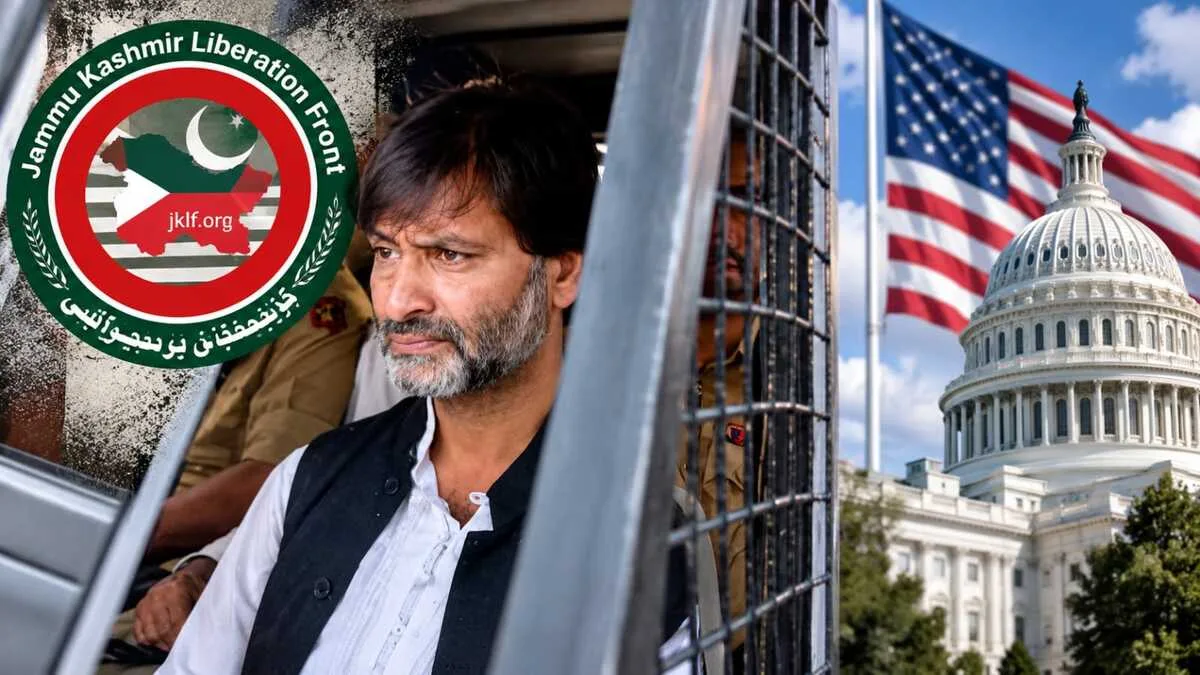
The incarceration of Jammu and Kashmir Liberation Front (JKLF) chief Yasin Malik in India has not ended the organisation’s political and organisational activity abroad. Instead, a network of Kashmiri separatist activists, Pakistani operatives and Islamist-linked organisations has continued to operate from the United States, with Dallas and other Texas cities emerging as important centres of activity.
Malik was sentenced by a special National Investigation Agency (NIA) court in New Delhi in May 2022 to life imprisonment in a terrorism-financing case after pleading guilty to the charges. The NIA said Malik had been convicted under provisions of the Indian Penal Code and the Unlawful Activities (Prevention) Act (UAPA), including provisions concerning terrorist acts, terrorist financing, conspiracy and membership of or support for terrorist organisations.
Yet Malik continues, in principle, to be regarded by the JKLF as its chairman, while operational activity connected to his faction has increasingly been conducted by supporters outside India. In Texas, that activity has involved Dallas-based JKLF figures, Pakistani and Kashmiri activists, Islamist networks, nonprofit organisations, media platforms and contacts with American political and academic institutions.
A federal US appeals court had previously characterised the JKLF as a Tier III terrorist organisation in an immigration case, citing evidence that the group had killed moderate politicians, detonated bombs in public places and claimed responsibility for high-profile kidnappings.
Dallas emerges as a centre of JKLF activity
For several years, until May 2026, Dallas-based Raja Muzaffar served as the JKLF’s “acting chairman”. Through organisations including the Kashmir Global Council and South Asia Democracy Watch, Muzaffar developed links with Texas institutions, policymakers, Islamist groups and radical Kashmiri activists.
The network’s outreach has included American political figures. At a JKLF conference held in Dallas in 2024 to “highlight the struggle” of Yasin Malik, participants included city councillors, state representatives and a federal lawmaker. The event placed the jailed JKLF leader at the centre of an American political and diaspora campaign concerning Kashmir separatism.
The network also developed links with Dallas-based Southern Methodist University. Following a partnership involving the university, Muzaffar in 2025 appointed Dr. Rick Halperin, described by the JKLF as a “renowned Human Rights Advocate and Director of the Human Rights Program at Southern Methodist University”, as head of the “Justice for Yasin Malik Campaign”. The campaign provided another institutional platform for efforts surrounding Malik and the JKLF.
The activities extended beyond political advocacy. In 2025, Muzaffar and other JKLF leaders organised a Dallas-based joint event with Ghulam Nabi Fai of the World Kashmir Awareness Forum to commemorate Amanullah Khan, the late founder of the JKLF. Contemporary accounts identify the event as having taken place on April 27, 2025, on the ninth death anniversary of Amanullah Khan.
Amanullah Khan’s record is central to understanding the history invoked by the Dallas network. He oversaw a campaign against Indian targets and acknowledged that militants involved in the campaign had been trained in terrorist camps in Pakistan in cooperation with Pakistan’s Inter-Services Intelligence (ISI).
In 1984, JKLF members kidnapped Indian diplomat Ravindra Mhatre in Birmingham, Britain and the incident ended with Mhatre’s murder. Historical accounts identify the National Liberation Army, the armed wing associated with the JKLF, in the kidnapping.
In the 1990s, Amanullah Khan refused to renounce violence against Indian targets and moved his JKLF operations to Pakistan. Nevertheless, participants at the 2025 Dallas event praised his “legacy of resistance and unity”. The event therefore connected contemporary Texas-based Kashmir separatism with the legacy of an organisation whose history includes armed militancy, terrorism and cooperation with Pakistani intelligence.
Ghulam Nabi Fai and Pakistan’s intelligence links
One of the most significant figures connecting the Dallas JKLF network with Islamist and Pakistani political activity is Ghulam Nabi Fai. The American-Kashmiri activist has long been associated with Jamaat-e-Islami and its American-linked networks.
Fai participated in the 2025 Dallas event alongside senior JKLF figures. His own history in the United States includes a federal criminal case concerning covert Pakistani funding of his Kashmir lobbying operation. In December 2011, Fai pleaded guilty in a US federal court to conspiracy and tax violations relating to at least $3.5 million transferred from the Pakistani government and ISI to support his lobbying efforts in the United States.
The US Department of Justice said the funds were connected to efforts to influence American policy on Kashmir.
Fai was subsequently sentenced in March 2012 to 24 months in prison and three years of supervised release. US prosecutors said the funding arrangement had operated for decades and that Fai had used the Kashmiri American Council to pursue political influence concerning Kashmir.
The Dallas network has also maintained connections with Pakistani intelligence figures. Raja Muzaffar has appeared alongside former ISI director Asad Durrani, illustrating the continuing interaction between Texas-based JKLF activists and figures associated with Pakistan’s intelligence establishment.
The connection between JKLF and Islamist politics also predates the Texas network. Following the JKLF split during the 1990s, the faction led by Yasin Malik, which operated in Kashmir, the United Kingdom and the United States, announced in 1994 that it had renounced violence and would pursue a peaceful political resolution.
However, Malik’s faction continued to work with Islamist networks, including the All Parties Hurriyat Conference. Attempts were reportedly made in 2005 and 2012 to reunite Malik’s faction with the rival JKLF faction that had rejected the renunciation of violence.
The India Policy Foundation has stated that, on the instructions of Pakistan’s ISI, Malik was accepted as chairman of two JKLF leadership centres, one in Rawalpindi and another covering the United Kingdom and United States.
Kashmir separatism, Islamist networks and Texas diaspora
The Dallas JKLF leadership has also relied on a Kashmiri and Pakistani diaspora infrastructure in Texas. One prominent participant in the 2025 event was Mujeeb Kazi, a Kashmiri businessman and head of the North Texas Islamic Council, described as an umbrella organisation for mosques in the Dallas-Fort Worth area.
Kazi operates several nonprofit organisations, including Voice of Kashmir TV. Its broadcasts have repeatedly provided platforms for JKLF figures. Among those appearing through the network is Toqeer Gilani, who succeeded Raja Muzaffar as the JKLF’s acting head in May 2026.
Through Voice of Kashmir, the JKLF has been presented as a political solution to Kashmir’s problems, while Yasin Malik and other separatist figures have received favourable attention. The media infrastructure consequently gives Kashmir separatism an additional route into the Kashmiri and Pakistani diaspora in North Texas.
The network extends beyond JKLF itself. Voice of Kashmir has disseminated appeals encouraging the Kashmiri diaspora to organise in support of Shabir Shah, whom Indian prosecutors have accused of contacts with Lashkar-e-Taiba (LeT) and involvement in terrorist financing. Other figures highlighted by the network include Hamid Fayaz, a senior leader of the terror-linked Islamist movement Jamaat-e-Islami in Kashmir, and Asiya Andrabi, founder of Dukhtaran-e-Millat.
The latter organisation has been described by The Economist as supporting terrorists and advocating jihad. Andrabi has also been linked to wider Islamist networks. In the United States, she appointed Texas activist Ghazala Habib to represent her interests.
Habib operates from Houston and Austin and has been associated with Friends of Kashmir, a Texas-based organisation involved in Kashmiri advocacy. Investigative accounts have described her as an appointed US representative of both Asiya Andrabi and the late Islamist separatist leader Syed Ali Geelani.
The Texas network has also intersected with Pakistan Tehreek-e-Insaf (PTI). PTI maintains a Texas presence, while its activists have interacted with Kashmiri separatist and Islamist networks. Through activists such as Ghazala Habib, Texas-based PTI figures have interacted with JKLF figures including Raja Muzaffar.
From Yasin Malik to a wider Islamist-separatist network
The present Texas network is rooted in a much longer history of JKLF militancy. The JKLF was established in the United Kingdom in 1977 with the objective of securing an independent Kashmir. Pakistan’s ISI initially supported the organisation, while JKLF members subsequently became involved in terrorist attacks, killings and kidnappings.
India’s Ministry of Home Affairs declared the Yasin Malik faction of the JKLF an unlawful association on March 22, 2019. The government accused the organisation of spearheading separatist activity and violence and linked the group to the 1989 killings of Kashmiri Pandits in Jammu and Kashmir. The Ministry subsequently continued the unlawful-association designation under Indian law.
The Indian government has specifically accused Yasin Malik and the JKLF of involvement in the killings and displacement of Kashmiri Pandits, as well as the murder of Indian Air Force personnel, kidnappings and terrorist financing.
The NIA subsequently alleged that Malik had visited Lashkar-e-Taiba camps in Murree in Pakistan-occupied Kashmir and addressed LeT cadres. LeT was responsible for the November 2008 Mumbai terrorist attacks, in which 166 people were killed.
In May 2022, Malik pleaded guilty before the Indian court. The case concerned the raising, receiving and collection of funds through illegal means, including hawala transactions, for separatist and terrorist activities in Jammu and Kashmir. The court found him guilty under multiple provisions of the IPC and UAPA and imposed life imprisonment.
The court proceedings also connected the JKLF’s financial operations with Hizbul Mujahideen, Dukhtaran-e-Millat and Lashkar-e-Taiba. The NIA described the separatist leadership as having acted in coordination with cadres of proscribed terrorist organisations.
The US legal record provides a separate description of the JKLF. In 2009, the US Court of Appeals for the Ninth Circuit upheld the denial of asylum to a JKLF member after finding “substantial evidence” that the organisation had killed moderate politicians, detonated bombs in public places and claimed responsibility for high-profile kidnappings. The court consequently classified the JKLF as a Tier III terrorist organisation for purposes of the relevant US immigration law.
The American base of Kashmir separatism
Although commentators and academic writings have sometimes described the JKLF as secular, its history includes sustained engagement with Islamist organisations and Islamist political rhetoric, including calls for jihad.
The network involving Jamaat-e-Islami, Dukhtaran-e-Millat, Lashkar-e-Taiba-linked figures, Pakistani political actors and JKLF activists demonstrates how Kashmir separatism has operated alongside strands of political Islam and Islamist activism.
The Texas network has therefore developed into more than a campaign centred solely on Yasin Malik. It includes JKLF leaders, Pakistani political activists, Islamist organisations, diaspora media, nonprofit groups, former Pakistani intelligence officials and American institutional contacts.
Texas Governor Greg Abbott’s November 18, 2025 designation of the Muslim Brotherhood and the Council on American-Islamic Relations (CAIR) as foreign terrorist organisations and transnational criminal organisations marked a separate state-level action concerning Islamist networks. The proclamation also imposed restrictions concerning property acquisition in Texas.
Against that background, the JKLF network surrounding Yasin Malik continues to operate through Dallas, Houston, Austin and the wider Texas Kashmiri and Pakistani diaspora. Raja Muzaffar’s transition from acting chairman in May 2026 and the emergence of Toqeer Gilani in that role have not removed the network but rather, the infrastructure created around JKLF, Voice of Kashmir, Kashmiri advocacy groups, Islamist activists and Pakistani-linked organisations provides continuing channels for promoting Yasin Malik, JKLF and Kashmir separatism in the United States.