Jailed J&K Liberation Front (JKLF) chief Yasin Malik has filed a 25-page affidavit before the court in which he said he has decided to end his marriage with Pakistani national Mushaal Hussein Mullick, citing his prolonged incarceration.
At the same time, Malik has said that he will no longer contest the trial in the 1990 murder of Kashmiri Hindu nurse Sarla Bhat, while continuing to deny any involvement in the killing. He has also requested that the court impose the death penalty on him.
The combination of these claims has triggered questions over whether Malik is attempting to reshape the public narrative around himself, presenting himself less as a separatist leader associated with the violent years of Kashmir militancy and more as a victim of what he describes as an unjust legal process.
Malik’s allegations are ultimately matters for the court to examine. His claims of innocence in the Sarla Bhat case do not amount to an acquittal, and his request for capital punishment does not itself establish guilt in that case.
Malik says he is divorcing Pakistani wife
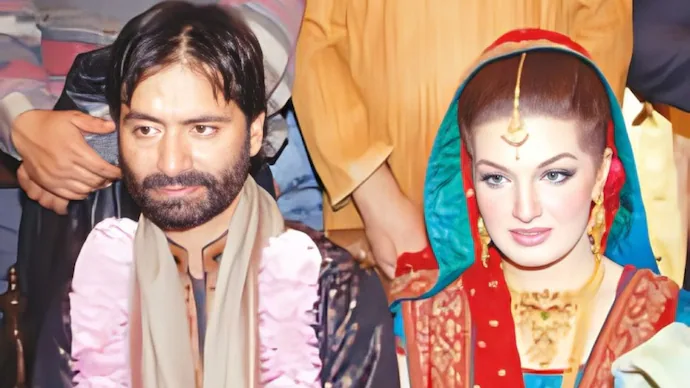
Malik has been married to Mushaal Hussein Mullick, a Pakistani citizen, since 2009.
In his affidavit, Malik said he had decided to dissolve the marriage because of his prolonged imprisonment and the circumstances surrounding his incarceration. He said he did not want his wife to continue carrying the burden of his situation.
The affidavit reportedly states that he wants her to be able to live the remainder of her life without being tied to his circumstances.
The personal decision comes against the backdrop of Malik’s continuing legal battles in India, including the Sarla Bhat murder case.
He denies role in Sarla Bhat murder
The State Investigation Agency (SIA) has accused Malik of involvement in the kidnapping and killing of Sarla Bhat, a Kashmiri Hindu nurse who was abducted and murdered in 1990.
Malik has strongly rejected the allegations.
In his affidavit, he described the charges against him as a subsequent invention and claimed that he could not have participated in the crime because he was critically injured around the same period.
Malik claimed that he had fallen from a building during a BSF raid in April 1990 and remained in a coma. He further claimed that he was even reported dead by news outlets at the time.
Using this account, Malik has argued that it was impossible for him to have participated in, directed or orchestrated Bhat’s killing.
Whether those claims stand up against the prosecution’s evidence will ultimately be decided by the court.
Malik says he will no longer contest trial
In a significant move, Malik has said he will no longer contest the proceedings in the Sarla Bhat case.
He has maintained that his decision should not be interpreted as an admission of guilt or acceptance of the prosecution’s allegations.
At the same time, he has asked the court to award him the death penalty.
The unusual stance has added another layer to the case, particularly because Malik has continued to deny involvement in Bhat’s killing while simultaneously saying that he does not wish to contest the proceedings.
A history that goes beyond the Sarla Bhat Case
The attempt to portray Malik solely through the prism of the Sarla Bhat case, however, leaves out his wider legal history.
Malik has already been convicted in a terror-funding case. In 2022, a special NIA court in Delhi sentenced him to life imprisonment after convicting him in a case involving terrorism financing and separatist activities in Jammu and Kashmir.
He also faces proceedings in other cases linked to the period of militancy and violence in the Kashmir Valley.
Malik has been accused in the 1990 attack on Indian Air Force personnel in Srinagar, in which four personnel were killed. He has also been accused in the 1989 kidnapping of Rubaiya Sayeed, daughter of then Union Home Minister Mufti Mohammad Sayeed.
These cases form an important part of Malik’s background and make it difficult to view his latest affidavit simply as the story of an ordinary prisoner facing personal hardship.
Is Malik trying to play the victim card?
The central question emerging from the affidavit is whether Malik is attempting to create a particular public narrative around himself.
By highlighting his years in prison, the breakdown of his marriage, his physical condition in 1990 and his claim of being falsely implicated, Malik appears to be placing himself at the centre of a story of personal suffering.
He has also repeatedly framed his legal troubles as part of a wider political conflict over Kashmir.
Analyst and columnist Amana Begam Ansari, in a post on X, described the affidavit as an apparent exercise in “damage control”. She argued that Malik was emphasising coercion, an unfair process and his post-1994 political role in a way that could make him appear more like a political actor caught in a larger conflict than a separatist leader associated with militancy.
That assessment is an opinion, rather than a judicial finding.
737-page chargesheet in Sarla Bhat Case
The SIA has prepared a 737-page chargesheet in the Sarla Bhat murder case, naming Malik among those accused.
The case has remained unresolved for more than three decades, making the renewed prosecution particularly significant for the families seeking justice.
BJP spokesperson Danish Bhatt has also criticised Malik’s position, arguing that the extensive chargesheet provides the prosecution with a substantial evidentiary basis to pursue the case.
However, as with any criminal proceeding, the final determination of Malik’s culpability in the Sarla Bhat case rests with the court.
Malik’s Pakistani connection
Malik’s marriage to Mushaal also connects the latest development to his long-standing relationship with Pakistan.
Malik reportedly met Mushaal during a visit to Pakistan in 2005, where he was seeking support for his separatist movement. They married in 2009.
Mushaal has herself remained politically active in Pakistan and was appointed as a special adviser on human rights and women’s empowerment in Pakistan’s caretaker government in 2023.
Her association with Malik has therefore remained part of the broader political narrative surrounding the JKLF leader.
A new narrative, but the past remains
Malik’s latest affidavit combines three striking elements: a decision to end his marriage, a refusal to contest the Sarla Bhat trial and a request for capital punishment.
But none of these developments erases the larger record surrounding him.
He remains a convicted terror-funding offender serving a life sentence, while the allegations in the Sarla Bhat case and other cases continue to be dealt with through the judicial process.
His portrayal of himself as a victim of political persecution is his own position. It is now for the court, not Malik’s affidavit, to determine what the evidence establishes in the Sarla Bhat case.