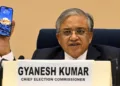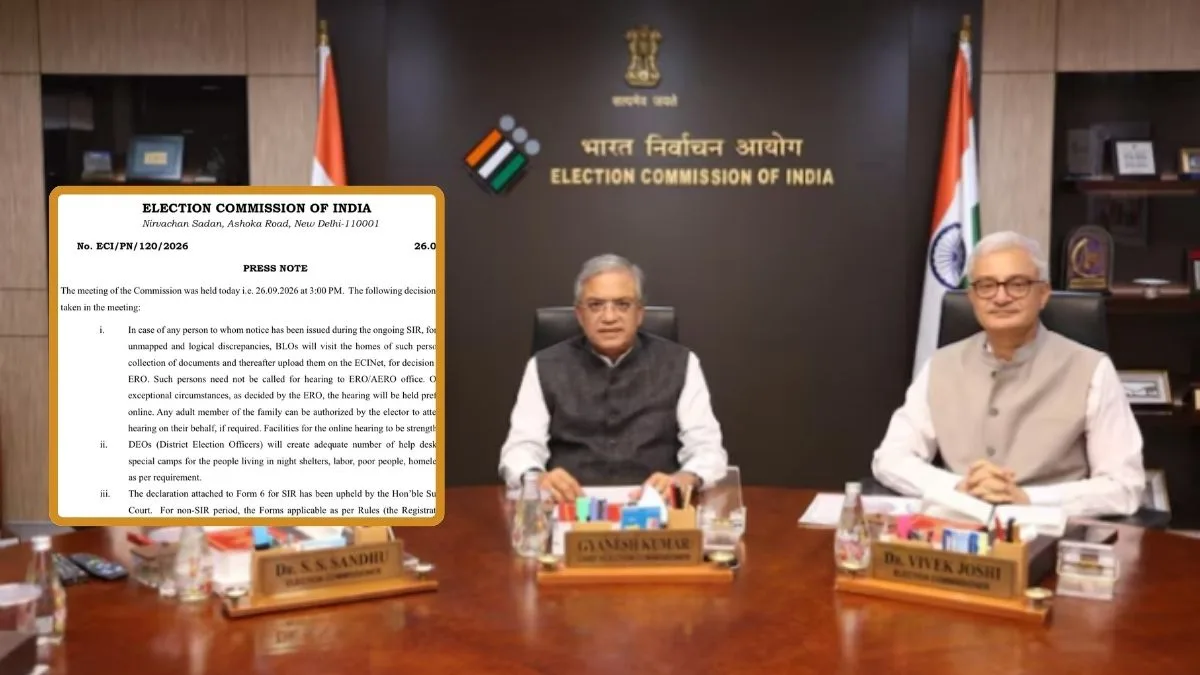
The Election Commission of India came out swinging on Saturday, shutting down claims of internal discord with a clear and forceful message: every major decision on the nationwide Special Intensive Revision of electoral rolls was taken with the full, unanimous approval of the entire Commission. Addressing the media after a meeting at Nirvachan Sadan, Director General (Media) Ashish Goyal said Chief Election Commissioner Gyanesh Kumar and Election Commissioners Dr Sukhbir Singh Sandhu and Vivek Joshi sat together and formally recorded several key decisions. The message was unmistakable — there was no split, no sidelining, and no unilateral action.
The formal release stated, “In recent months, the Commission has taken numerous decisions, including SIR across the country. The order for the SIR issued on 24.6.2025 for all the States/UTs, starting with Bihar, followed by West Bengal and 30 other States/UTs, was issued with the unanimous approval of the Commission. The same has been upheld by the Hon’ble Supreme Court of India vide its order dated 27.5.2026. The schedule for SIR for 12 States and UTs was issued on 27.10.2025, and those for 19 States/ UTs was issued on 14.05.2026 with the unanimous approval of the Commission.”
The official clarification followed media reports, particularly in The Indian Express, alleging disagreements within the EC over the SIR of electoral records. The poll body also stated that its SIR order had been upheld by the Supreme Court. Additionally, it announced steps to streamline the process for voters who receive notices over discrepancies.
The Commission’s press note drove the point home. The original SIR order issued on 24 June 2025, which kicked off the exercise across the country starting with Bihar and West Bengal, carried the unanimous stamp of all three members. That same order was later upheld by the Supreme Court on 27 May 2026. Subsequent schedules — for 12 states and Union Territories on 27 October 2025, and for another 19 on 14 May 2026 — were also cleared with complete consensus. The clarification came in direct response to a report in The Indian Express that claimed the two Election Commissioners had repeatedly objected to decisions taken without their knowledge.
Finally, ECI’s full commission met today at 3 PM.
1. During non-SIR period, old Form 6 will be used.
2. A Committee headed by Sr Dy EC including an expert from IIT /IIIT will review ECINET.
3. To help electors whose names have been removed in the SIR exercise, ECI will launch… pic.twitter.com/R9xaXmgZoh
— Arvind Gunasekar (@arvindgunasekar) September 26, 2026
The Commission rejected that narrative outright. It also addressed the controversy around a letter sent to the Cabinet Secretary. That communication, officials stressed, had nothing to do with any policy matter or the IT division. It concerned only the functioning of an officer on deputation. Work-redistribution orders issued by that officer were never actually implemented after the two Commissioners intervened, and oversight of the IT division was never withdrawn. It stated: “The letter to the Cabinet Secretary was not related to any policy matter of the Commission or IT division but related to the work of an officer on deputation to ECI. The work redistribution orders issued by the concerned officer were not actually implemented after the orders of the two Commissioners, and the oversight over the IT division by the DEC was never actually withdrawn.”
On the ground, the revision process itself continues at pace. SIR has already been completed in 20 states and Union Territories, including Bihar and West Bengal. The final elector figures for the remaining 12 states under Phase-III will be known only after the last publication of the rolls.In short, the Election Commission’s position is clear and unyielding: the process was collective, the approvals were unanimous, the Supreme Court has backed the order, and claims of internal rift do not hold.
The Election Commission also noted that the Supreme Court has upheld the declaration attached to Form 6 for the Special Intensive Revision (SIR). It clarified that, for the non-SIR period, the forms prescribed under the Registration of Electors Rules, 1960, will continue to be used.
Here are the main points:
- During non-SIR periods, the older version of Form 6 will continue to be used
- A committee headed by a Senior Deputy Election Commissioner, and including an expert from IIT/IIIT, will review the ECINET system
- To assist electors whose names were removed during the SIR exercise, the ECI will launch a special drive to re-enrol their names