The Election Commission of India (ECI) is a constitutional body established under Article 324 of the Constitution. It is responsible for the superintendence, direction and control of elections to Parliament, state legislatures, and the offices of the President and Vice-President.
The Commission’s independence is essential to ensuring free and fair elections. The Chief Election Commissioner (CEC), who heads the institution, enjoys particularly strong constitutional protection against removal. These safeguards are intended to prevent the executive or political parties from using the threat of dismissal to influence the conduct of elections.
However, disagreements over the Commission’s functioning and credibility are not new. Such controversies have emerged under different governments and political arrangements. One of the most significant episodes occurred in 2009, when a serving CEC formally recommended the removal of another Election Commissioner, but the Congress-led government rejected the recommendation.
Understanding how the CEC can be removed, and how the procedure differs from that applicable to other Election Commissioners, is important to assessing both the current political debate and the institution’s history.
What does the constitution say about removing the CEC?
Article 324(2) provides that the Election Commission shall consist of the Chief Election Commissioner and such number of other Election Commissioners as the President may determine from time to time. The President appoints the CEC and other Election Commissioners, subject to any law made by Parliament.
The appointment process is now governed by the Chief Election Commissioner and Other Election Commissioners (Appointment, Conditions of Service and Term of Office) Act, 2023. Under this law, a selection committee recommends appointments. It comprises the Prime Minister, the Leader of the Opposition in the Lok Sabha, and a Union Cabinet Minister nominated by the Prime Minister.
This arrangement replaced the interim mechanism prescribed by the Supreme Court in Anoop Baranwal v. Union of India (2023). Under that arrangement, the Chief Justice of India was part of the selection committee until Parliament enacted a law. Challenges to the 2023 Act remain pending and have been referred for consideration by a larger bench.
The tenure of the CEC and other Election Commissioners is six years or until they attain the age of 65, whichever comes first. They are not eligible for reappointment.
The most important safeguard, however, concerns removal. Article 324(5) states that the CEC cannot be removed from office except in the same manner and on the same grounds as a judge of the Supreme Court. This provision links the CEC’s removal to Article 124(4) of the Constitution.
The Constitution recognises only two grounds for such removal: proved misbehaviour or incapacity.
Misbehaviour can include corrupt practices, abuse of official authority or conduct incompatible with the responsibilities of the office. Incapacity refers to an inability to perform the duties attached to the position. These grounds must be established through the prescribed legal process. Political disagreement or criticism of the CEC’s decisions does not, by itself, satisfy this constitutional requirement.
The removal process: Why is it so difficult?
The procedure for removing the CEC is governed by the Judges (Inquiry) Act, 1968. It is deliberately stringent to protect the office from political interference.
The process begins when a notice of motion seeking removal is introduced in either House of Parliament. The notice must be signed by at least 100 members of the Lok Sabha or 50 members of the Rajya Sabha.
The Speaker of the Lok Sabha or the Chairman of the Rajya Sabha then decides whether to admit the motion. Admission does not automatically lead to removal. It initiates the next stage of the process.
If the motion is admitted, a three-member inquiry committee is constituted. The committee comprises a sitting Supreme Court judge, the Chief Justice of a High Court, and a distinguished jurist. It investigates the allegations and gives the CEC an opportunity to be heard.
If the committee establishes the charges, the matter proceeds to Parliament. Both Houses must pass an address seeking removal by a special majority. This means the motion must secure a majority of the total membership of each House and the support of at least two-thirds of the members present and voting.
Only after both Houses meet this requirement can the President issue an order removing the CEC from office.
The constitutional protection also extends to service conditions. The CEC’s conditions of service cannot be changed to their disadvantage after appointment.
These safeguards are comparable to those provided to Supreme Court judges. No Chief Election Commissioner has ever been removed through this procedure.
Why do other Election Commissioners have different protection?
The Constitution draws an important distinction between the CEC and the other Election Commissioners.
Under Article 324(5), other Election Commissioners and Regional Commissioners cannot be removed from office except on the recommendation of the CEC. They do not enjoy the same removal protection as the head of the Commission.
The distinction is deliberate. The CEC receives the higher level of constitutional protection, while the provision governing other commissioners gives the CEC a specific role in recommending their removal when warranted.
The Chief Election Commissioner and Other Election Commissioners (Appointment, Conditions of Service and Term of Office) Act, 2023, reiterates these constitutional protections.
This difference became particularly significant in 2009, when then CEC N. Gopalaswami recommended the removal of Election Commissioner Navin Chawla. The episode raised questions about the extent of the CEC’s authority, the independence of the Commission and the government’s role in deciding the matter.
From a single-member commission to a three-member body
For nearly four decades after Sukumar Sen became India’s first Chief Election Commissioner in 1950, the Election Commission functioned as a single-member body.
That arrangement changed in October 1989, when the Rajiv Gandhi government appointed S.S. Dhanoa and V.S. Seigell as Election Commissioners alongside CEC R.V.S. Peri Sastri.
The experiment was short-lived. On January 1, 1990, the posts were abolished. Dhanoa challenged the decision in the Supreme Court.
In S.S. Dhanoa v. Union of India (1991), the Supreme Court recognised the removal protection provided to the CEC under Article 324(5). However, it upheld the government’s authority to abolish the additional posts it had created, holding that the authority responsible for creating such posts could also abolish them.
Following the decision, the Commission returned to its single-member structure.
The permanent multi-member arrangement was introduced in October 1993 under the government of P.V. Narasimha Rao. M.S. Gill and G.V.G. Krishnamurthy were appointed Election Commissioners alongside CEC T.N. Seshan.
The change placed the members on broadly similar terms regarding tenure and service conditions. It also established that the majority view would prevail when the members disagreed.
The expansion was controversial because Seshan had transformed the Election Commission into a more assertive institution. His tenure was marked by strict enforcement of the Model Code of Conduct, greater use of election observers and confrontations with governments over electoral rules. Seshan argued that the appointment of additional commissioners diluted his authority.
The dispute eventually reached the Supreme Court.
What the Supreme Court ruled in the T.N. Seshan case
In T.N. Seshan v. Union of India (1995), a five-judge Constitution Bench upheld the multi-member structure of the Election Commission.
The Court rejected the argument that the CEC’s opinion must automatically prevail over those of the other commissioners. It held that Article 324 vests the Commission’s functions in the institution as a whole, rather than in an individual office-holder.
The CEC serves as the chairman and is first among equals, with certain administrative responsibilities. However, decisions can be taken by a majority when members disagree.
The judgment established the principle of collegial functioning that continues to govern the three-member Election Commission. Under this model, the CEC does not have an automatic veto over the other commissioners merely by virtue of holding the top position.
The ruling remains important to present-day debates over alleged internal disagreements within the Commission. Differences between members must be considered within the constitutional framework of collective decision-making, rather than automatically treated as evidence of institutional breakdown or political bias.
The Navin Chawla controversy: What happened in 2009?
One of the most significant internal confrontations in the Election Commission’s history took place in 2009, during the Congress-led United Progressive Alliance government.
Navin Chawla, an Indian Administrative Service officer from the 1969 batch, was appointed Election Commissioner in May 2005. His record had already attracted controversy because of his role during the Emergency of 1975-77.
At the time, Chawla was serving as secretary to the Lieutenant Governor of Delhi. His conduct was examined by the Shah Commission of Inquiry, which investigated excesses committed during the Emergency.
The Shah Commission described Chawla and two other officers as “authoritarian and callous”. It alleged that they had grossly misused their positions and abused their powers. The Commission also concluded that their conduct made them unfit for public office requiring fair play and consideration for others.
A subsequent Delhi High Court judgment set aside aspects of the relevant proceedings. Chawla continued to hold senior positions in public service. Nevertheless, the Shah Commission’s findings remained part of the public record and continued to feature in debates about his suitability for the Election Commission.
Opposition parties, particularly the Bharatiya Janata Party (BJP), repeatedly questioned Chawla’s proximity to the Congress leadership and his suitability for the post.
In March 2006, BJP leader L.K. Advani and a large group of MPs approached President A.P.J. Abdul Kalam seeking Chawla’s removal under Article 324(5). They alleged that Chawla was politically partisan. The matter was subsequently pursued before the Supreme Court and then CEC N. Gopalaswami.
The controversy intensified in January 2009, when Gopalaswami sent a detailed recommendation, approximately 93 pages long, to the President seeking Chawla’s removal.
Gopalaswami cited 12 instances which, in his assessment, individually suggested partisanship and collectively indicated a pattern of conduct favouring one political party. He alleged that Chawla appeared to remain in constant contact with the party whose interests he was accused of advancing.
The matters examined included disagreements over election schedules, the handling of a petition concerning Sonia Gandhi, and questions surrounding donations from Congress MPs to a trust associated with Chawla’s wife.
Gopalaswami also alleged that Chawla had attempted to influence fellow Election Commissioner S.Y. Quraishi by relying on political narratives rather than valid arguments.
In making the recommendation, Gopalaswami invoked the second proviso to Article 324(5) and maintained that the CEC had the authority to recommend the removal of another Election Commissioner.
Why did the government reject the recommendation?
The Congress-led government rejected Gopalaswami’s recommendation.
On March 1, 2009, President Pratibha Patil accepted the government’s advice that the recommendation lacked the required constitutional basis and that the allegations did not justify Chawla’s removal.
The decision was followed by another significant development. Within weeks, Chawla was appointed Chief Election Commissioner, taking charge on April 20, 2009, the day Gopalaswami retired.
Chawla oversaw four of the five phases of the 2009 Lok Sabha election.
The sequence became one of the most controversial episodes in the Election Commission’s history. The serving CEC had formally alleged political partisanship and sought the removal of a colleague. The Congress-led government rejected the recommendation, after which the same officer was elevated to head the institution.
The recommendation was rejected, and the controversy did not result in Chawla’s removal. Instead, he went on to become CEC.
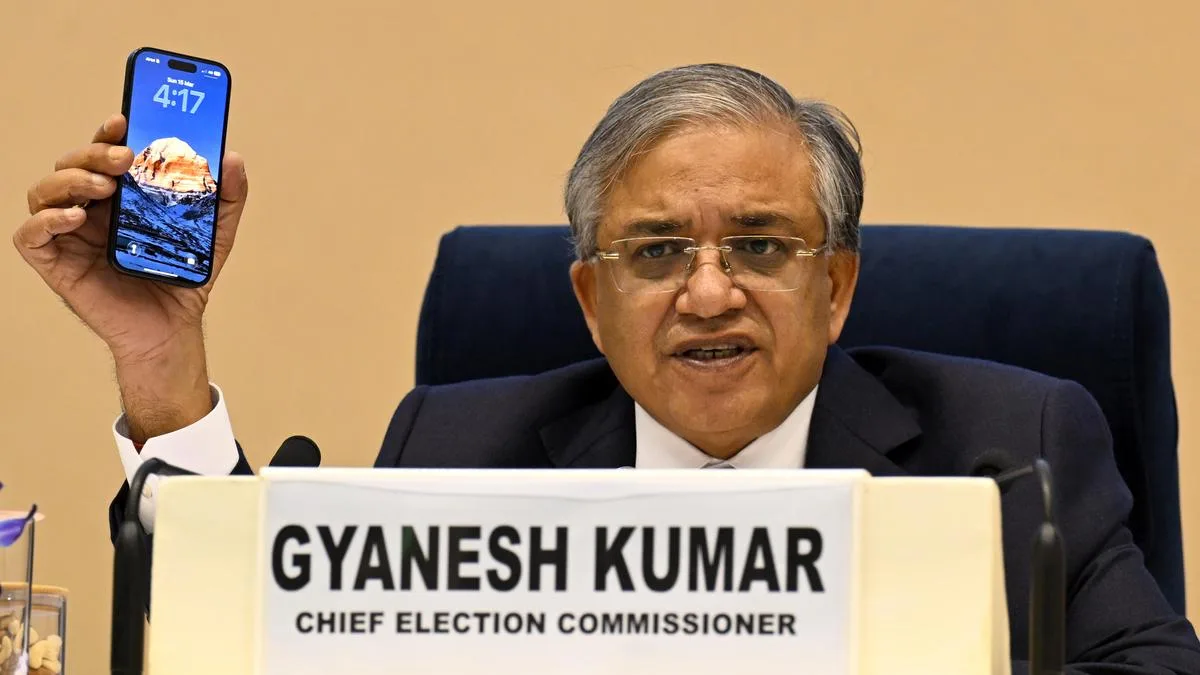
Gyanesh Kumar and the Special Intensive Revision
The current political debate centres on Chief Election Commissioner Gyanesh Kumar and the Election Commission’s Special Intensive Revision (SIR) of electoral rolls.
The exercise has resulted in large numbers of voter names being identified for possible deletion or correction across states.
Opposition parties, including the Congress, have accused the Commission of bias and questioned how deletions and restorations are being handled.
The Election Commission, however, has described differences among its members as part of normal collegial deliberations. It has maintained that key decisions were taken unanimously or through the prescribed decision-making process.
The Supreme Court has issued notices on certain petitions challenging aspects of the revision exercise and the manner in which decisions were taken. However, it has not ordered a suspension of the exercise or the interim removal of the CEC.
Demand for resignation
Congress leader Rahul Gandhi has repeatedly alleged that the 2024 Lok Sabha election and subsequent Assembly elections were “rigged” and has demanded the resignation of Chief Election Commissioner Gyanesh Kumar. But if Gandhi is so certain that the electoral process was compromised, a legitimate question arises: what concrete evidence does he have, and why does he not bring a formal removal motion before Parliament and put his allegations to constitutional scrutiny?
The Constitution provides a clear mechanism for seeking the removal of the CEC. Under Articles 324(5) and 124(4), removal requires proved misbehaviour or incapacity, an inquiry and a special majority in both Houses of Parliament. If Gandhi believes he has evidence that meets this threshold, Parliament is the appropriate forum to present it, debate the charges and allow the constitutional process to take its course. Repeatedly making allegations in public and demanding a resignation is not a substitute for establishing the charges through the prescribed procedure.
The question also remains: why should the CEC resign simply because Rahul Gandhi is dissatisfied with the electoral process or the appointment of the person heading the Commission? An independent constitutional office cannot function on the expectation that its head must step down whenever a political leader questions their credibility. Nor can an allegation, however loudly repeated, be treated as proof of misconduct.
Gandhi and the Congress are entitled to question the Election Commission, demand transparency and challenge its decisions through appropriate legal channels. But such criticism must also carry a responsibility to substantiate serious claims. If the evidence supports his allegations, he should place it before the appropriate constitutional forum and seek action under the law. If he is demanding resignation without pursuing that route, he must explain why a political demand should take precedence over the constitutional procedure designed specifically to deal with allegations against the CEC.
What the present dispute reveals about the commission’s structure
The current controversy brings the debate back to the constitutional principles established by the Supreme Court in the T.N. Seshan case. The Election Commission is designed to function as a collective body, with decisions taken by majority when its members disagree. The Chief Election Commissioner chairs the institution but does not have an automatic right to overrule the other commissioners on every issue. Therefore, reported disagreements within the Commission cannot, by themselves, be treated as proof of political bias or evidence that the institution has failed to perform its duties.
Those demanding Gyanesh Kumar’s resignation must also answer a fundamental question: are they seeking accountability under the Constitution, or are they expecting a constitutional authority to step down simply because its decisions do not suit their political interests?
Disagreement with the Commission’s decisions is not, in itself, grounds for demanding the resignation of its head. If every political party could force the CEC to leave office by questioning the Commission’s credibility, the independence that the Constitution seeks to protect would be seriously undermined.
Under Articles 324(5) and 124(4), the CEC can be removed only on grounds of proved misbehaviour or incapacity, following the prescribed inquiry and a special majority in both Houses of Parliament. This is not an arbitrary barrier; it is a safeguard against politically motivated attempts to remove an independent constitutional authority. The CEC’s removal cannot depend on whether Rahul Gandhi or any other political leader is satisfied with the Commission’s functioning. It must depend on evidence, established grounds and the procedure laid down by the Constitution.
Those questioning the CEC must be willing to subject their allegations to the same constitutional standards they invoke. Otherwise, repeated calls for resignation risk becoming a political pressure campaign rather than a serious effort to establish accountability.
The political double standard debate
The 2009 Navin Chawla controversy has gained renewed relevance in the context of current allegations against the Election Commission.
At the time, the Congress-led government rejected a formal and detailed recommendation from the serving CEC, N. Gopalaswami, alleging political partisanship by Chawla. The government subsequently saw Chawla elevated to the position of Chief Election Commissioner, under whose watch a substantial part of the 2009 general election was conducted.
Today, after successive electoral setbacks, Congress leaders have positioned themselves as prominent defenders of electoral credibility and have described the electoral process as compromised or rigged.
The contrast has become a point of political argument over whether parties apply the same standards when they are in power as they do when they are in opposition.
The history shows that allegations of political influence over the Election Commission are not new and have not been confined to one party or government. Political parties have questioned the Commission’s independence at different times, often in response to disputes over appointments, election administration or the handling of electoral processes.
The Chawla episode is therefore relevant to the current debate, particularly when examining how governments respond to allegations made against members of the Commission. However, the historical controversy and present allegations must each be assessed on their own facts and evidence.
Why the High constitutional bar matters
The Constitution’s high threshold for removing the CEC is intended to ensure that the office cannot be made vulnerable to temporary political majorities or campaigns.
The Election Commission’s history illustrates the importance of this protection. From the single-member arrangement that prevailed for decades to the introduction of additional commissioners in 1989, the return to a single-member structure in 1990 and the permanent multi-member system established in 1993, the institution has evolved through both political decisions and judicial scrutiny.
The assertive tenure of T.N. Seshan and the Supreme Court’s subsequent affirmation of collective decision-making established important principles governing the Commission’s functioning. The Navin Chawla controversy, meanwhile, exposed the tensions that can arise when the CEC alleges that a fellow commissioner is acting in a partisan manner and the government rejects the recommendation.
The present dispute over Gyanesh Kumar, electoral-roll revisions and alleged internal disagreements raises related questions about institutional credibility and political accountability.
The constitutional protection afforded to the CEC is not a licence for unaccountable conduct. Equally, it is not a mechanism that can be invoked lightly whenever a political party disagrees with the Commission’s decisions.