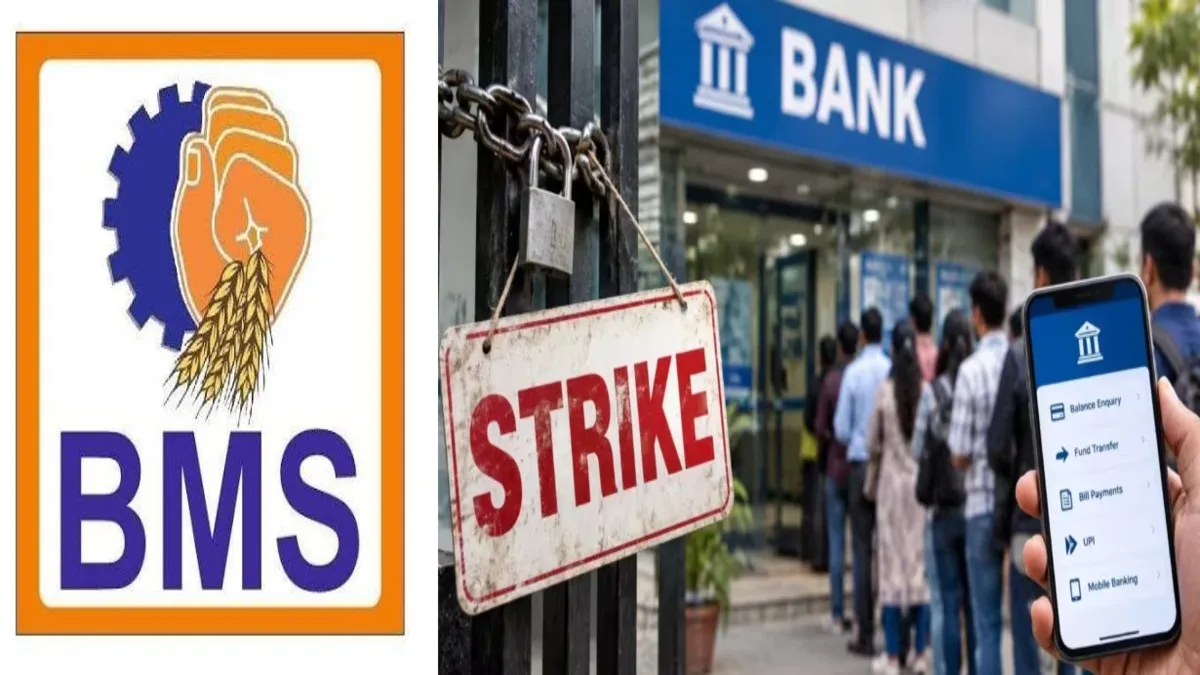
NEW DELHI: Banks across the country will witness a three-day strike from September 28 to 30 called by the United Forum of Bank Unions (UFBU), with five-day banking as the principal unresolved demand.
The Bharatiya Mazdoor Sangh (BMS), however, has decided to stay out of the strike, while maintaining that it strongly supports five-day banking and workers’ concerns.
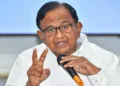
Speaking to Organiser, Girish Arya, BMS Finance Sector In-charge, said the organisation will not take part in the strike. “We support five-day banking, but we are not part of this strike,” he said, stressing that BMS was neither consulted before the strike programme nor asked to join it.
According to Arya, BMS has chosen to pursue the issue through direct engagement with the Government, bank managements and institutional mechanisms rather than participate in the present agitation.
He questioned the United Forum of Bank Unions (UFBU)’s approach to the long-pending five-day banking demand and other issues. Arya said BMS will independently pursue five-day banking, work-life balance, working conditions, concerns of women employees and pensioners’ demands. He also spoke about the present differences between the unions and the debate over the strike call, saying BMS is capable of pursuing five-day banking independently.
Five-Day banking is a genuine employee issue
For BMS, five-day banking is primarily a question of work-life balance and employee welfare. Arya said bank employees often have fixed reporting times but no fixed time for leaving work, resulting in long working hours and difficulties in maintaining family and social commitments.
He particularly highlighted the problems faced by women employees and said banking employees should have a working schedule. BMS, he said, has consistently raised this issue rather than treating five-day banking merely as a demand for additional holidays.
Arya also said five-day banking alone would not fully address work-life balance if employees continued to be called for duties on Saturdays and Sundays, including ATM-related work. He said proper compensatory arrangements would also be required for such weekend work.
Arya pointed to BMS’s earlier participation in collective action, the organisation is not opposed to workers’ movements. Its banking federations participated in the January 27 action, while BMS subsequently took up banking and pension-related issues during its August 17 nationwide agitation across 662 districts.
The distinction, according to BMS, is between supporting an employee demand and supporting a particular strike programme.
Why BMS is staying out
Arya said BMS was earlier part of the broader banking-union platform but was subsequently excluded from the present UFBU process. He said BMS was not consulted while the latest strike programme was finalised.
He questioned the present composition of the UFBU and argued that a forum that no longer includes all the unions that were part of the earlier process cannot automatically claim the support of organisations that were not consulted.
BMS, he said, therefore decided to approach the Government directly on issues affecting bank employees.
A BMS delegation met Union Finance Minister Nirmala Sitharaman on July 9 and again on September 7. Arya said five-day banking, pensioners’ issues, medical facilities, ex-gratia, PLI and grievance redressal were among the matters raised.
National Organisation of Bank Officers (NOBO) and National Organisation of Bank Workers (NOBW), in a September 23 communication, also said they were neither consulted nor invited to any joint deliberation before the proposed strike was announced. They said no formal communication seeking their views or participation was received.
What is the PLI dispute?
The Productivity Linked Incentive (PLI) scheme was another major point of contention between the unions and the Government.
Arya said BMS had initially joined the collective opposition to the PLI structure introduced through the Department of Financial Services’ June circular. He questioned the disparity in the proposed incentive structure, particularly the difference between the maximum benefit available to employees up to Scale III and that for Scale IV and above.
According to Arya, the unions had initially decided that crediting of the disputed PLI would trigger a flash strike. Punjab & Sind Bank credited the amount on August 21 and other banks followed by August 24, but the proposed flash strike did not materialise.
Arya said the PLI structure would be discussed in the next bipartite settlement, with a uniform formula to be negotiated and implemented.
The Government subsequently kept the PLI scheme for 2025–26 in abeyance. The Finance Ministry has said that this addressed one of the two principal demands raised by the unions, leaving five-day banking as the major unresolved issue.
In its September 23 communication, NOBO and NOBW also cited the PLI decision as an example of their approach of pursuing the issue through dialogue, saying the scheme was kept in abeyance and would be taken up in the next Bipartite Settlement/Joint Note.
Arya said BMS had again raised the PLI issue during its September 7 meeting with the Finance Minister and sought a uniform mechanism to be negotiated through the next bipartite settlement.
Pensioners also at the Centre of BMS demands
BMS has also placed the concerns of retired bank employees alongside those of serving employees.
Arya said pension updation remains a longstanding demand. He also highlighted the high cost of medical insurance for pensioners, saying many retired employees pay around Rs 60,000–Rs 70,000 annually and that BMS wants banks to bear the insurance premium.
For BMS, he said, employee welfare cannot end with retirement. Pension, medical coverage and other concerns of retired employees need to be addressed through a regular institutional mechanism.
NOBO and NOBW also cited 100 per cent Dearness Allowance neutralisation for pre-2000 retirees and ex-gratia relief for pensioners under the last Bipartite Settlement among the recent outcomes they attributed to their efforts.
Another important demand raised by BMS is a structured grievance-redressal system for bank employees.
Arya said unions should have a regular opportunity to place workplace grievances before management instead of allowing problems to accumulate until they result in industrial action. He said discussions with the Finance Ministry also covered regular interaction between unions and bank managements.
The organisations also said Industrial Relations meetings had been extended to all recognised trade unions, allowing participation irrespective of their majority or minority status.
BMS, therefore, is seeking a wider mechanism covering five-day banking, working conditions, pensioners’ welfare and workplace grievances.
BMS has also raised the issue of transfers in the banking sector, seeking a uniform and transparent transfer policy across all banks. According to Arya, the organisation has urged the Finance Ministry to examine the existing transfer policies and address complaints, particularly regarding alleged discrimination faced by women employees in transfers.
Arya said BMS will work for the interests of all bank employees, irrespective of their union membership. He said the organisation considers the entire banking workforce part of the banking fraternity and will continue to take up issues concerning employees and pensioners through dialogue and negotiations.
NOBO and NOBW have also issued a directive of complete non-participation, asking their affiliated units, office-bearers and members to attend duties normally, ensure uninterrupted customer service and refrain from participating in the proposed strike under their banner.
BMS questions strike timing
Arya also questioned the timing of the earlier September 11 strike, which preceded the BRICS Summit in Delhi, and alleged that the timing could have created a negative impression about India’s business environment.
He similarly questioned the September 28–30 programme because it coincides with the half-yearly closing of banks on September 30. The Finance Ministry has also flagged the significance of the date, noting that the strike, combined with the preceding weekend, could disrupt banking operations for five consecutive days.
Arya also questioned the present composition of the UFBU. He said BMS was earlier part of the broader forum, which had nine federations, but three have since moved out. He therefore questioned the present structure of the UFBU and said BMS was not consulted before the latest strike programme was announced.
Arya also questioned whether the required statutory notice process had been properly followed. He pointed out that, according to rules, a strike notice has to be given in advance. He said the notice period and the manner in which the strike programme was finalised raised questions about compliance with the prescribed process, particularly as organisations such as BMS were not consulted.
The Government has appealed to unions to defer the strike and has taken contingency measures. Public Sector Banks and Regional Rural Banks have been directed to remain operational on Sunday, September 27, with RBI approval for branches, offices, ATM-linked branches and currency chests to function that day.
Arya said BMS is prepared to take responsibility for pursuing the unresolved concerns of bank employees and pensioners.
He appealed to bank employees and unions to give BMS one year to work on issues concerning the banking sector. For nearly 60 years, we have extended our uninterrupted support to the UFBU to maintain unity. If the UFBU remains silent and allows us to work without interruption for just one year, we assure bankers that with your support, we will make every sincere effort to resolve the outstanding issues of pensioners and serving employees, including five-day banking, work-life balance, pension updation, medical insurance and other employee concerns.
As we have successfully achieved Industrial Relations (IR) for all trade unions of banks, we are now looking ahead to the upcoming 13th Bipartite Settlement, due for implementation from 1 November 2027. The Hon’ble Finance Minister reiterated her assurance on 7 September regarding the timely commencement and resolution of the process.
On the principle of responsive cooperation, we believe in dialogue cum agitation “संघर्ष एवं संवाद” and sincere negotiations as essential to achieving meaningful outcomes.
He also called for greater representation of younger employees in trade-union leadership, pointing out that the current strike notice has been served by seven leaders, five of whom are retired and some are up to 80 years of age, arguing that the younger generation should be given an opportunity to take responsibility for the future of the banking workforce.
Arya mentioned that BMS does not oppose strikes or collective movements as a principle. But we never resort to strikes as the first option and at the cost of finding practical solutions to employees’ concerns.
“Five-day banking is close to our heart,” Arya said, reiterating that BMS will continue to pursue the demand.